
DSA Article 21 – out-of-court dispute settlement for content moderation decisions 2026

Short answer: According to Article 21 of the Digital Services Act (DSA), users and complainants affected by certain content moderation decisions can choose a certified out-of-court dispute settlement body. This applies, for example, when an online platform removes or retains content, restricts an account, or rejects a notice under the conditions specified in Article 20(1). The body must normally issue a decision within 90 calendar days; for highly complex disputes, this time may be extended by a maximum of 90 additional days. For the user, the procedure must be free of charge or offered for a nominal fee. However, the body cannot force the parties to accept a binding solution.
Legally fact-checked: October 19, 2026. Legal sources: Regulation (EU) 2022/2065, Articles 19–21, the European Commission's current list of certified bodies, and the Swedish Post and Telecom Authority's (PTS) guidance.
- Article 21 applies to disputes over decisions covered by Article 20(1), not generally all disputes arising on the internet.
- A body must be certified according to Article 21(3), and its subject matter expertise and language must be appropriate for the case.
- In principle, the affected person can choose a competent body in another EU country; the country is not the sole deciding factor.
- You generally do not need to exhaust the platform's internal complaint-handling system first; unresolved internal cases are also covered.
- Normally, 90 calendar days apply, and at most 180 calendar days for highly complex disputes according to Article 21(4).
- The allocation of fees and costs in Article 21(5) depends on the outcome. The procedure is not the same as a free internal Article 20 review.
Which disputes are covered by DSA Article 21?
The right applies to recipients of the service, including persons and organizations that have submitted a notice, who are affected by the decisions listed in Article 20(1). These are decisions to remove, block, or restrict the visibility of content – or not to do so – as well as certain decisions concerning the restriction of the service, account, or the ability to monetize published information. The decision must have the connection to illegal or policy-violating content as set out in Article 20.
It may therefore apply, for example, to an external seller whose advertisement has been removed from a marketplace, or a complainant who questions why an online platform did not act against allegedly illegal content. A common dispute regarding a faulty delivered product, delayed transport, or an unpaid invoice, however, is not automatically an Article 21 dispute. Such matters may fall under contract law, consumer law, or other agreements.
Does this apply to every company that runs a website?
No. Article 21 is located in the DSA section regarding specific obligations for providers of online platforms. A regular web shop selling its own products is not automatically such a platform. Article 19 also, as a main rule, exempts certain micro and small platform providers from these specific obligations, with exceptions and transitional provisions – including for very large online platforms.
It is therefore incorrect to claim that all Swedish e-retailers must hire or offer a specific dispute settlement body. See also our comprehensive guide on DSA for marketplaces.
How do you find a certified dispute settlement body?
The European Commission publishes an updated list of bodies certified under the DSA. This list shows the types of cases the body is certified to examine, the languages it handles, and which national authority decided on the certification. The list can change as bodies are added, have their competence changed, or lose their certification.
| What to check? | Why? | Example of check |
|---|---|---|
| Current certification | A general mediation service is not automatically an Article 21 body. | Is the body in the Commission's official list? |
| Type of dispute | Certification can apply to specific platform types and content issues. | Can the body process decisions about product ads or accounts? |
| Language | The body needs to be able to handle the case in the appropriate language. | Does it accept Swedish or, for example, English? |
| Procedural rules | Bodies' rules may contain procedural steps and documentation requirements. | What supporting documents must be submitted? |
| Fee conditions | Article 21(5) provides specific rules, but fees may apply. | What does an application cost, and what applies in different outcomes? |
The platform may not unilaterally require the user to choose only a specific body in their home country if another certified body in the EU has the competence to resolve the current dispute. However, it is also not the case that all certified bodies can process every subject in all EU languages. Check both the scope and the language before applying.
What does certification according to Article 21(3) entail?
It is the Digital Services Coordinator (DSC) in the member state where the body is established that certifies it. The certification is valid for a maximum of five years at a time and can be renewed. Among the requirements are impartiality and independence from platforms and users, documented expertise in relevant issues, transparent and fair procedures, and the ability to handle cases electronically.
The European Commission's list shows bodies certified by authorities in different member states. A certification in one EU country can be used in other EU countries, within the limits of the body's substantive and linguistic competence. Neither a regular law firm, a commercial mediation company, nor an association automatically becomes a DSA body by offering dispute resolution.
How does external dispute settlement under the DSA work – step by step
- Identify the decision. Check that the platform's moderation decision is covered by Article 20(1) and that Article 21 is applicable.
- Gather documentation. Preserve the text of the decision, the date, relevant ads or published content, previous communications, and any internal review.
- Choose a body. Compare certification, competence, language, procedural rules, and fees in the Commission's official list.
- Submit application. Follow the body's electronic application procedure and provide the information needed to identify the dispute.
- Participate in good faith. Both the user and the platform shall cooperate honestly and constructively with the body according to Article 21(2).
- Take part in the outcome. The body normally issues a decision within 90 calendar days after receiving the complaint, with a specific possibility for extension.
- Assess next steps. The decision is not in itself binding on the parties. Any potential court review or other available legal remedies are assessed separately.
How much time does the dispute settlement body have?
According to Article 21(4), certified bodies shall inform the parties of a decision within a reasonable time and at the latest 90 calendar days from the receipt of the complaint. If the matter is highly complex, the body may, at its own discretion, extend the period by a maximum of 90 calendar days, meaning a total maximum of 180 calendar days.
It is important that this deadline is not mistaken for a general response time for the online platform's internal complaint-handling according to Article 20. It is also a different rule than Article 20's at least six months of access to internal complaints calculated from the relevant decision notification. State the correct deadline in the correct place in the company's routines and customer information.
What does external dispute settlement cost – who pays?
Article 21(5) contains several different rules. For the user, the dispute resolution must be accessible without a fee or for a low fee. It is therefore not necessarily completely free, unlike Article 20's free internal system. The body must inform the parties about its fees or how they are calculated before the procedure begins.
| Outcome | General rule regarding costs |
|---|---|
| The dispute settlement body finds in favor of the user | The platform bears all fees charged by the body and reimburses the user's other reasonable expenses in connection with the dispute settlement. |
| The dispute settlement body finds in favor of the platform | The user generally does not need to reimburse the platform's own fees or costs, unless the body finds that the user clearly acted in bad faith. |
| Fees before the procedure | The user shall be able to participate without a fee or for a low fee; both parties shall receive information about applicable fees before the process begins. |
The body's fees to online platforms shall be reasonable and may not exceed the body's costs for the dispute settlement. The table is a simplification of Article 21(5); for a specific case, the procedure's costs and any specific conditions must be assessed based on the law and the body's published rules.
Is the body's decision legally binding?
No, not through Article 21 in itself. According to Article 21(2), the certified body may not impose a binding solution on the parties. At the same time, the platform and the user are obliged to cooperate in good faith with the body. It would therefore be just as incorrect to describe the outcome as an enforceable court decision as it would be to claim that the platform can freely refuse to participate in any case.
According to the same provision, the platform may refuse to cooperate when a dispute has already been settled regarding the same information and the same grounds for the alleged illegality or contract violation. This is a specific limitation and should not be used as a general right to reject all external review.
The right to bring proceedings before a court is not affected by Article 21. According to Article 21(1), court proceedings may be initiated at any stage according to applicable law. Article 21 also does not replace the rules on alternative consumer dispute resolution according to Directive 2013/11/EU when these are relevant (Article 21(9)).
What does the Swedish Post and Telecom Authority (PTS) do?
The Swedish Post and Telecom Authority (PTS) is Sweden's national coordinator for digital services. The authority examines applications for certification of dispute settlement bodies established in Sweden according to Article 21. PTS can also receive complaints about suspected violations of the DSA for supervisory purposes.
For an actual dispute, use the Commission's current list of bodies and languages instead of an older, static list. The list can change after the article's fact-check date.
Checklist for the platform – information and case management
- Assess whether the service is an online platform covered by Articles 20–21 or by the exemptions in Article 19.
- Document which moderation decisions are covered by Article 20(1) and can thus be reviewed externally.
- Make information about certified external dispute settlement clear, easily accessible, and user-friendly on the platform interface.
- Distinguish information about the free internal complaint system from the Article 21 procedure.
- Provide correct information about the possibility of choosing a competent body, including bodies in other EU countries where competence and language are suitable.
- Prepare routines for cooperation in good faith with the chosen body, with appropriate persons responsible and contact channels.
- Preserve necessary decision-making documentation and handle personal data according to applicable data protection law.
- Document received cases, decisions, time spent, any actions taken, and applicable fees.
- Assess reporting obligations according to Article 24(1)(a) for platforms covered by the provision.
- Update links to the Commission's list when certification status or language coverage changes.
Example: a seller's ad has been removed
A marketplace removes an external seller's product advertisement citing that the content violates the platform's terms. The seller receives a statement of reasons according to Article 17 and believes the decision is based on a misunderstanding. The seller can, where applicable, appeal through Article 20's internal complaint-handling system, but can also try if a certified body with the right competence accepts the case according to Article 21.
The seller chooses a body that handles the current platform type and a suitable language, and submits the ad, the decision, and relevant supporting documents. Both parties cooperate in good faith. The body issues a decision within the time limits of Article 21(4). If the decision is in the user's favor, Article 21(5)'s specific cost rules apply. The outcome is not a binding court judgment.
Legal disclaimer: This is an illustrative example. A specific body may have limited competence for product ads or require that other specified conditions are met.
Frequently asked questions about DSA Article 21
Must I use the platform's internal appeal first?
Not as a general requirement in Article 21. External dispute settlement also covers unresolved internal complaints, and the possibility of bringing an action in court is not affected.
Can I use a dispute settlement body from another EU country?
Yes, if the body is certified and has the competence and language skills for the type of dispute in question. Check the Commission's current list.
Is external DSA dispute settlement always free?
No. For the user, it shall be free or offered for a low fee. Article 21(5) contains specific cost rules depending on who wins the case.
How fast must the body make a decision?
Normally within 90 calendar days after receipt of the complaint. Only in very complex cases can a maximum of 90 more days be added, totaling a maximum of 180 days.
Can the body force the marketplace to reopen my account?
Not through a binding decision according to Article 21(2). However, the parties must cooperate in good faith, and separate court review is possible according to applicable law.
Can I send the Article 21 dispute directly to PTS?
PTS is the Swedish coordinator and certification/supervisory authority but does not act as a general body that resolves private moderation disputes. Choose a certified body with relevant competence.
Do the same rules apply to a regular consumer purchase?
Not automatically. Article 21 applies to specific moderation decisions on relevant online platforms. Complaints about a faulty product and civil law contract disputes may fall under other procedures.
DSA Marketplace Compliance – document support for companies
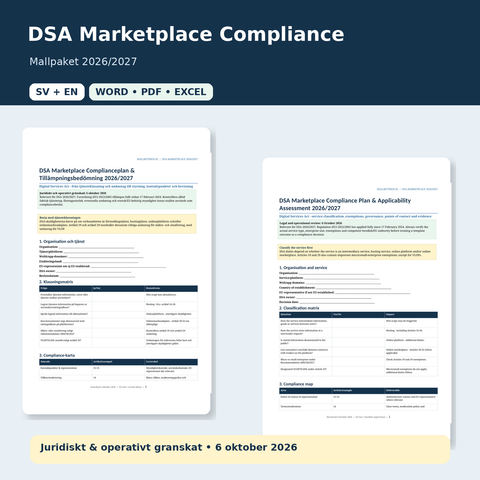
Mallbutiken's DSA Marketplace Compliance 2026/2027 includes, among other things, structured templates for moderation, Notice and Action, KYBC, and administrative registries. These materials can contribute to traceable documentation. Always check separately which legal obligations your specific platform is subject to and which dispute settlement procedure is applicable.
Related DSA guides
- DSA Article 20 – Internal complaint-handling system and six-month deadline
- DSA Article 17 – Statement of reasons for moderation decisions
- DSA Article 16 – Notice and Action
- DSA Article 32 – Information to consumers regarding illegal offers
- DSA for marketplaces – overview and checklist
Official legal sources and guidance
- Regulation (EU) 2022/2065 – Articles 19, 20, 21 and 24 (binding law).
- European Commission – certified out-of-court dispute settlement bodies (current list, languages and competence).
- Swedish Post and Telecom Authority (PTS) – who is covered by the DSA and Swedish certification.
- PTS e-service for supervisory complaints regarding the DSA (not to be confused with external Article 21 dispute settlement).
Templates in this article
Explore the topic
 Business guides – contracts, HR, AI & compliance
DSA for marketplaces 2026 – KYBC, notice-and-action, and illegal products
Practical guide to the DSA for online platforms and marketplaces: KYBC, trader traceability, compliance by design, notice-and-action, and informati...
 Business guides – contracts, HR, AI & compliance
DSA Article 20 – Internal complaint-handling system and appeal 2026
Practical guide on the internal complaint-handling system under DSA Article 20: which moderation decisions can be appealed, the six-month deadline,...
 Business guides – contracts, HR, AI & compliance
DSA Article 17 – Statement of reasons for removals and account suspensions 2026
DSA Article 17: when hosting services must provide a statement of reasons for ad removal, demotion, or account suspension. Checklist regarding grou...


