
DSA Article 20 – Internal complaint-handling system and appeal 2026

Short answer: DSA Article 20 requires online platforms covered by the provision to offer an effective, electronic, and free-of-charge internal complaint-handling system. Through this system, sellers, users, and individuals who have submitted notices, among others, must be able to challenge certain decisions to remove or retain content, restrict services, suspend accounts, or restrict revenue. The opportunity to complain must be available for at least six months from the date the person was informed of the decision according to Article 16(5) or 17. Decisions regarding complaints must be subject to oversight by qualified staff and may not be taken solely by automated means.
Legally verified: October 19, 2026. Binding source: DSA – Regulation (EU) 2022/2065, specifically Articles 19–21. The guide applies to certain online platforms within the EU and not to every ordinary web shop or all hosting services.
- Article 20(1): Relevant users and complainants must be able to complain free of charge and electronically against specified moderation decisions.
- Article 20(2): A minimum of six months counted from when the user or complainant was informed of the decision according to Article 16(5) or 17.
- Article 20(3–4): Accessible, user-friendly complaint functionality and prompt, diligent, non-discriminatory, and non-arbitrary processing.
- Article 20(4): An unjustified decision must be reversed without undue delay when the complaint provides sufficient grounds for doing so.
- Article 20(5–6): Reasoned notification, information on external remedies, and qualified human oversight of the decision.
- Article 19: Exceptions exist for certain micro and small platform providers, with specific reservations.
Which companies are covered by DSA Article 20?
Article 20 is part of the section on additional obligations for providers of online platforms. Under the DSA, an online platform is a specific form of hosting service that, at the request of the recipient, stores and disseminates information to the public. The regulation's definition also contains exclusions for certain ancillary functions. A digital marketplace with external sellers may be covered, whereas an ordinary e-commerce shop that only sells its own goods does not become such a platform simply because it is built on Shopify.
It is important to assess the actual digital service before designing a complaint-handling system.
Exemptions for micro and small platform providers
According to Article 19, the specific obligations in this section generally do not apply to providers of online platforms that are micro or small enterprises according to Recommendation 2003/361/EC. In some cases, the relief may continue for twelve months after the business has lost that status, and it does not apply to a platform designated as a Very Large Online Platform (VLOP) under Article 33. Article 19 also contains an express exception to the exception for Article 24(3).
Which moderation decisions can be appealed internally?
Article 20(1) applies both to decisions taken following a notice and to the specifically enumerated decisions regarding content or user behavior based on illegal content or content that violates the service's terms and conditions. It also includes those who have submitted a notice and are dissatisfied that the platform did not take any action.
| Decision according to Article 20(1) | Examples | Who has the right to complain? |
|---|---|---|
| a – remove, block, or restrict visibility, or refrain from doing so | A product ad is removed or remains online after a notice. | The affected service recipient and, where relevant, the notifier. |
| b – suspend or terminate the service in whole or in part, or refrain | The marketplace's ad function is blocked. | The affected recipient of the service. |
| c – suspend or terminate an account, or refrain | A seller loses access to their account. | The affected account holder. |
| d – suspend, terminate, or otherwise restrict monetization, or refrain | Limited ability to earn money from an ad. | The affected recipient according to the article's conditions. |
However, not all dissatisfaction constitutes an Article 20 complaint. A standard complaint about a delivered product being broken is typically governed by consumer law and any marketplace terms and conditions. Article 20 primarily refers to decisions concerning moderation and the restriction of user information or services.
How is the six-month deadline calculated under Article 20(2)?
The complaint-handling system must be accessible for the relevant decisions for at least six months. The period begins on the day the service recipient was informed of the decision according to Article 16(5) or Article 17. It is therefore not calculated automatically from the date the advertisement was first published or when an authority later began investigating the offer.
Do not confuse the deadlines: In DSA Article 32 there is another six-month rule, linked to purchases before the marketplace becomes aware of an illegal offer. Article 20 instead concerns the deadline for complaining about a moderation decision.
Article 20(3) – how should an internal complaint-handling system function?
The system must be easily accessible and user-friendly, and it must allow those who wish to complain to submit a sufficiently precise and well-founded objection. Complaints must be capable of being submitted electronically and free of charge. The legal text does not prescribe a specific software provider, a certain form, or a specific number of fields, but the design must make the right practically usable.
Suggested relevant fields
| Fields in a complaint function | Purpose | Status |
|---|---|---|
| Case or decision ID | Link the complaint to the exact moderation decision. | Recommended design. |
| Affected ad, account, or content | Identify what was restricted or left without action. | Practical support for precision. |
| Notification date of the decision | Assess the six-month deadline. | Relevant for Article 20(2). |
| Why the decision is wrong | Provide a sufficiently clear and substantiated objection. | Article 20(3). |
| Any attachments | Show new facts, contracts, or explanations. | Recommended function. |
| Decision-maker and review log | Traceable processing and qualified oversight. | Practical support for 20(4) and 20(6). |
Avoid unnecessarily complicated formal requirements. Recital 58 of the DSA emphasizes that the system should be usable effectively without the complainant having to formulate detailed legal arguments or specify exact legal sections to have their complaint examined.
Article 20(4–5) – how should the complaint be processed?
The platform must process complaints promptly, without discrimination, diligently, and non-arbitrarily. It may not routinely uphold a previous decision when the complaint contains sufficient grounds for the opposite.
If the objection shows that the decision not to take action against notified content was unfounded, that the content was not illegal or in breach of terms, or that the user's behavior did not justify the restriction in question, the decision must be reversed without undue delay according to Article 20(4).
What should the response to the complainant state?
According to Article 20(5), the platform must provide a reasoned decision without undue delay and inform about the possibility of external dispute resolution according to Article 21 and other available remedies. The notification should identify the original decision, the objection, the facts assessed, the conclusion, and the next available legal steps.
Example of notification after re-evaluation
We have reviewed your complaint regarding [case ID and affected ad]. The original decision is [reversed/upheld]. The assessment is based on the following circumstances: [concrete reasoning and relevant legal basis or terms provision].
You may, if conditions are met, use [relevant certified external dispute resolution according to Article 21] and [other available legal remedies].
The text is an illustrative example, not an official EU template or a guarantee of correct handling.
Article 20(6) – can AI make complaint decisions on its own?
Decisions regarding complaints referred to in Article 20(5) must be taken under the oversight of appropriately qualified staff and may not be based solely on automated means. The company may use digital systems for sorting, case distribution, and decision support, but these may not replace the qualified human oversight required.
This does not mean that all technology or automation is prohibited. However, the company must organize its process so that staff with relevant competence have real insight and the ability to correct assessments.
Article 21 – external dispute resolution and courts
For the 90/180-day deadlines, the choice of certified body, cost allocation, and what the outcome entails, see our deep dive into DSA Article 21 – out-of-court dispute resolution.
Article 21 describes a separate opportunity for out-of-court dispute resolution. Those affected by a decision under Article 20(1) can, under detailed conditions, choose a body that has been certified by the Digital Services Coordinator in the EU. External dispute resolution is not the same as the platform's own complaint-handling system.
According to Article 21(1), an affected person does not always need to have first exhausted the internal complaint-handling system to be able to use certified external dispute resolution. The provision also does not affect the possibility of initiating legal proceedings before a court according to applicable law. A certified dispute resolution body cannot unilaterally impose a binding solution on the parties according to Article 21(2).
According to Article 21, the platform must make information about external dispute resolution easily accessible, clear, and user-friendly on its interface. The cost rules for external dispute resolution are not identical to Article 20's requirements for free-of-charge internal complaints. Therefore, do not write that all external dispute resolution is always free.
Practical example: the seller appeals a removed product ad
A platform removes an external seller's ad following a notice about suspected illegal content. The seller receives a decision statement according to Article 17 and believes that the platform has misunderstood the relevant product documentation. The seller uses the internal complaint-handling function and attaches new evidence.
An authorized caseworker reviews the material and determines that the restriction is no longer supported. If the conditions in Article 20(4) are met, the platform must reverse its previous decision without undue delay and provide the seller with a reasoned notification of the result.
If the complaint is instead rejected, the decision must be explained and relevant external remedies must be disclosed. If the original notice concerned a dangerous consumer product, obligations under other product legislation may simultaneously exist – an Article 20 complaint must not be confused with the product safety assessment.
Checklist for the platform's complaint-handling system
- Determine if the service is an online platform and if the exemption under Article 19 applies.
- Identify the moderation decisions and recipients covered by Article 20(1)(a–d).
- Calculate the six-month period from the actual notification according to Article 16(5) or 17.
- Offer an accessible, electronic, and free-of-charge complaint form.
- Enable the submission of understandable and sufficiently substantiated objections without unnecessary formalities.
- Organize processing that is prompt, diligent, objective, and non-discriminatory.
- Document when new information makes a previous decision unjustified and reverse it without undue delay.
- Ensure that complaint decisions are subject to oversight by appropriately qualified staff and are not taken solely by automated means.
- Send a reasoned decision and inform about Article 21 and other legal remedies.
- Retain appropriate control information with consideration for GDPR and applicable storage rules.
- Coordinate processes with Article 16 regarding notices, Article 17 regarding decision statements, and any other product/consumer law.
Common mistakes when implementing Article 20
- Confusing hosting service and online platform: Article 20 is a specific platform obligation, unlike Articles 16–17.
- Counting six months from the wrong date: the starting point is the relevant decision notification, not the advertisement's publication.
- Charging a fee for internal complaints: Article 20 requires a free-of-charge internal system.
- Fully automating the final decision: Article 20(6) requires qualified staff under whose oversight decisions are taken.
- Ignoring an objectively correct objection: decisions must be reversed without undue delay when Article 20(4)'s conditions are met.
- Withholding external remedies: the decision must inform about Article 21 and other available possibilities for review.
Documentation for DSA complaints and moderation decisions
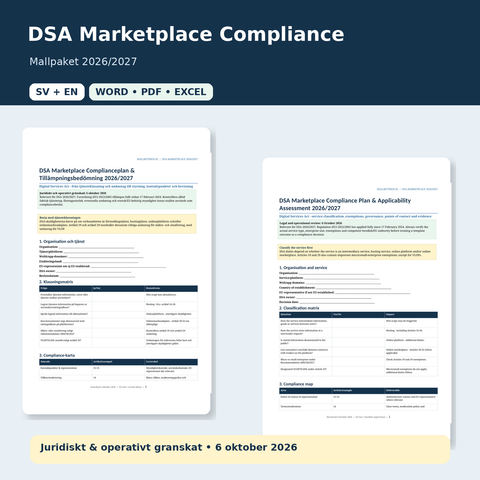
The template store's DSA Marketplace Compliance package includes, among other things, documentation for Notice and Action, KYBC, and documentation of relevant platform processes. The package can complement an internal workflow, but verify for yourself which parts are actually needed for Article 20. A document template or an Excel register never guarantees that the business complies with the DSA.
See DSA Marketplace Compliance 2026/2027 – Word, PDF, and Excel
Frequently asked questions about DSA Article 20
Must all web shops have an internal complaint-handling system according to Article 20?
No. The rules apply to relevant online platforms, with specific exemptions under Article 19. A shop that only sells its own products is not automatically covered by Article 20 simply because it is operated on the internet.
Can a user complain when the platform does not remove a notified post?
Yes, relevant individuals who have submitted a notice are covered by Article 20(1), including decisions not to remove or restrict certain information according to specified conditions.
Are complaints always possible after exactly six months?
The DSA requires at least six months of access for complaints regarding relevant decisions, calculated from the notification according to Article 16(5) or 17. The actual platform can have longer deadlines in other procedures.
Is AI allowed to review and reject complaints automatically?
Complaint decisions according to Article 20(5) must be subject to oversight by qualified staff and may not be taken solely through automated means. Automated decision support is not in itself prohibited.
Must the platform change a decision just because the seller complains?
No. Article 20(4) prescribes re-evaluation and reversal without undue delay when the complaint contains sufficient grounds showing that the previous decision is not justified.
Is out-of-court dispute settlement under Article 21 free of charge?
Article 20 requires a free-of-charge internal complaint-handling system. Out-of-court certified dispute settlement is regulated separately under Article 21 and may have its own cost rules.
What is the difference between Article 17 and Article 20?
Article 17 requires a statement of reasons in certain cases when a hosting service restricts content or an account. Article 20 provides relevant individuals with the opportunity to request an internal review of specific decisions by the online platforms concerned.
Related guides in the Template Store
- DSA Article 16 – Notice and Action and illegal content
- DSA Article 17 – statement of reasons for moderation decisions
- DSA Article 32 – information to buyers regarding illegal products
- DSA for marketplaces – broad overview and checklist
- EU compliance for companies 2026/2027
Legal sources and official guidance
- Regulation (EU) 2022/2065 (DSA), Articles 19–21 and Recital 58.
- DSA Articles 16–17 and 24, regarding decision information and transparency.
- European Commission – Questions and Answers on the Digital Services Act.
Templates in this article
Explore the topic
 Business guides – contracts, HR, AI & compliance
DSA Article 16 – Notice and Action: report illegal content 2026
Guide to DSA Article 16 and Notice and Action: how hosting services receive notifications, require correct information, send confirmations and deci...
 Business guides – contracts, HR, AI & compliance
DSA Article 17 – Statement of reasons for removals and account suspensions 2026
DSA Article 17: when hosting services must provide a statement of reasons for ad removal, demotion, or account suspension. Checklist regarding grou...
 Business guides – contracts, HR, AI & compliance
DSA Article 32 – informing buyers about illegal products 2026
Practical guide to DSA Article 32: which buyers must be informed of illegal products and services, the six-month rule, public information, and diff...


