
DSA Article 17 – Statement of reasons for removals and account suspensions 2026

Short answer: Under Article 17 of the DSA, a provider of a hosting service must provide a clear, specific statement of reasons when it restricts a user's content, payments, service, or account due to illegal content or violations of its terms and conditions – provided that relevant electronic contact details are known. The statement must specify the meaning of the decision, the relevant facts, the legal or contractual grounds, and information on available remedies. The regulation contains important exceptions.
Last legally reviewed: October 19, 2026. Legal basis: DSA – Regulation (EU) 2022/2065, Articles 17, 19–21, and 24. Read the original text when determining the actual obligations of the service.
- Article 17 applies to relevant hosting services, not just large marketplaces.
- The reason may be that the content is illegal or violates the platform's terms; the distinction must be clear.
- The decision may concern removed or demoted information, payment restrictions, service restrictions, or account suspension.
- The statement of reasons must be provided no later than when the restriction takes effect, if Article 17 is applicable.
- Exceptions: unknown relevant electronic contact details, deceptive commercial content in large volumes, and decisions based on government orders under Article 9.
- A separate obligation under Article 24.5 may require reporting to the EU transparency database for concerned online platforms, but not for every hosting service.
When does DSA Article 17 apply – and to which companies?
The provision is aimed at providers of hosting services, i.e., services that store information provided by a user at their own request. Marketplaces with external sellers, certain social platforms, and other relevant hosting services are typical examples. A traditional e-commerce store with only its own products does not automatically become such a provider for its own product descriptions.
Article 17 applies when a decision regarding the restrictions specified in the article is made because information provided by the user is deemed illegal or incompatible with the service's terms. An arbitrary account suspension for other reasons must be assessed against the actual wording and other applicable legal rules.
For the process before a moderation decision, read DSA Article 16 – Notice and Action regarding illegal content.
Which types of restrictions trigger Article 17?
Article 17.1 lists four main types of decisions, if the decision is based on the user's illegal or policy-violating information.
| Type of decision | Example | Legal scope |
|---|---|---|
| Visibility or access to content | Product ad removed, content blocked or demoted. | Article 17.1 a – reduced visibility is also covered. |
| Payment or monetization | Payouts restricted or suspended due to content. | Article 17.1 b – decisions on monetary payments. |
| Restricted service | Seller temporarily loses access to advertising features. | Article 17.1 c – the service, fully or partially. |
| Account suspension | Account temporarily or permanently suspended. | Article 17.1 d – suspended or terminated account. |
Not every case where a product disappears from a store is automatically an Article 17 decision. For example, the seller may remove an ad themselves, or a legal item may be sold out. Assess who made the decision and on what grounds.
What must be included in the statement of reasons under Article 17.3?
The statement of reasons must be clear and as precise as reasonably possible, so that the affected user can understand the decision and exercise relevant remedies. The following six information areas are based on Article 17.3 a–f:
| Article | Information | Practical documentation |
|---|---|---|
| 17.3 a | Which restriction was decided and, where relevant, geographical scope and duration. | Action, which information/ad/account, start, potential end date, territory. |
| 17.3 b | Facts on which the decision is based, including relevant information about the report or own investigation. | Concrete observations, evidence, and case reference; complainant identity only when strictly necessary. |
| 17.3 c | Information on automated methods when used, including for identification. | If automation contributed to discovery or decision. |
| 17.3 d | When content is considered illegal: legal basis and explanation of why it is deemed illegal. | Applicable provision and individual justification. |
| 17.3 e | When content is considered to violate terms: policy reference and justification. | Relevant terms version, section, and concrete violation. |
| 17.3 f | Understandable information on available remedies. | Relevant points of contact, internal complaints where applicable, external dispute settlement, and judicial review. |
Misinterpretation to avoid: A generic email that just says "We removed your ad because our rules were not followed" does not necessarily satisfy the requirement for a specific and useful statement of reasons. Article 17.4 requires sufficient precision for the recipient to exercise their right to review.
The difference between illegal content and policy violations
A product may be prohibited by law, but it may also be legal while still violating the platform's own valid terms and conditions. Both situations can fall under Article 17, but the information requirements differ: legal grounds must be provided when illegality is invoked, and contractual grounds must be provided when a policy violation is invoked. If multiple reasons exist, they must be explained objectively.
When is no statement of reasons required under Article 17?
There are three particularly important limitations in the legal text:
- Unknown electronic contact details: Article 17.2 stipulates that Article 17.1 only applies when the provider knows the relevant electronic contact details. The need for other obligations must be assessed separately.
- Deceptive commercial content in large volumes: Article 17.2 contains an explicit exception for this category. It should not be used as an arbitrary general exemption for commercial seller ads.
- Government orders under DSA Article 9: Article 17.5 exempts such orders from the rules of Article 17. Article 9 instead has specific requirements regarding information about decisions and enforcement.
Recommended decision-making process for moderation
The following workflow is a practical process suggestion, not a legal obligation to use a specific form, a specific Excel template, or specific software.
- Register the case: identify the product/ad/content, user, relevant time, and case number.
- Check service and decision: determine if Article 17 applies, which restriction is being decided, and which explicit exceptions exist.
- Document the grounds: state whether the decision follows from applicable law, terms of service, or multiple grounds.
- Describe the facts: formulate a concrete and objective statement of reasons that is understandable to the affected user.
- Disclose potential automation: document if an automated aid or an automated decision was used.
- Check potential remedies: describe internal complaint handling, external dispute settlement, and judicial review to the extent they are applicable.
- Send in time: provide the statement of reasons no later than when the restriction is enforced, where Article 17 is applicable.
- Report separately: determine if the platform is also covered by Article 24.5 regarding the EU transparency database.
- Document the follow-up: note the notice sent, any complaint, and the final outcome while respecting GDPR.
Article 24.5 – must the decision be reported to the EU transparency database?
The obligation to provide a statement of reasons to the affected user under Article 17 is not identical to the obligation to provide information to the Commission's transparency database under Article 24.5. The latter applies to certain providers of online platforms, which is a specific category within hosting services.
According to Article 24.5, covered online platforms must, without undue delay, submit relevant decisions and statements of reasons to the European Commission's DSA Transparency Database. Submitted information must not contain personal data. The platform must therefore ensure proper de-identification before submission.
Article 19.1 provides exemptions from, among other things, Article 24.5 for certain micro and small online platforms, with special restrictions and exceptions to the exception for very large online platforms. This relief should not be confused with Article 17, which applies to hosting services based on their own criteria.
The EU Commission describes the database as a tool for transparency in content moderation. The information reported should be specific and legally relevant, but a public database entry is not an EU approval that a moderation decision was correct. Read the Commission's FAQs about the database.
Which appeal options must be described?
In addition to internal review, an affected person may have the right to choose a certified body. See DSA Article 21 – out-of-court dispute settlement and remedies.
The practical appeal process for concerned online platforms is explained in DSA Article 20 – internal complaint-handling system and moderation review.
According to Article 17.3 f, the affected user must receive clear information about the review options that actually exist. For online platforms covered by Article 20, there is a requirement for an effective, free-of-charge electronic internal complaint system for certain decisions. Article 21 addresses, under its conditions, out-of-court dispute settlement.
The additional requirements in Articles 20–21 should not be routinely explained as if they apply to all hosting services, because online platforms and other hosting services have different obligations, and Article 19 may provide exemptions for certain small platforms.
A user should be able to understand which decisions can be challenged, where to turn, and how the process works. The statement of reasons should therefore refer to the actual service's applicable remedies – not a standard page that lacks functioning pathways forward.
Example of a statement of reasons when a product ad is removed
Decision regarding your product ad
We have decided to restrict the visibility of ad [ad-ID and product title] from [date/time]. The action applies to [territory] and is valid until [date or condition].
Reasons: We have assessed [concrete fact]. The legal basis is [legal rule and explanation] and/or the current term of service is [term number/version and explanation].
Basis for decision: [relevant facts and, if necessary, information on how the case was identified]. Automated methods [were/were not] used for [discovery/assessment] to the extent relevant.
Options for review: [specific relevant complaint channels, external review, and legal proceedings].
The example is an illustrative layout, not an official government form or a guarantee of Article 17 compliance. A real statement of reasons must be based on the actual decision and applicable rules.
When the seller objects to the decision
Assume an external seller appeals the removal and can show that a relevant safety document was misinterpreted. The platform then needs to assess the objection according to applicable complaint rules and document a new decision. If Article 20 applies, special procedural requirements may apply to the platform. A previous "automatic block" does not in itself mean that the platform can skip the relevant remedies.
Checklist for DSA Article 17
- Have we classified the service as a relevant hosting service and assessed the article's scope of application?
- Is the decision a visibility, payment, service, or account restriction covered by Article 17?
- Do we know if relevant electronic contact details exist?
- Have any exceptions for deceptive commercial mass content or Article 9 orders been assessed?
- Does the decision state exactly which information or account is affected and for how long the action applies?
- Are facts and circumstances disclosed without revealing the complainant's identity unnecessarily?
- Are the legal basis and/or reference to the current terms of service correct and explained?
- Is the role of automated methods disclosed where applicable?
- Is there concrete information on relevant review options?
- Is the statement of reasons sent in a timely manner and in a language and way that the affected user can understand?
- Have separate reporting obligations to the transparency database under Article 24.5 and associated exceptions been assessed?
- Do we have internal traceability of decisions and feedback with appropriate personal data handling?
How are Articles 16, 17, 20, and 32 connected?
Article 16 deals with receiving and handling notifications of potentially illegal content. Article 17 deals with providing reasons for certain actual moderation decisions to affected users. Article 20 applies, under specific conditions, to the online platform's internal complaint-handling system. Article 32 relates to specific information to buyers when an illegal product or service has been offered via a relevant marketplace.
For the entire marketplace's responsibility, these processes need to be coordinated with KYBC and seller identification under Article 30 as well as compliance by design under Article 31. Also read our broad DSA guide and the comparison between GPSR and DSA.
Document templates for DSA and moderation decisions
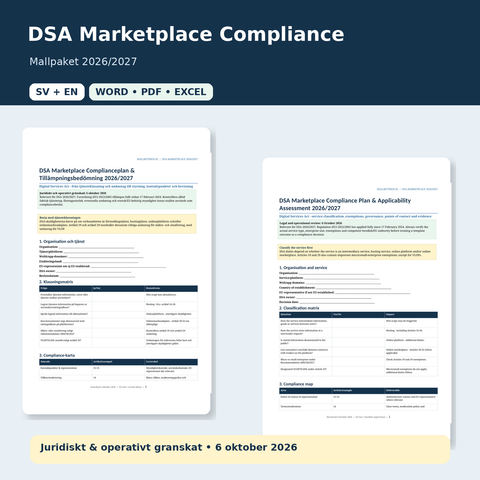
The template store's DSA Marketplace Compliance 2026/2027 offers Swedish and English documentation for Notice and Action, handling of illegal offers, decision documentation, and related registers. These documents can help the business collect and review information but do not replace your own legal assessment.
FAQ about DSA Article 17
Does the seller always have to receive a statement of reasons when an ad is removed?
When Article 17 is applicable and relevant electronic contact details are known, the affected service recipient must receive a clear statement of reasons no later than when the restriction is introduced. At the same time, Article 17 has explicit exceptions that must be considered.
Does the statement of reasons requirement also apply when the advertisement is not illegal?
Yes, if there is a relevant restriction based on the user's information violating the platform's terms and conditions. The grounds and explanation must then relate to the terms and the factual circumstances.
Do small hosting services need to comply with Article 17?
There is no general micro/small enterprise exemption from Article 17 corresponding to certain specific online platform requirements. However, the service must actually fall within the scope, and the exemptions within the provision itself apply.
Must the same statement of reasons be published publicly?
Not in that way for all hosting services. A separate reporting obligation to the EU transparency database under Article 24.5 applies to certain online platforms, with explicit exceptions and a prohibition on personal data in the reporting.
Is the text "Violation of terms of service" sufficient?
Not necessarily. Article 17 requires concrete reasons and references that allow the affected user to understand why the decision was made and how it can be challenged.
What applies if moderation is performed using AI?
Article 17(3)(c) requires relevant information regarding automated means used in detection or decision-making. Other regulations concerning automated decisions may also be relevant depending on the implementation.
Must the platform offer an internal complaint-handling system?
Article 20 applies to certain online platforms, with specific exceptions including those under Article 19. Article 17 requires information about the remedies actually available, but not every hosting service is automatically subject to all Article 20 requirements.
Official legal sources and guidance
- DSA – Regulation (EU) 2022/2065, in particular Articles 17.1–5, 19–21, 24.5 and Recitals 54–56 and 66.
- European Commission: DSA Transparency Database – questions and answers.
- European Commission DSA Transparency Database.
- European Commission on transparency under the DSA.
Templates in this article
Explore the topic
 Business guides – contracts, HR, AI & compliance
DSA Article 16 – Notice and Action: report illegal content 2026
Guide to DSA Article 16 and Notice and Action: how hosting services receive notifications, require correct information, send confirmations and deci...
 Business guides – contracts, HR, AI & compliance
DSA Article 21 – out-of-court dispute settlement for content moderation decisions 2026
DSA Article 21 – guide to certified out-of-court dispute settlement bodies, the 90/180-day deadline, fees, eligibility, cooperation, and the differ...
 Business guides – contracts, HR, AI & compliance
DSA Article 20 – Internal complaint-handling system and appeal 2026
Practical guide on the internal complaint-handling system under DSA Article 20: which moderation decisions can be appealed, the six-month deadline,...


