
Microplastics in shampoo 2027 – REACH entry 78, supplier evidence and lot holds
Practical guidance for cosmetic companies on the 2027 rinse-off microplastics rule, supplier testing, transitions and batch holds.

Short answer: REACH Annex XVII entry 78 introduced by Regulation (EU) 2023/2055 restricts intentionally added synthetic polymer microparticles at 0.01% by weight or more where its definition and conditions apply. The deadline for other rinse-off cosmetics such as certain shampoos and shower gels without abrasive microbeads is 17 October 2027. Abrasive microbeads have been restricted since 17 October 2023. A synthetic polymer name alone does not establish that a formulation contains legally defined microparticles.
Which rinse-off cosmetics are affected in 2027?
First determine whether a product is a cosmetic and rinse-off under the cosmetics rules. Investigate whether the polymer is solid, the relevant particle size and shape, intentional addition, functional purpose and concentration. Naturally occurring unmodified, water-soluble, appropriately biodegradable or carbon-free polymers may be excluded under defined conditions that need evidence. An INCI name does not itself prove particle size, solubility or degradation.
Which synthetic polymer particles count?
Legal scope: Entry 78 covers solid synthetic polymers in particles meeting the specified size criteria, including particles up to 5 mm and certain elongated particles up to 15 mm. Water-soluble, properly biodegradable, naturally formed unmodified or carbon-free polymers may be outside the definition. Paragraphs 4–5 contain other conditional exemptions; neither an INCI name nor the word polymer alone proves a ban.
Dates and decision table
| Product or situation | Relevant legal check |
|---|---|
| Exfoliating product with abrasive plastic microbeads | Already covered from 17 October 2023, not the later general rinse-off transition. |
| Shampoo washed off, no microbeads | Assess actual qualifying microparticles and the specific 17 October 2027 transition. |
| Leave-on hair product | Separate transition from 17 October 2029; product classification matters. |
| Lip, nail and make-up cosmetics | Special 17 October 2035 restriction and 17 October 2031 labelling as defined. |
| Polymer particles used to encapsulate fragrance | Separate 17 October 2029 transition based on actual use. |
| Old finished stock made before 2027 | No automatic sell-through assumption after 16 October 2027; the general 2023 stock derogation does not automatically cover point 6 products. |
The rinse-off transition ends on 16 October 2027; entry 78 paragraph 6(b) applies the next day. Regulation (EU) 2026/1168 added a limited research-and-development derogation and later clarification of permanent incorporation into a solid matrix for an intended end use of at least one year, applicable from 22 June 2028. This is generally not a shortcut for rinse-off shampoo. Sweden's 3 November 2026 memorandum proposes removing the overlapping national cosmetics microplastics prohibition on 1 April 2027; it is a proposal, not enacted law.
What should supplier evidence contain?
A usable supplier polymer declaration identifies supplier, material, formulation and lot, chemical and physical polymer characteristics, particle sizes, intended function, percentage by weight and documented methods for solubility or biodegradability claims. Any exemption must map to the actual legal provision. Exactly 0.01% meets the numerical threshold if all other elements apply. Check current evidence for the exact product, rather than relying on marketing claims.
Six steps for reformulation and lot holds
- Inventory SKUs, formulation versions, cosmetic category, responsible person, suppliers and intended polymer functions.
- Request supplier evidence for polymer identity, solid state, particle dimensions, concentration, testing and any documented exclusions.
- Assign the actual deadline: abrasive microbeads 2023, other rinse-off 2027, some fragrance encapsulation or leave-on 2029, certain cosmetics 2035.
- Plan ingredient substitution and document performance, stability, cosmetic safety assessment, PIF, ingredient labelling and possible CPNP updates.
- Record real first market placement, batch, customer and stock movements; place uncertain lots on internal hold for qualified review.
- Record the authorised manual decision and retain source evidence, test reports and corrective actions; no spreadsheet may certify a product automatically.
Two practical scenarios
Case A – shampoo at 0.02%: A supplier confirms intentionally added solid synthetic polymer microparticles within the legal definition. Verify size, purpose, possible exclusion and actual EU placing on the market before concluding applicability.
Case B – shower gel with ambiguous INCI: A polymer name appears on an ingredient list without evidence of particle form or solubility. Record 'insufficient evidence' and request targeted technical data; do not assume a zero concentration.
Frequently asked questions
Are all synthetic polymers in shampoo banned?
No. Entry 78 requires specific solid microparticle and legal conditions; an INCI name is insufficient.
Do abrasive microbeads also get until 2027?
No. Those were subject to the restriction from 17 October 2023.
May old rinse-off stock always sell after the 2027 deadline?
No. The general pre-October 2023 stock exemption does not automatically extend a product-specific paragraph 6 transition.
Can these documents certify my formula as compliant?
No. They structure evidence and decisions but cannot replace scientific, legal and cosmetic safety review.
Official sources and scope
eu2023 · eu2026 · kemi · cosmetic · commission · sweden
Editorial review of official sources 13 November 2026. General EU/Swedish guidance only, not laboratory testing, official clearance or an individual cosmetic safety certificate.
Practical Word, PDF and Excel templates
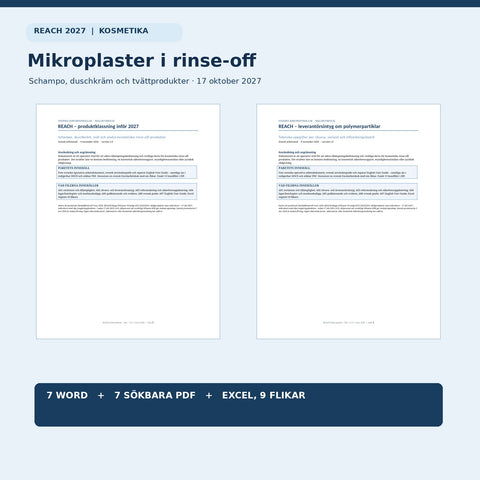
For editable supporting documents, see REACH microplastics 2027 – shampoo, shower gel, polymer certificate & batch block | Word/PDF/Excel. Check the product page for the exact included files.
Related in-depth guide
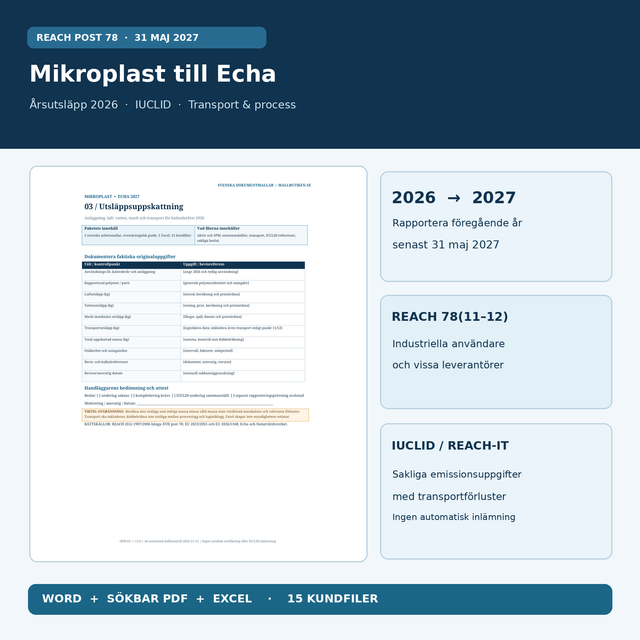
Read also ECHA microplastics reporting 2027 – who reports, IUCLID and transport losses. Product restrictions and any ECHA reporting duties are separate questions. Assess each obligation individually.
Templates in this article
Explore the topic
 Business guides – contracts, HR, AI & compliance
ECHA microplastics reporting 2027 – who reports, IUCLID and transport losses
Practical guide to the 2027 ECHA SPM annual emissions report, roles, transport data, supplier exemptions and REACH-IT handoff.


