Svenska Dokumentmallar
PFAS in your own well 2026 – interpret PFAS4/PFAS21, request retesting and document actions | Word/PDF/Excel
PFAS in your own well 2026 – interpret PFAS4/PFAS21, request retesting and document actions | Word/PDF/Excel
- File format
- DOCX, PDF, XLSX
- Document language
- Five Swedish work templates and a Swedish guide plus an English User Guide in DOCX/PDF; Swedish Excel register with nine tabs.
- Number of files
- 7
Digital download. No physical product is shipped.
Couldn't load pickup availability
About this template
PFAS in your own well 2026 – practical templates for understanding PFAS4 and PFAS21 in laboratory tests, ordering retests, and documenting actions. Do you have a drilled or dug well and have received a test result showing PFAS, PFOS, or PFOA? The new Swedish levels from January 1, 2026 are 4.0 ng/l for PFAS4 and 100 ng/l for PFAS21. Our complete Word/PDF/Excel product helps you correctly document the sampling point, laboratory, analysis totals, retests, contact with the municipality, and any purification measures.
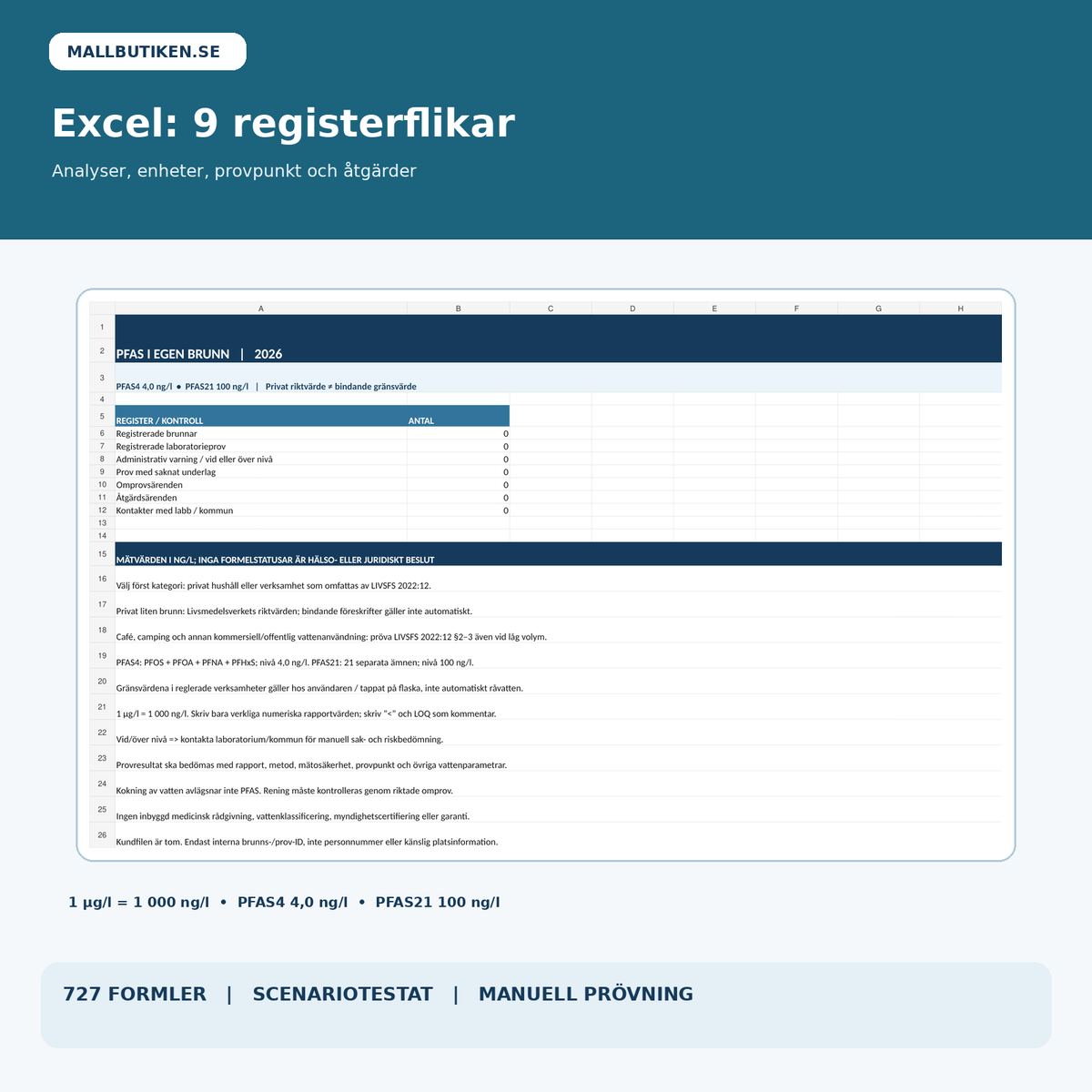
Quick facts: Five editable work templates in Swedish, a Swedish guide, an English User Guide, and an Excel register with nine tabs and 727 formula cells. You receive 7 DOCX + 7 searchable PDFs + 1 XLSX = 15 customer files in a ZIP file. The documents are intended for Swedish regulations and can be used by private well owners and as administrative support for certain drinking water activities, but their legal status must first be determined.
01. Package contents
Five Swedish work templates: facility/regulatory review, laboratory order and sampling chain, analysis sheet for PFAS4/PFAS21, written inquiry to the municipality or laboratory, and an action and retest log. In addition, a Swedish user guide and English User Guide, all in Word and PDF. An Excel register with nine tabs and 727 formulas is included. A total of 15 files in a digital ZIP.
02. What the files contain
Fields for well ID, intended use, number of people supplied, water volume, whether the sample comes from the user's tap, raw water, or after purification, the laboratory's report ID, and units of measurement. Excel has specific columns for ng/l and µg/l, as well as PFAS4 and PFAS21 totals, sample and action tracking. No document approves the water for consumption, issues an official assessment, or replaces the laboratory's original report.
What's new from January 1, 2026
In the Swedish Food Agency's drinking water regulations LIVSFS 2022:12, there are binding levels for water within regulated activities. The requirements for several new analysis parameters, including PFAS4 and PFAS21, began to apply on January 1, 2026. The values for PFAS at the sampling point at the user's location are 4.0 ng/l and 100 ng/l, respectively. There are also new requirements for raw water testing for operators and other expanded parameters; the exact testing requirements need to be assessed according to the established program and risk analysis of the activity where required.
Important legal distinction: a small private well where the water is used solely for private purposes, supplies fewer than 50 people, and produces less than 10 m³ per day, is normally not the same kind of regulated drinking water facility as a municipal supplier or waterworks covered by LIVSFS 2022:12. For private small wells, the Swedish Food Agency instead uses advisory guidelines and water analysis assessments. The water can be assessed as fit for consumption, fit for consumption with a warning, or unfit for consumption. The well owner is responsible for follow-up and any actions.
Businesses with their own well: water used or provided in public or commercial activities is covered by the drinking water regulations even with a small water volume. Examples include a café, a campsite, or an activity that rents out accommodation. However, for some small commercial facilities, there are special exemptions from certain provisions, including requirements for risk analysis. Check the scope according to Sections 2–3 of LIVSFS 2022:12 and the municipality's guidance. An Excel cross cannot determine whether the activity legally complies with the regulations.
The difference between PFAS4 and PFAS21
PFAS4 is the sum of four specifically stated PFAS compounds: PFOS, PFOA, PFNA, and PFHxS. The level is 4.0 nanograms per liter. PFAS21 is the sum of 21 specified PFAS substances according to the Swedish Food Agency's regulations, with the level 100 ng/l. PFAS21 is not the same as PFAS4, and you cannot reliably calculate a complete PFAS21 result if the laboratory only measured the other four substances.
The laboratory can report individual concentrations, a laboratory-calculated sum, reporting limits, and results with the < symbol. The documents help you record what the laboratory actually reported; do not create made-up figures from a result below the reporting limit. Values that are missing, uncertain, or reported in different units should be assessed by the laboratory.
The unit is crucial: ng/l or µg/l?
1 µg/l = 1,000 ng/l. If the report, for example, reports PFAS4 as 0.005 µg/l, that corresponds to 5 ng/l. This can easily be confused with a value of 0.005 ng/l, which is a thousand times lower. In Excel, you can select the report unit and let the workbook perform the purely mathematical conversion, but the actual laboratory report, measurement uncertainty, and assumptions must be reviewed manually.
Why does the sampling point matter?
The difference between raw water before filtration and drinking water at the user's location is important. The stated binding PFAS limit values in LIVSFS 2022:12 apply at the user's location and to water bottled or filled into containers according to the regulations' sampling points, not automatically to every raw water measurement. A raw water sample may be important for risk assessment, but should not be presented as if it itself established an exceedance at the user's tap. Template 02 and Excel separate these sampling points.
What is included in the 15 customer files?
| No. | File | Practical use | Format |
|---|---|---|---|
| 01 | Well and applicable regulations | Private household, shared well, or regulated commercial water activity. | DOCX + PDF |
| 02 | Laboratory order & sampling chain | Request the correct analysis, check the sampling point, container, reporting limit, and sample ID. | DOCX + PDF |
| 03 | Interpretation of PFAS4 and PFAS21 | Compile the original report, units, four and 21 substances respectively, and expert assessment. | DOCX + PDF |
| 04 | Letter to municipality / laboratory | Request local risk data, factual guidance, and relevant retesting. | DOCX + PDF |
| 05 | Action and retest log | Alternative water, filter investigation, follow-up testing, and traceable follow-up. | DOCX + PDF |
| 06 | Swedish user guide | Legal status, sampling, advisory levels, and four examples. | DOCX + PDF |
| 07 | English User Guide | Instructions for the Swedish working documents and Excel. | DOCX + PDF |
| 08 | Excel register with nine tabs | Wells, test results, PFAS4, PFAS21, retests, actions, and contacts. | XLSX |
Excel – nine tabs and 727 formulas
Start: compilation of registered samples and retests. Wells: well type and testing of private versus regulated use. Test results: report ID, PFAS4/PFAS21, ng/l or µg/l, sampling point, and warning status. PFAS4: check of the four individual analyses and the laboratory's sum. PFAS21: verify that the laboratory actually reports 21 substances and the relevant sum. Retests: new samples and chain of custody. Actions: recommended temporary solutions, purification investigation, and follow-up testing. Contacts: questions to the lab or municipality. Sources: official Swedish references.
The 727 formula cells have been tested with seven different administrative situations, including levels below 4.0 ng/l, at exactly 4.0 ng/l, above 4.0 ng/l, conversion from µg/l, raw water samples, and empty cases. The status messages distinguish between “Below level – MANUAL REVIEW”, “AT LEVEL – EXPERT REVIEW”, “ABOVE LEVEL – EXPERT REVIEW”, and “Sampling point/category – MANUAL REVIEW”. An administrative status is never a laboratory finding, health advice, or legal approval. Excel is empty of customer data and fictitious test cases when delivered.
Four examples
- A private well tests PFAS4 at 3.5 ng/l and PFAS21 at 80 ng/l: the results are below the respective levels, but the workbook still states that the actual water quality and other parameters need a manual assessment. It is not a general certificate of safe water.
- PFAS4 at 4.5 ng/l in the household tap: the new level is exceeded. Document the laboratory's report, contact relevant experts and the municipality regarding local risk sources, and investigate alternative water or purification with the right expertise.
- A well reports PFAS4 at 0.0045 µg/l: Excel can mathematically convert this to 4.5 ng/l and flag the need for follow-up. Always check the laboratory's original unit.
- A café with its own drilled well: even if the activity uses small volumes of water, the rules for commercial drinking water use should be reviewed. It is not sufficient to use the private well guidance.
Recommended six-step workflow
- Determine who owns and uses the well, and whether the water is used solely for private purposes or in an activity.
- Request a relevant water sample from a suitable accredited laboratory. Follow the lab's specific sampling instructions for PFAS.
- Record the sampling point, the laboratory's report ID, sample date, PFAS4, PFAS21, and unit. Keep the entire original report.
- In case of unclear or concerning results: request the laboratory's expert interpretation and contact the municipality for information on local risk sources.
- If actions are considered: document the advice, temporary drinking water, and any purification. Purification with activated carbon or reverse osmosis requires the correct sizing and maintenance.
- Retest according to an expert plan. Follow up after filter replacement or other action. Keep the original evidence and let the responsible person make the final assessment.
Frequently asked questions
What is the limit value for PFAS4 in drinking water 2026?
For regulated drinking water in Sweden, the limit value is 4.0 ng/l at the user's location. For small private wells, the Swedish Food Agency has a corresponding advisory guideline and a special water analysis assessment.
What is the level for PFAS21?
100 ng/l. It applies to a different substance sum than PFAS4. An analysis of four substances is not a complete PFAS21 result.
Must all private wells follow LIVSFS 2022:12?
No, not automatically. A small well solely for private consumption is assessed against the authority's advisory guidelines. For commercial or public provision, the regulations may apply, even on a smaller scale.
Can you see or taste PFAS in the water?
No. The fact that the water is clear and tastes normal does not mean that PFAS is absent. A relevant laboratory analysis is required.
Is it enough to boil the water?
No. Boiling does not remove PFAS. Ask an expert about suitable purification or alternative water supply and follow up with new samples.
Is a sample from the well the same as a sample at the tap?
No. Raw water may differ from water after filtration or at the user's tap. The sampling point must be stated in the documentation.
How often should a private well be tested?
The Swedish Food Agency normally recommends at least every three years, and at least annually if children up to five years old use the water or the well supplies more than two households. In case of suspected contamination or a major incident, additional samples may be needed. PFAS is not automatically included in every normal analysis.
Can Excel determine that my drinking water is fit for consumption?
No. The workbook is a documentation aid, not a laboratory investigation, medical assessment, or official classification of water.
Can I use the letter to claim damages from a suspected polluter?
The letter in the package is a factual request for information and a retest. Responsibility for pollution or potential compensation must be investigated separately; the template does not determine who is responsible.
Are English work templates included?
Five work templates and Excel are in Swedish. A Swedish guide and a separate English User Guide are included. All seven documents are available in Word and searchable PDF.
Related Mallbutiken product
Do you have a shared well with joint operation and cost allocation? See Shared well – cooperation agreement, water sample, operation, and cost register. This new PFAS product instead focuses on PFAS4/PFAS21, laboratory measurement, retests, and the assessment of the 2026 guidelines/limit values.
Official sources and limitation of liability
Swedish Food Agency – own well; Swedish Food Agency – interpret your water analysis; Swedish Food Agency – water sample and analysis; Swedish Food Agency's Control Wiki – chemical parameters; LIVSFS 2022:12 and small commercial drinking water facilities.
Version 1.0 · AI-assisted source review November 12, 2026. No independent legal, accredited laboratory, water purification, or medical review has been conducted. The product does not include a sampling service, measuring equipment, official form, health guarantee, or pollution certification. Check the latest official guidance, original laboratory evidence, and relevant professional advice. Digital delivery via Shopify is linked separately after a publication decision.
Read the related guide: PFAS in a private well in Sweden – PFAS4, PFAS21, test results and retesting. Find the applicable rules and examples before using the templates.