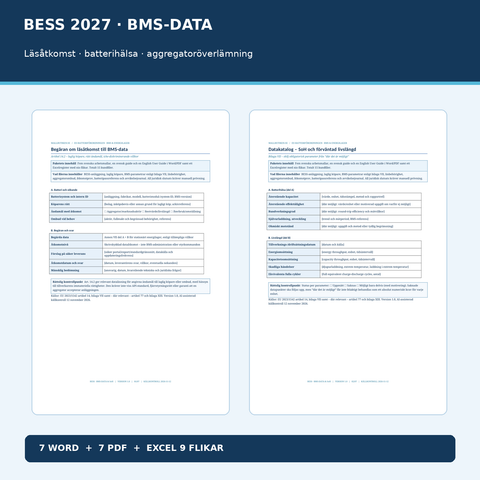
Battery storage BMS data – request state of health and prepare aggregator handover
Practical guide to BMS read-only access, state of health, Annex VII data and safe handover to an independent aggregator under EU law.

Short answer: A person who has lawfully purchased a stationary battery energy storage system may, for defined purposes, obtain read-only access through the battery management system (BMS) to state-of-health and expected-lifetime parameters in Annex VII under Article 14 of EU Regulation 2023/1542. This provision has applied since 18 August 2024. The battery passport under Article 77 is a separate obligation starting on 18 February 2027 for specified batteries.
What is covered – and what is not?
This guide primarily concerns purchasers of stationary battery energy storage systems (BESS), authorised representatives and professionals evaluating remaining life or preparing a handover to an independent aggregator. Other battery categories have partly different parameters. An app subscription, a lease or simple use of the equipment does not automatically prove purchaser status under Article 14. Check purchase records, battery category, scope and the actual party requesting access.
Article 14 does not automatically grant administrator credentials, write access, remote control, every internal signal, a particular API, grid connection or energy-market participation. Manufacturer intellectual-property rights remain protected. Technical safety and commercial aggregation require separate arrangements. For older installations, assess applicability and the original market placement.
Choose the correct rule
| Question | Applicable route |
|---|---|
| Need remaining capacity and lifetime data in the BMS? | Article 14 and Annex VII; confirm lawful purchaser, permitted purpose and read-only access. |
| Will a new industrial battery above 2 kWh need a passport? | Article 77: from 18 February 2027 for relevant batteries placed on the market or put into service. |
| Does the aggregator want to control charging? | A separate technical and commercial arrangement is required; data reading is not a control mandate. |
| A parameter is available only ‘where possible’? | Seek a technical explanation rather than automatically assuming a breach. |
Which data belong in Annex VII?
For stationary storage, Annex VII distinguishes state-of-health parameters (Part A) from expected-lifetime parameters (Part B). Data must be up to date, while actual export mechanisms and measurement methods need technical validation.
- Part A, state of health: remaining capacity; where possible, remaining power capability and round-trip efficiency; evolution of self-discharge rates; where possible, ohmic resistance.
- Part B, expected life: manufacturing date and, where relevant, commissioning date; energy throughput; capacity throughput; harmful events such as deep discharge and extreme temperatures; equivalent full charge-discharge cycles.
Request and check BMS data step by step
- Identify the battery, BMS version, lawful purchaser and the actor controlling data access. Do not attach credentials or sensitive topology to an open ticket.
- Cite Article 14(2) and Annex VII. State a permitted purpose such as residual valuation or access for an independent aggregator.
- Request the relevant BMS parameters, timestamps, units, measurement explanation and a secure read-only route. Do not request control rights.
- For an aggregator or consultant, specify the purchaser, representative's identity, written authority, purpose, time window and secure contact.
- Have authorised technical staff perform a safe read test. Verify units, timestamps, battery identity and the ability to interpret the output.
- Keep an evidence log of values received, missing fields, technical explanations, reply date and next action. Distinguish legal and interoperability issues.
Example request wording
As the lawful purchaser of battery [model/identifier], I request read-only BMS access to the relevant Annex VII parameters under Article 14(2) of Regulation (EU) 2023/1542. The purpose is [residual valuation / preparation for an independent aggregator / another permitted purpose]. Please specify a secure access method, available values, units, timestamps and any parameters that can only be supplied where technically possible. I do not request write or control access.
Two practical cases
Case 1 – farm battery: The purchaser only sees state of charge in an app and wants to compare aggregators. Gather proof of purchase, request Annex VII data and have a technician validate comparable values. Actual battery dispatch needs a separate agreement.
Case 2 – commercial property: The operator wants to value an older battery. Request capacity, cycles and harmful-event history with BMS provenance; verify market placement and scope. Missing readings must not be entered as zero.
Common mistakes
- Do not confuse state of charge (SoC) with state of health (SoH).
- Do not confuse the Article 14 BMS right with the Article 77 passport or a right to remotely dispatch a battery.
- Do not ask for passwords or unrestricted diagnostic logs without a valid basis.
- Do not treat a ‘where possible’ parameter as unconditionally mandatory.
- Do not expose equipment identifiers, security details or credentials in public logs.
Questions and answers
Does using a battery app grant access to all BMS signals?
No. Article 14 depends on who requests access, specified purposes and Annex VII parameters. App access alone is not proof.
Must the manufacturer provide a specific open API?
Article 14 sets a read-only, non-discriminatory access right for identified data, but does not itself mandate one particular API or remote-control function.
Is the battery passport equivalent to a BMS export?
No. Article 77's passport and Article 14's BMS access are separate mechanisms with different purposes.
Sources and limitations
EU Regulation 2023/1542, Articles 14 and 77, Annex VII · Consolidated EU text (13 August 2026) · European Commission: Battery Passport · Kemikalieinspektionen: Batteries.
Editorial legal source check: 13 November 2026. This is general EU-law information for use in Sweden, not an individual legal opinion, electrical safety assessment or technical certification.
Practical document templates
Find the editable Word, PDF and Excel package: Battery Storage 2027 – BMS Data, Battery Health (SoH) and Aggregator Handover | Word/PDF/Excel. See product details for the exact files included.