
MFA in OT under Sweden's NIS2 rules – vendors, administration and emergency access
When is MFA required for operational technology in Sweden? Practical guidance on MCFFS 2026:11, vendor remote access, privileged accounts and emergency procedures.

In brief: Where the relevant provisions of Sweden's MCFFS 2026:11 apply, Chapter 4, Section 17 requires multi-factor authentication (MFA) for system administration in production IT and OT segments and for staff or suppliers entering the digital environment from external networks. Other access requires an assessment and appropriate action; not every local operator login is subject to the same express rule.
Who is covered?
First establish whether the operator falls under Sweden's Cybersecurity Act (2025:1506) and the specific provisions of MCFFS 2026:11. Energy, water, manufacturing and other critical activities may be affected, but owning industrial equipment alone does not establish NIS2 coverage.
Scope exception: Under Chapter 1, Section 1 of this regulation, operators engaged exclusively in certain listed sectors, including specified digital and business-to-business ICT services, are subject only to the management-training provision of this particular regulation. Other legal duties or stricter sector rules may still apply.
OT MFA decision table
| Access scenario | Assessment under Chapter 4, Section 17 |
|---|---|
| System administrator in a production OT segment | MFA expressly required. |
| Employee or vendor connecting from an external network | MFA required for access to the digital environment. |
| IT system handling information requiring enhanced protection | MFA expressly required. |
| Local operator without administrative privileges | Identify and address the need for MFA; do not automatically assume the same express rule applies. |
How to document secure access
- Check the legal entity, sector and applicability of the Act and this regulation.
- Map access routes, IT/OT segments, privileged identities and vendor remote service without publishing sensitive network diagrams.
- Classify access as expressly subject to MFA, requiring a needs assessment, or outside this regulation; record the legal basis and owner.
- Test actual MFA on the access path; a policy statement or vendor promise alone is not proof.
- Restrict vendor permissions to the task and appropriate duration; terminate access and review relevant logs.
- Log exceptions, accountable owners, remediation deadlines, retesting and management decisions in protected records.
Emergency access is not a blanket exemption
A failure of the ordinary identity service calls for a pre-approved, tested continuity procedure. A local service port or emergency account is not automatically exempt from binding MFA requirements. Consider resilient authentication, time-limited permissions, dual controls and audit trails. Under Chapter 7, Section 1, Sweden's FRA may grant an individual exemption for special reasons; internal risk acceptance is not a legal exemption.
Two practical examples
Example 1 – remote water-plant service: A technician remotely administers a control server via VPN. Assess both external access and privileged OT access; verify MFA, limited permissions and post-service logs.
Example 2 – local HMI operator: An employee uses a local panel without administrative rights or external access. Do not mechanically apply the special administrator rule; document the separate needs assessment and protection from unauthorised changes.
Frequently asked questions
Does each PLC and HMI need its own MFA prompt?
Not necessarily. Assess the access path and privilege; compliant MFA may be implemented at an appropriate gateway or other access point.
Can a vendor keep a shared permanent service account?
Persistent shared privileges create accountability risks. Assess identity, least privilege, duration and logging under Sections 14–17 and 21.
Can the company waive MFA if older equipment lacks support?
No internal decision alone can waive a binding requirement. Investigate compliant architectures and any formal exemption under Chapter 7, Section 1.
Sources and legal limitations
Cybersecurity Act (2025:1506) · NCSC/FRA: MCFFS 2026:11 · MCFFS 2026:11, full wording.
Legal editorial check: 13 November 2026. Information about Swedish law, not an individual legal opinion or cybersecurity audit. Verify sector rules and actual architecture.
Start with the scope assessment: Before selecting OT access controls, establish whether the organisation falls within Sweden's cybersecurity legislation and identify its role. Read Which organisations are covered by NIS2 and Sweden's cybersecurity law?.
Practical document templates
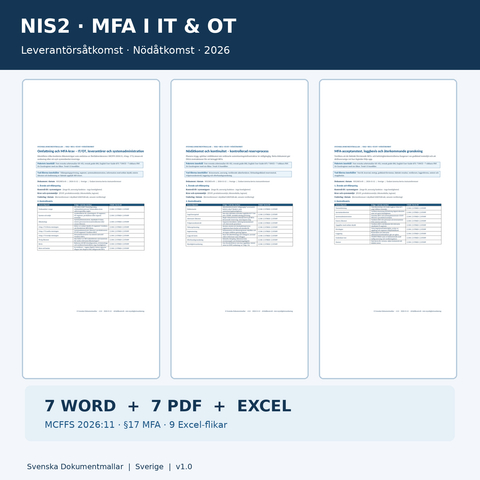
Find the editable Word, PDF and Excel package: NIS2 MFA in OT 2026 – vendor access, emergency access and audit logs | Word/PDF/Excel. See product details for the exact files included.
Templates in this article
Explore the topic
 Business guides – contracts, HR, AI & compliance
Which companies are covered by NIS2 and the Cybersecurity Act?
How Swedish organizations determine if they are covered by the Cybersecurity Act: sector, establishment, size, special cases, essential/important e...


