
Lease agreement for grazing land – rules, terms and conditions and checklist 2026/2027
Guide to grazing land lease agreements under Swedish law: agricultural lease or residential lease, written terms, lease term, maintenance, fencing, water, and practical checklist.

A grazing land lease agreement regulates how a specific area of land may be used for grazing, for what period and for what compensation. If the land is granted for agricultural use, the rules on agricultural leases in Chapters 8–9 of the Land Code may apply. The actual content and use of the agreement are more important than its title.
Is the grant of grazing land an agricultural lease?
Chapter 8, Section 1 of the Land Code describes the four forms of lease: agricultural lease, residential lease, facility lease, and flat lease. Chapter 9, Section 1 applies to agricultural leases, where land is granted for cultivation. The Swedish Courts state that an agricultural lease refers to land that is to be cultivated and that arable land or grazing land must be included. Grazing land used in agricultural activities can therefore be an agricultural lease.
A grant for another purpose that does not meet the criteria for an agricultural, residential, or facility lease may be a flat lease. An agreement with the title “grazing agreement” may therefore need to be analyzed more closely. Consider the parties' intention, the actual use, the compensation, and who controls the land.
Farm lease and ancillary lease
If the lessee's residence is included in the agricultural lease, it is a farm lease. If the residence is not included, it is normally an ancillary lease. An agreement for grazing land only is often an ancillary lease when the other criteria for an agricultural lease are met. The difference is important for, among other things, the lease term and certain protective rules.
What should a grazing land lease agreement contain?
For an agricultural lease, Chapter 8, Section 3 of the Land Code requires a written agreement stating all terms. Even when other rules apply, a clear agreement is important. Describe at least the following:
| Contractual part | Practical content |
|---|---|
| Parties and property | Landowner, lessee, property designation, and contact details. |
| Area | Area, map, boundaries, access road, gates, and excluded areas. |
| Purpose | Grazing operations, permitted animal species, restrictions, and any special management requirements. |
| Time and payment | Access, lease term, termination, fee, due date, and any index adjustment. |
| Management and risk | Fencing, water, supervision, brush clearing, damage, insurance, and incident reporting. |
| Return | Vacation, restoration, remaining facilities, and documentation. |
A dated map approved by both parties reduces the risk of boundary disputes. Also describe whether the lessee may move fences, install water pipes, clear trees, fertilize, or further grant the land. These rights should not be assumed to follow automatically from a brief agreement.
Lease term, termination, and security of tenure
Agricultural leases are specifically regulated in Chapter 9 of the Land Code. The agreement should normally be made for a fixed period. If the lease term is not determined according to the rules of the law, the agreement generally applies for five years. A farm lease generally has a minimum term of five years, while an ancillary lease does not have the same general minimum term. Rules on termination and extension may be mandatory.
The scope of security of tenure depends on the nature and terms of the grant. Therefore, do not use a general termination clause from another agreement without checking the current lease form, the lease term, and whether a possible waiver requires the approval of the lease committee.
Who is responsible for fencing, water, and grazing operations?
Distinguish between the condition of the land and ongoing animal husbandry. Agree who will check the fences before animals are turned out, pay for repairs, arrange water, clear brush, manage gates, and handle damage. Determine how errors and urgent incidents should be reported and documented.
If the land is subject to conservation conditions, environmental restrictions, or agricultural subsidies, these conditions need to be checked separately. A lease agreement does not automatically grant the right to agricultural subsidies or to change the land use. Therefore, describe any restrictions on, for example, fertilizing, soil cultivation, and management.
Checklist before the agreement is signed
- Check that the grantor has the right to grant the land.
- Assess whether the grant is an agricultural lease, flat lease, or other right of use.
- Attach a clear map showing boundaries, roads, gates, and water points.
- Specify permitted use, animal species, and any restrictions.
- Check the lease term, termination, and extension according to the correct lease form.
- Regulate the fee, payment, and any VAT assessment.
- Determine responsibility for fencing, maintenance, damage, supervision, and insurance.
- Document the condition of the land at access and return.
- Ensure that both parties sign all terms and appendices.
Relevant document templates and guides
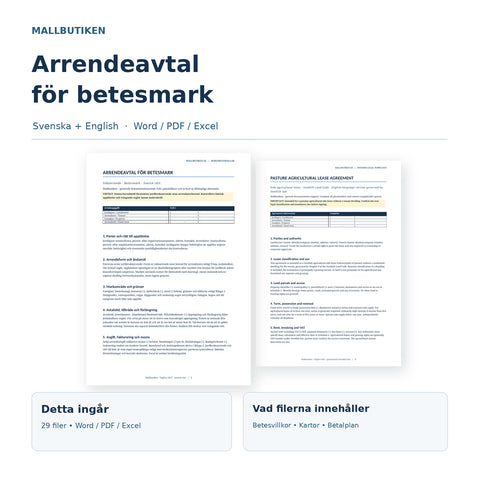
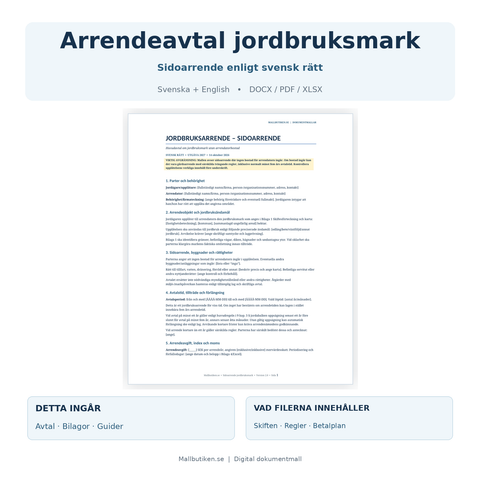
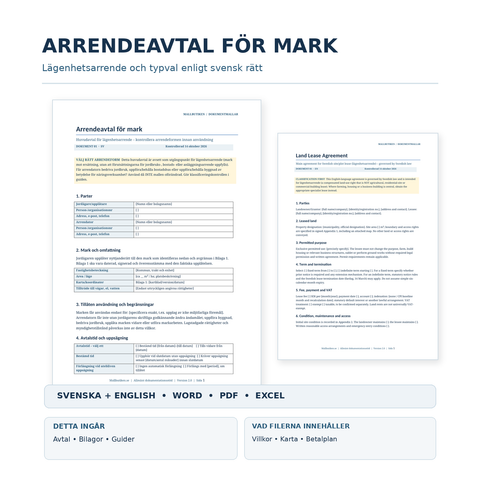
For a grazing land grant, you can use lease agreement for grazing land as a working document. See also lease agreement for agricultural land and lease agreement for land. Choose the template based on the legal lease form and actual terms, not solely the product name.
Read more in the guide to lease agreements, the Land Code's lease rules, and security of tenure in leases.
Frequently asked questions
Must a grazing land lease be in writing?
Yes, if the grant is an agricultural lease. The Land Code then requires a written agreement stating all terms. For a flat lease, other formal requirements apply, but it is still wise to have it in writing.
Can grazing land be leased without a residence?
Yes. An agricultural lease without a residence is normally an ancillary lease. Check that the land is actually granted for agricultural use.
Is it enough to state the price and “grazing land”?
That provides a weak basis. Also state the exact area, purpose, time, access, management, fencing, water, responsibility, and return. Mandatory legal rules may apply even if they are not mentioned in the agreement.
Sources and scope
- The Land Code (1970:994), especially Chapters 8–9 – Swedish Parliament
- The Swedish Courts – right of use and lease
- The Swedish Courts – agreement, term, and fee in agricultural leases
- The Swedish Courts – flat lease
General information about Swedish law, not individual advice. Source checked 31 October 2026. No specific legal review has been performed.
Templates in this article
Explore the topic
 Land lease agreements – guides, rules & templates
Land leases in Sweden – a practical guide
Complete guide to lease agreements: four types of leases, written requirements, fees, contract duration, termination, security of tenure, VAT, and ...
 Land lease agreements – guides, rules & templates
Swedish Land Code: rules for land leases
The Land Code divides leaseholds into agricultural, residential, facility, and apartment leases. This section explains formal requirements, lease t...
 Land lease agreements – guides, rules & templates
Security of tenure for leaseholds – agriculture, residential, and facility
Security of tenure differs between forms of lease. Compare direct protection in agricultural and residential leases, and indirect protection in com...


