Svenska Dokumentmallar
AI vision system in production cell – model change, pilot series and release decision | Word/PDF/Excel
AI vision system in production cell – model change, pilot series and release decision | Word/PDF/Excel
- File format
- DOCX, PDF, XLSX
- Document language
- Five Swedish work templates Swedish user guide and English User Guide; Swedish Excel register
- Number of files
- 7
Digital download. No physical product is shipped.
Couldn't load pickup availability
About this template
Are you changing, retraining, or updating an AI model that inspects products with a camera in a production cell? This Swedish template package helps industrial, quality, and automation teams document the system version, representative sample set, human ground truth, misclassifications, deviations, and an authorized release decision. Important limitation: intended solely for quality inspection, not for AI systems that control machine safety, emergency stops, or other personal safety functions. Such a connection requires separate competent safety assessment.
Quick overview – choose the right document package
Use: AI vision systems for quality control in Sweden. Delivery: The ZIP download contains 7 editable DOCX files, 7 searchable PDF files and 1 XLSX workbook (15 files in total).Language: five Swedish working documents, one Swedish guide, and a separate English User Guide; Excel in Swedish. Software: Word and Excel or compatible editing software. The PDF files are not interactive fillable forms.
01. Package contents
Five Swedish working templates (model identity, safety screening, sample set, classification test, and release decision), one Swedish user guide, and one English User Guide. Each standalone document is available in Word/DOCX and a corresponding searchable PDF: 7 + 7 = 14 files. In addition, there is an editable Excel workbook with nine tabs (1 XLSX). Total of 15 customer files – seven standalone documents, not 15 different templates.
02. What the files contain
Identify the old and new AI model, test environment, and rollback version; separate non-safety-critical quality sorting from machine safety; predetermine the actual sample selection and acceptance criteria; compare the manual ground truth with the AI classification; count false accepts and false rejects; manage deviations, retesting, and a traceable manual decision branch. Excel does not automate CE, legal, or safety approval.
Who should use the templates – and when are they not right?
Situation 1: a camera has received a retrained quality model and you need to show that defect types are detected with comparable ground truth before deployment. Situation 2: quality technicians change the classification threshold for defective components and need to document false accepts, false rejects, the sample set's borderline cases, and a version-locked decision.
Choose other materials and a specialist if the camera is part of a safety circuit, person detection, interlocking, protective stop, or modification that could affect the machine's compliance. This package is not a machine risk assessment, CE technical file, harmonized testing method, general safety PLC test, or complete AI Act high-risk assessment.
All files – actual function and language
| Document | Purpose | Language | Format |
|---|---|---|---|
| 01. Model change and system identity | Model ID, camera, thresholds, operating environment, and rollback | Swedish | DOCX + PDF |
| 02. Safety delimitation and risk assessment | STOP screening if machine safety or a protective function is affected | Swedish | DOCX + PDF |
| 03. Sample set and acceptance criteria | Predetermined sample selection, reference ground truth, and limits | Swedish | DOCX + PDF |
| 04. Classification test and deviations | False accepts/false rejects, correction, and retesting | Swedish | DOCX + PDF |
| 05. Release and rollback plan | Manual authorized decision, version locking, and post-check | Swedish | DOCX + PDF |
| 06. Swedish user guide | Instructions, legal limits, sources, and final checklist | Swedish | DOCX + PDF |
| 07. English User Guide | English instructions for the Swedish working templates | English | DOCX + PDF |
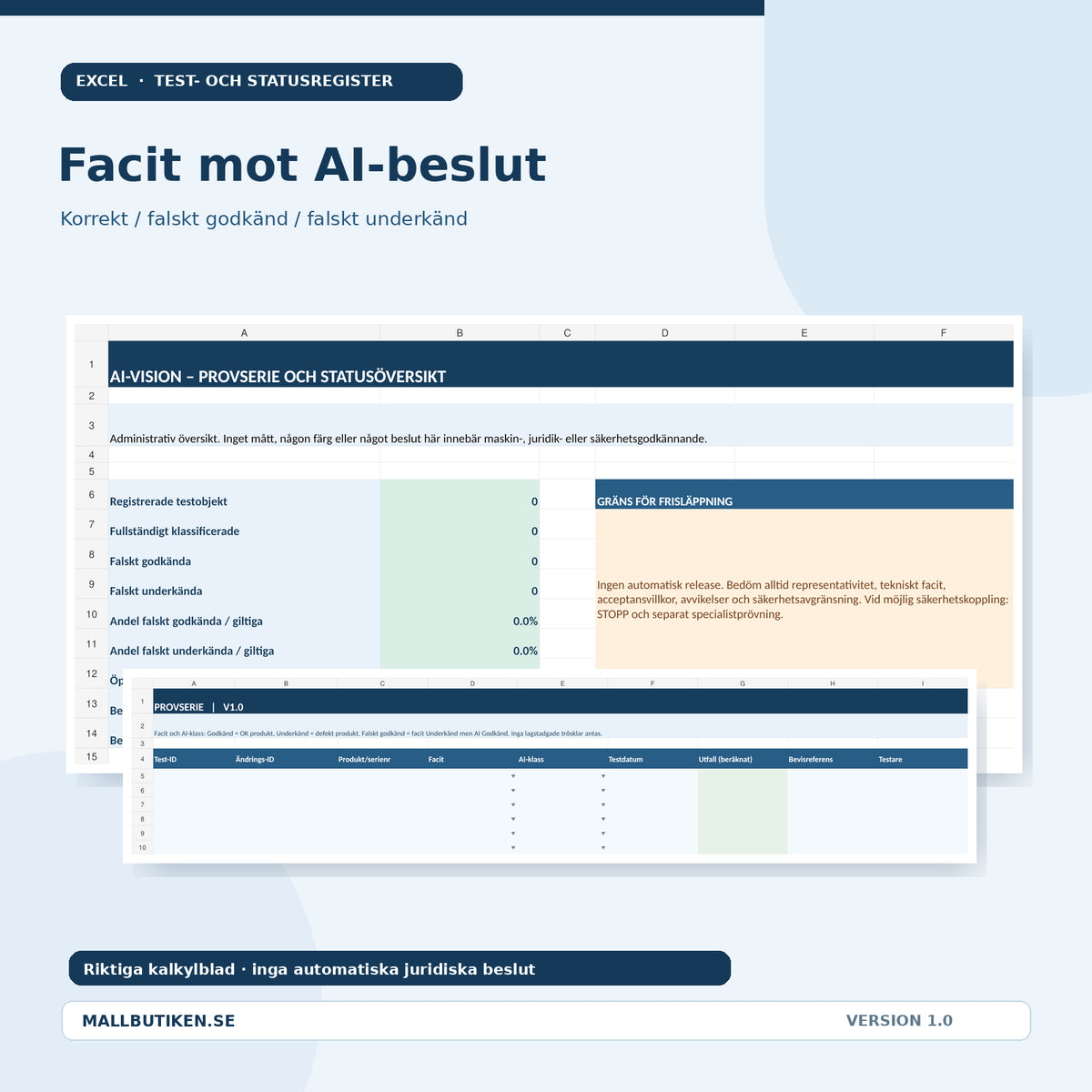
| 08. Excel – sample set and status register | Nine tabs, test results, deviation, risk, and decision logs | Swedish | XLSX |
The DOCX versions are editable in a compatible word processor. The PDF versions are searchable and intended for reading/printing but are not interactive fillable PDFs. Excel (XLSX) is an editable workbook with formulas and drop-down lists. The English guide is guidance – not English versions of the Swedish working documents.
How Excel works in practice
The workbook has nine tabs: Overview, System, Versions, Sample Set, Deviations, Risk Assessment, Actions, Decisions, and Read Me. In the Sample Set tab, you manually enter the reference ground truth and AI class for each test object: Accepted or Rejected. A formula classifies the row as Correct, False Accept, or False Reject. If a class is missing, no result is displayed. The Overview counts the number and percentage of fully classified objects; administrative decision branches and deviations are counted separately.
Anonymized test example: four test objects with manual ground truth yield two correct results, one false accept, and one false reject – that is, 25 percent of each error type in this particular small test series. These fictional test tasks have been removed from the delivered customer workbook. The figures do not constitute automatic acceptance limits; you must determine the actual criteria, a representative sample, and an authorized quality assessment yourself.
Step by step
- Prepare: gather model versions, camera/lighting configuration, product criteria, and previously approved test materials.
- Delimit: check and document that the AI camera does not affect the machine's safety functions or personnel safety. Stop the quality flow and escalate if there is uncertainty.
- Plan: establish the reference ground truth, representative sample set, and technical acceptance requirements before testing.
- Test: record actual test results, false accepts, false rejects, borderline cases, and deviations.
- Decide: document exactly one decision branch with an authorized attestation. Planned, tested, decided, and actually deployed are different statuses.
- Verify and archive: check post-start, saved model data, evidence, and actual rollback capability.
Legal prerequisites and limitations
Work environment: before planned changes, the employer shall investigate whether they may entail risks to health or accidents and assess them according to the relevant provisions in AFS 2023:1. A completed screening is not a substitute for such an actual risk assessment. Use of work equipment may also require special inspection according to AFS 2023:11.
Machine regulations: the Machinery Regulation (EU) 2023/1230 will start to apply mainly on January 20, 2027. The article on substantial modification is only relevant when the actual requirements are met. Changes solely to quality classification are not automatically a substantial machine modification. Assess the machine's status and applicable regulations at the actual date of modification.
AI and images: the AI Act (EU) 2024/1689 does not classify all quality cameras as high-risk; product-integrated safety AI may require different assessment and has a special application period. If the image material identifies persons, GDPR (EU) 2016/679 may apply. The package is not an official form and provides no certification, external legal review, or guaranteed legal compliance.
What is the difference compared to other documents?
For a change that affects the machine's safety or manufacturer liability: Substantial machine modification – Article 18. For changes in a safety-controlled PLC: Safety PLC – program change and restart test. For system integration and safety testing of the entire cell: Integrated production cell – interface and CE documentation. These are different user tasks and are not replaced by this quality testing package.
Frequently asked questions
Is every AI vision system high-risk according to the AI Act?
No. Decide based on the camera's actual intended use, safety connection, and applicable regulations. Regular product quality sorting is not automatically high-risk AI.
Do we have to CE-mark the machine when the AI model is retrained?
Not automatically. A machine modification requires an actual technical and legal assessment of the impact; if possible safety changes occur, a competent specialist should be engaged.
Can Excel approve the sample set itself?
No. Excel classifies manually entered results and sums the number and percentage. Representativeness, acceptance limits, deviations, and release are decided manually.
How do we distinguish false accept from false reject?
False accept means that the reference ground truth says an item is defective but the AI accepts it. False reject means that the reference ground truth accepts the item but the AI rejects it.
Can we use the files for protective stop or person detection?
No. Protective functions and personnel safety are expressly excluded and require special machine safety assessment.
Are the Swedish templates available in English?
No. A separate English User Guide is included, but the five main documents and the Excel workbook are in Swedish.
Sources and version information
Version 1.0 · November 18, 2026 · AI-assisted check of official legal sources and actual file functions. No independent external lawyer or machine safety expert has reviewed or approved the file version. Official legal sources are linked directly above. The product's technical tests apply to the exemplary formula and document function – not to a verification of any customer's actual machine or AI model.