Svenska Dokumentmallar
Allergen incident in restaurant & café – incident report, traceability and corrective action register | Word/PDF/Excel
Allergen incident in restaurant & café – incident report, traceability and corrective action register | Word/PDF/Excel
- File format
- DOCX, PDF, XLSX
- Document language
- Five Swedish operational workbooks in DOCX and corresponding searchable PDF a Swedish user guide in DOCX/PDF a separate English User Guide in DOCX/PDF; Excel workbook in Swedish. No full English version of the main workbooks.
- Number of files
- 7
Digital download. No physical product is shipped.
Couldn't load pickup availability
About this template
Document a suspected allergen incident in a restaurant, café, or catering operation – from the initial report to verified action. The package contains practical templates for incident reporting, ingredient/batch traceability, product decisions, communication records, and root cause analysis. It is an incident management tool based on Swedish/EU law, not a complete HACCP system or an automatic decision to issue a recall. If there are signs of a serious allergic reaction: call 112 and prioritise emergency medical care over documentation.
Quick facts: Five Swedish operational templates, a Swedish guide, and a separate English User Guide, each available as an editable DOCX and a searchable/printable PDF. A Swedish Excel register with nine tabs. A total of 15 customer files: 7 DOCX + 7 PDF + 1 XLSX. The PDF files do not contain interactive form fields. Delivery format: digital ZIP.
Package contents
7 independent document types: incident report, ingredient traceability, risk and product decisions, communication records, root cause analysis, Swedish guide, and English User Guide. All seven are available as both Word documents and corresponding searchable PDFs. There is also a Swedish XLSX register with nine worksheets. Format copies are not separate legal documents.
What the files contain
Fields for incident ID, dish, and recipe version; source of information; supplier and batch; suspected cross-contact; actual contact with guests/suppliers/authorities; product management decisions; and corrective actions. The Excel file keeps reported, received, performed, and verified separate – without automatically assessing food safety or legal obligations.
Who should use the package – and when is it not suitable?
Example 1: A guest says that a dish served may have contained an undeclared allergen. The restaurant’s responsible person needs to secure the correct menu version, ingredient data, and contact details, and document the actions taken. Example 2: A supplier changes an ingredient composition, and staff discover that the allergen information has not been updated for the affected dishes or batches.
Choose another product if you primarily need to establish a complete preventive self-monitoring program: HACCP & Self-Monitoring for Restaurants and Cafés. This incident package does not replace medical assessment, notification of authorities, qualified food safety analysis, or an actual decision to recall products.
All files and formats
| Document | Function | Language | Format |
|---|---|---|---|
| Incident report and immediate actions | Incident, initial actions, sources of fact, and evidence ID | Swedish | DOCX – editable; PDF – searchable and printable, not interactive |
| Ingredient and batch traceability | Recipe version, supplier, batch, and possible cross-contact | Swedish | DOCX – editable; PDF – searchable and printable, not interactive |
| Risk assessment and product decisions | Separate assessment of hold, Article 19, contact with authorities, and recall | Swedish | DOCX – editable; PDF – searchable and printable, not interactive |
| Customer, supplier, and authority communication | Customisable drafts with contact log and fact-checking | Swedish | DOCX – editable; PDF – searchable and printable, not interactive |
| Root cause analysis and verified closure of actions | Causes, corrective actions, and actual verification | Swedish | DOCX – editable; PDF – searchable and printable, not interactive |
| Swedish user guide | Step-by-step workflow, legal sources, and closure checklist | Swedish | DOCX – editable; PDF – searchable and printable, not interactive |
| English User Guide | English instructions for the Swedish operational templates | English | DOCX – editable; PDF – searchable and printable, not interactive |
| Excel – register, nine tabs | Incidents, traceability, risk decisions, communication, non-conformities, actions, and overview | Swedish | XLSX – editable workbook |
The Excel tool in practice
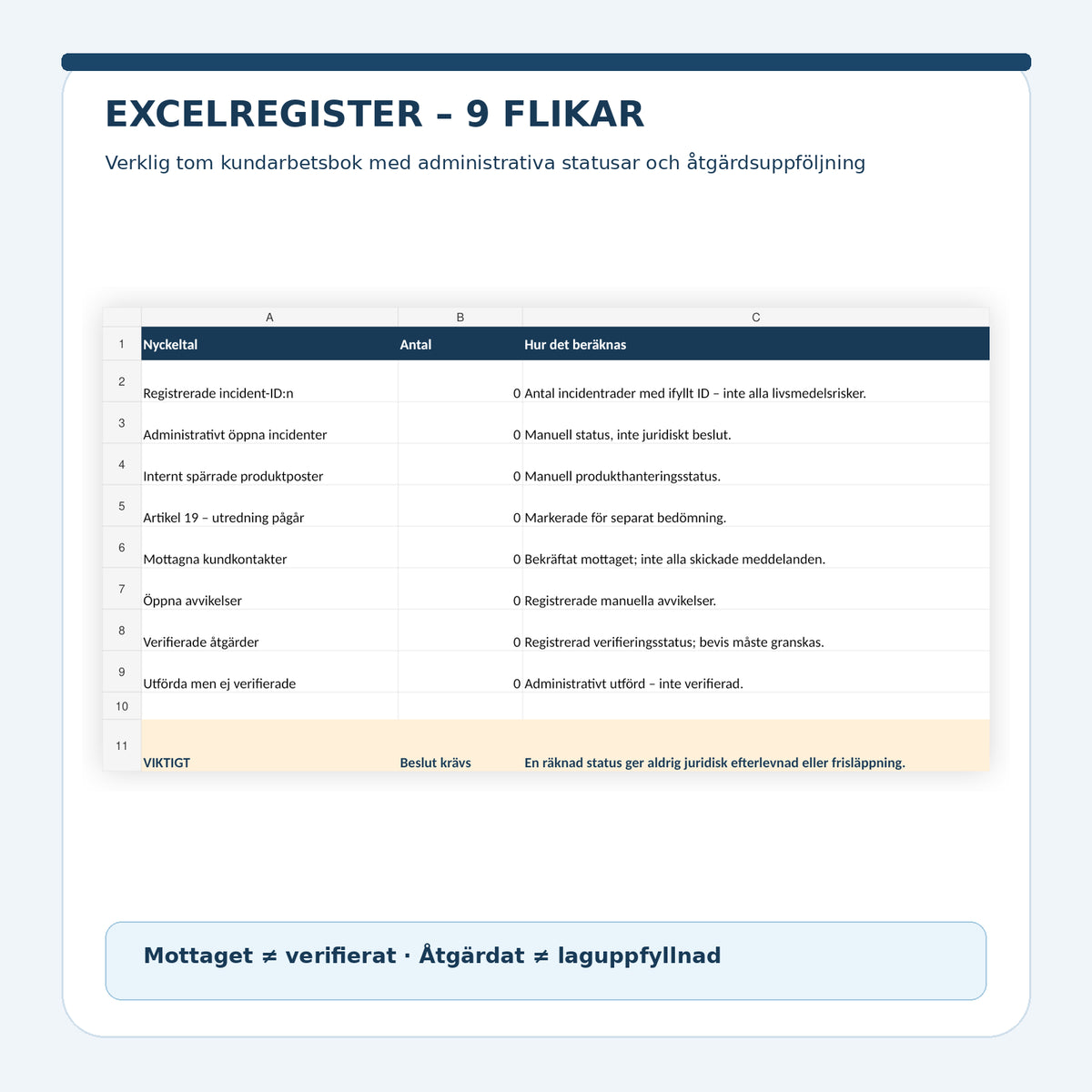
The workbook’s nine tabs: Read Me, Overview, Incidents, Ingredient Traceability, Risk Decisions, Communication, Non-Conformities, Actions, and Sources. Record actual incidents and their references, traceable ingredients, manual product decisions, documented contacts, and the actual status of actions.
The overview counts registered incidents, open incident statuses, manually held product items, Article 19 assessments under investigation, confirmed received contacts, open non-conformities, and actions marked as performed or verified. The formulas have been tested against specific fictional cases; the customer version is empty. No formulas determine whether the food is safe, whether Article 19 applies, or whether a case may be closed.
Workflow from discovery to verification
- Prioritise safety: If a serious allergic reaction is suspected, call 112. Stop the suspected service immediately if safety requires it.
- Document the facts: State the incident ID, time, dish, and exactly what the guest or staff member actually reported.
- Trace: Collect the current menu/recipe version, supplier details, batch, label, and information about any cross-contact.
- Assess separately: Make a decision on unsafe food, internal hold, other potentially affected parties, and the conditions of Article 19.
- Communicate: Contact the relevant recipients in the correct way; information that has not been confirmed must be explicitly described as uncertain.
- Correct and verify: Update the affected procedures, verify the result, and document the actual decision to close the case.
Legal requirements and situational limitations
Allergen information: Regulation (EU) 1169/2011, Articles 9.1(c), 21 and 44, and Annex II regulate mandatory information about substances that cause allergies or intolerances. For food that is not prepackaged, Swedish national rules affect how the information must be provided. The Swedish Food Agency explains the methods of providing information.
Food safety and traceability: Regulation (EC) 178/2002, Articles 14 and 18 regulate the prohibition of unsafe food and traceability obligations. Article 19 may entail requirements for withdrawal, notification of authorities, and a potential consumer recall when its respective conditions are met. A single report of a possible allergic reaction does not automatically make all actions mandatory. Sound judgment and the actual circumstances prevail.
HACCP and control: Regulation (EC) 852/2004, Article 5 concerns HACCP-based procedures and corrective actions. See also the Swedish Food Agency’s allergen guidance. The product’s forms do not replace the company’s own safety procedures.
Emergency care and data protection: According to 1177 on food allergies, serious symptoms require immediate medical attention. Health data may be particularly sensitive under GDPR Article 9; use only the personal data that is necessary and choose secure communication channels.
Difference from a general HACCP template
HACCP materials help a business design its preventive processes. This package, instead, concerns a specific suspected incident and the traceability, assessment, communication, and verification following the incident. The two functions complement each other without constituting duplicate versions of the same template.
Frequently asked questions
Is the restaurant always obliged to recall food in the event of an allergen complaint?
No, not automatically. Assess whether the food is or may be unsafe and whether the specific requirements of Article 19 are met. Document the reasons and contact the competent supervisory authority when required.
What do we do if a guest has a serious allergic reaction?
Prioritise immediate medical attention and call 112 in the event of serious symptoms. Document the incident only after the acute situation has been managed. The documents are not medical instructions.
Can Excel determine whether we can serve the food again?
No. Excel summarises manually recorded statuses. Decisions on food safety, hold, and any release require the actual assessment of the responsible person.
Can the template be used if the cause is still unknown?
Yes. It has specific fields for suspicion, source of fact, missing information, and manual investigation status. Unknown must never be interpreted as confirmed safe.
Are the PDF versions digitally fillable?
They are searchable and printable but are not interactive fillable forms. Edit the corresponding DOCX files and create your own final versions.
Is the entire package in English?
No. Five operational templates, the Swedish guide, and the Excel file are in Swedish. The English User Guide is a separate set of instructions in English for the Swedish documents.
Is the package approved by authorities or legally reviewed?
No. The documents have undergone internal AI-assisted legal source checking and technical file testing. No external legal review, food safety audit, or official certification is guaranteed.
Verified related resources
HACCP & Food Self-Monitoring for preventive procedures, as well as Allergens in Food Delivery for checking information in ordering apps.
Sources, product version, and transparency
Version 1.0, 17 November 2026. Internal AI-assisted legal source check on the same date. Key official sources: EU 1169/2011, EC 178/2002, EC 852/2004, the Swedish Food Agency, 1177. The sources do not constitute an endorsement of the product.