Svenska Dokumentmallar
Epoxy, acrylates & allergenic chemicals – exposure assessment, medical surveillance and work-related decisions | Word/PDF
Epoxy, acrylates & allergenic chemicals – exposure assessment, medical surveillance and work-related decisions | Word/PDF
- File format
- DOCX, PDF
- Document language
- Four Swedish work templates and a Swedish user guide
- Number of files
- 4
Digital download. No physical product is shipped.
Couldn't load pickup availability
About this template
Do you work with epoxy, acrylates, diisocyanates, or cyanoacrylate adhesives? Distinguish between the work steps that require medical control and those that also require a valid certificate of fitness for work. The package helps employers document exposure, offers, orders, work decisions, and follow-up.
Quick Facts
| Format | 5 DOCX and 5 searchable PDFs |
|---|---|
| Language | Swedish |
| Version | 1.0 |
| Delivery | Digital ZIP, one-time purchase |
| Legal Basis | AFS 2023:15, Chapters 4–5 |
Package Contents
- Exposure assessment – substance, classification, time limit, and documentation of negligible exposure.
- Offer and order – information, voluntary participation, and order documentation.
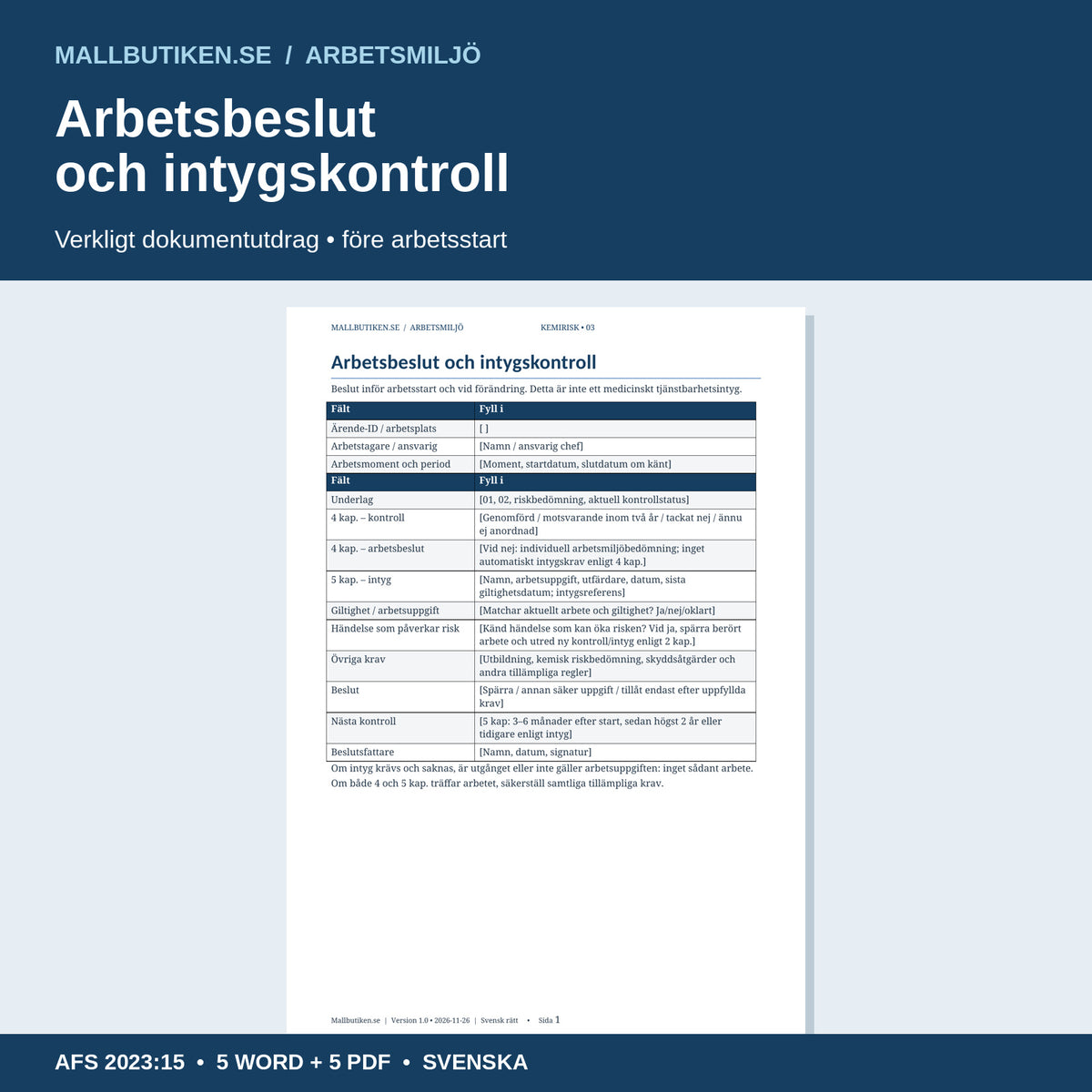
- Work decision and certificate check – actual validity, work task, and decision.
- Follow-up and documentation card – exposure, control status, measures, and deadlines.
- Swedish user guide with four fictional borderline cases.
What the Files Contain
| File | Function | Format |
|---|---|---|
| 01 Exposure assessment | Assessment of standard procedures | DOCX/PDF |
| 02 Offer and order | Information and control administration | DOCX/PDF |
| 03 Work decision | Certificate check and work decision | DOCX/PDF |
| 04 Follow-up | Documentation card and measures | DOCX/PDF |
| 05 User guide | Instructions, examples, and sources | DOCX/PDF |
Four Swedish work templates and a guide. DOCX files can be edited in a word processor that supports DOCX. PDFs are searchable print copies, not interactive forms. Excel files and medical certificates are not included.
Who Is the Package For?
Employers, occupational health and safety officers, and managers in manufacturing companies, workshops, construction companies, and salons. The package complements the chemical risk assessment and the Swedish Work Environment Authority's order forms. Other exposures, such as asbestos, lead, and night work, are assessed separately.
How to Use the Templates
- Identify substances and actual exposure using safety data sheets, risk assessments, and relevant documentation.
- Assess Chapters 4 and 5 separately. Document any exceptions without basing them solely on personal protective equipment or respiratory protection.
- Inform the employee and offer medical control. If necessary, order medical control from a doctor with the prescribed expertise.
- Check for a valid certificate of fitness for work where required. Prohibit work requiring a certificate if the certificate is missing or does not cover the task.
- Follow up on deadlines, feedback, and occupational health and safety measures. Limit access to necessary personal data.
Legal Boundaries
According to AFS 2023:15 Chapter 4, Sections 1–4, medical control applies to exposure to products classified as H317 or H334 due to acrylates, epoxy resin components, or formaldehyde resins. Medical control must be arranged before work, unless a corresponding control was carried out within two years before starting. New medical control is required if there are reported signs of illness or allergy under the conditions in Section 3. Chapter 5 covers, among other things, H334 due to diisocyanates or organic acid anhydrides, ethyl- or methyl-2-cyanoacrylate when working more than 30 minutes per week, and diisocyanates formed during thermal decomposition. Medical control with a certificate of fitness for work must be arranged before work, after 3–6 months, and thereafter at intervals of no more than two years, or earlier as specified in the certificate. A certificate that is already valid for the current work may replace a new medical control before starting work. Negligible exposure is assessed according to the specific conditions of the respective chapter, and the reasons must be documented in writing.
Fictional Example
A workshop uses an ethyl-2-cyanoacrylate adhesive for a total of 45 minutes per week. If the airborne exposure is not negligible according to Chapter 5, the employer must arrange medical control with a certificate of fitness for work. At exactly 30 minutes, the time criterion is not met, but other risks and regulations must still be assessed. None of the templates issue a certificate.
Frequently Asked Questions
Are certificates of fitness for work required for all work with epoxy?
No. For products covered by Chapter 4, medical control is required, but this is not a requirement for a certificate of fitness for work in itself. Other substances or regulations may still trigger a certificate requirement.
Is participation voluntary?
Yes. However, where a certificate is required, the employee may not perform the work without a valid certificate. If medical control under Chapter 4 is declined, the employer must conduct an individual occupational health and safety assessment.
Is respiratory protection sufficient to assess exposure as negligible?
No. Chapter 5 requires an assessment of airborne exposure without respiratory protection. For Chapter 4, an assessment without personal protective equipment is required.
Can the template replace a doctor's certificate of fitness for work?
No. It documents the employer's check of the actual certificate.
How often is follow-up required under Chapter 5?
Medical control 3–6 months after starting work and thereafter at intervals of no more than two years, or earlier as specified in the certificate.
Can I store diagnoses in the worksheet?
Avoid medical details. Document necessary administrative information and applicable certificates with limited access.
Sources and Scope
Swedish Work Environment Authority – AFS 2023:15 · AFS 2023:10 · Medical Control · Prevent – Chemical Guide. Internal legal source check November 26, 2026; no external legal review. Administrative work aid, not a medical assessment or guarantee of regulatory compliance.