Svenska Dokumentmallar
Battery Raw Materials 2027 – Due Diligence, Supplier Evidence and Risk Mitigation | Word/PDF/Excel
Battery Raw Materials 2027 – Due Diligence, Supplier Evidence and Risk Mitigation | Word/PDF/Excel
- File format
- DOCX, PDF, XLSX
- Document language
- Five Swedish operational templates and a Swedish user guide in DOCX/PDF plus a separate English User Guide in DOCX/PDF; one Swedish XLSX with nine tabs. The main templates are not in English.
- Number of files
- 7
Digital download. No physical product is shipped.
Couldn't load pickup availability
About this template
Can you show where the cobalt, lithium, nickel and natural graphite in your batteries come from – and what risks you have actually assessed and addressed? This specialised document package helps affected battery companies prepare and document raw material due diligence, supplier traceability, risk mitigation measures and audit evidence ahead of the EU's new application date.
Correct date and scope: Chapter VII of Regulation (EU) 2023/1542 covers, among other things, supplier traceability and social/environmental risks for the raw materials listed in Annex X. Through Regulation (EU) 2025/1561, the application of Article 48 is postponed until 18 August 2027. According to Article 47, not all companies are covered: check the economic operator's net turnover during the financial year preceding the latest, the 40-million-euro threshold and the group's consolidated turnover. Special exemptions also apply to certain batteries that were placed on the market earlier and are subsequently reused/reprocessed. Consolidated EU Battery Regulation · The 2025 Amendment.
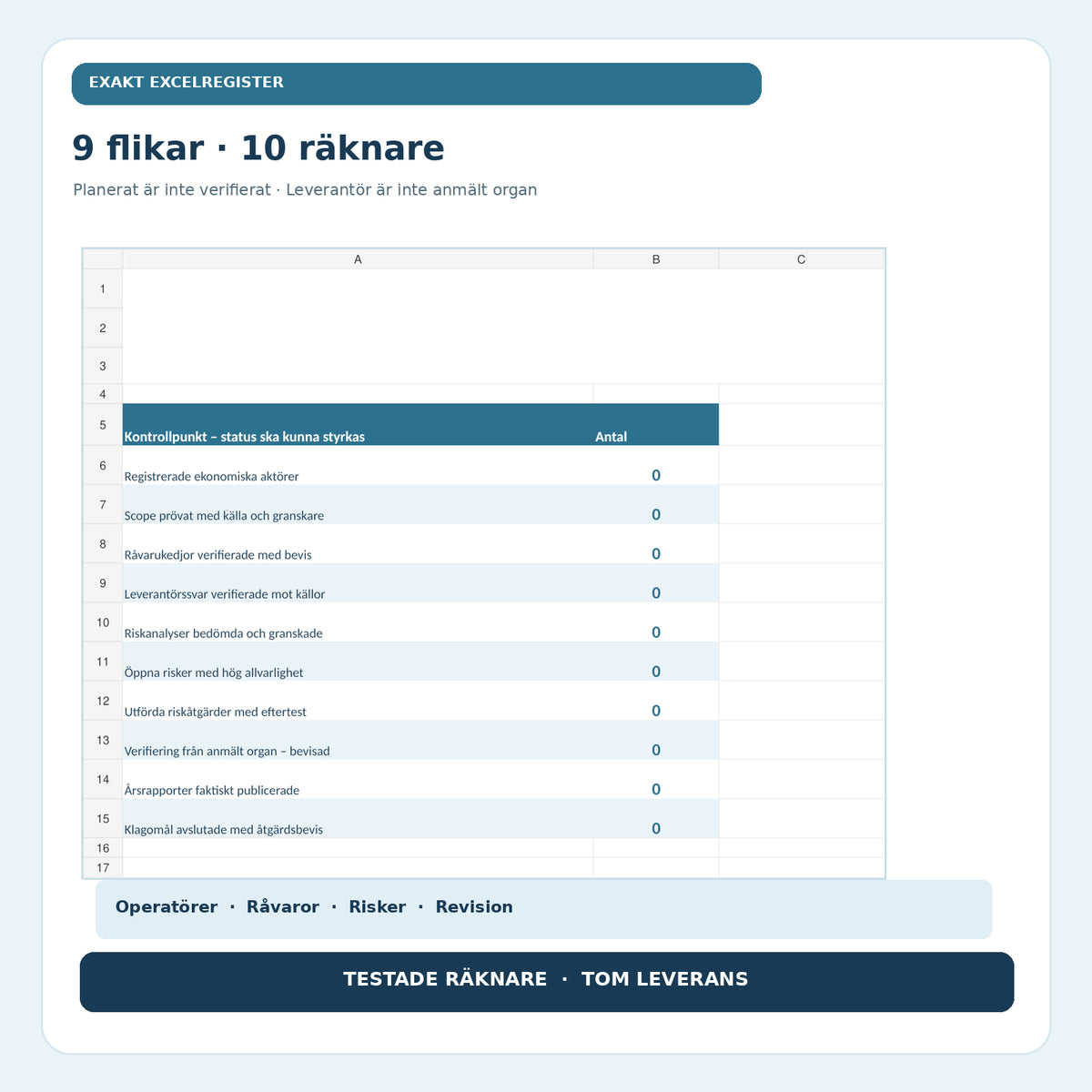
The delivery: A ZIP file with 15 customer files: 7 Word (DOCX), 7 corresponding searchable/printable PDFs and 1 Excel register (XLSX). Five Swedish operational documents, a Swedish user guide and a separate English User Guide. The Excel file has nine tabs and ten tested administrative summaries. The PDFs are not interactively fillable. Use compatible programs for Word/PDF/Excel.
01. Package contents
Five Swedish work templates, a Swedish user guide and a separate English User Guide, all as DOCX and searchable PDF (14 document files). In addition, a Swedish Excel register with nine tabs. Total of 15 files in the ZIP. The English guide is not an English version of the Swedish main documents.
02. What the files contain
Legal scope assessment and group threshold, raw material batch, supplier and upstream chain, proof of origin and chain of custody, risk identification according to Annex X, supplier letter and actual correction, complaint handling, audit report from a notified body when required, annual reporting and check of ten-year archiving.
For whom is the product relevant?
For battery manufacturers, importers, brand owners and other economic operators who place batteries on the EU market or put them into use and who are actually covered by Chapter VII. Particularly relevant for purchasing, sustainability officers, compliance, quality functions, supplier development and internal risk management.
Not for all small businesses: if the special turnover and group assessment shows that the operator is covered by the Article 47 exemption, the company should not be marketed as mandatorily covered. Other EU rules or contractual requirements may still be relevant, but should not be confused with Chapter VII.
Difference from Mallbutiken's other battery templates: EU Battery Regulation & Battery Passport is a broad compliance product with CE/QR and passport. Battery Passport – data owner and QR is about the passport's data points and access. This product focuses only on the raw materials' upstream chain, risk management and actual third-party evidence according to Articles 47–52.
Exact file by file
| Document | Practical function | Language | Format |
|---|---|---|---|
| 01. Applicability and responsibility | Turnover and group assessment according to Article 47, correct operator and application from 2027. | Swedish | DOCX + searchable PDF |
| 02. Raw materials and supply chain | Trace cobalt, lithium, nickel and natural graphite via upstream suppliers and proof of origin. | Swedish | DOCX + searchable PDF |
| 03. Risk assessment according to Annex X | Assess social and environmental risks with sources, uncertainties and management reporting. | Swedish | DOCX + searchable PDF |
| 04. Risk mitigation measures and supplier statements | Request improvements, document escalation, complaints and verified retesting. | Swedish | DOCX + searchable PDF |
| 05. Independent audit and publication | Check verification from a notified body, annual reporting, submission and archive. | Swedish | DOCX + searchable PDF |
| 06. Swedish user guide | Step by step, three scenarios, legal boundaries and source references. | Swedish | DOCX + searchable PDF |
| 07. English User Guide | English instructions for Swedish operational templates; no translated workbooks. | English | DOCX + searchable PDF |
| 08. Excel – raw material DD register | Nine tabs with evidence references and ten status calculations. | Swedish | XLSX |
The Excel register: nine tabs and ten status counters
Overview, Operators, Raw Materials, Suppliers, Risks, Measures, Audit, Publication and Read Me. The calculation sheet shows registered operators, source-based scope decisions, verified raw material chains, received supplier responses with evidence, documented risk assessments, open high-risk cases, completed measures with retesting, manually registered third-party reports, published annual reports with verification reference and closed complaints with evidence of action.
Important: Excel cannot check actual suppliers, detect human rights violations, verify raw materials or certify a company. The counters are based on manually entered statuses and evidence IDs. A status of "third-party verification" is not in itself actual verification. The templates have been tested with fictitious data which was then cleared; all ten counters are at zero in the customer file.
How you use the documents – seven steps
- Assess the correct operator. Document company, EU market role, turnover year, group and any exemptions according to Article 47.
- Identify affected raw materials. Check cobalt, natural graphite, lithium and nickel as well as relevant batteries and products.
- Trace the supply chain. Request sources for the material's trade name, suppliers and relevant steps back in the chain, with evidence that can be followed up.
- Assess Annex X risks. Document social and environmental negative impacts, actual source information, remaining uncertainties and internal reporting.
- Implement risk mitigation measures. Request corrections from suppliers, follow up on responses, assess escalation or termination of relationship in case of failed risk reduction and document complaint mechanism.
- Review independent requirements. For affected operators, Article 48.2 requires third-party verification from a notified body according to Article 51 and recurring audit; the templates can never replace this.
- Report and retain. Handle relevant external information requirements and annual report according to Article 52, as well as document retention according to Articles 48–49.
Legal details that are often missed
Article 47 – 40 million EUR: the starting point is net turnover during the financial year preceding the latest, with assessment of whether a parent/subsidiary group consolidated exceeds the threshold. Separate exemptions for already placed on the market and subsequently reused/reprocessed batteries may be relevant. The threshold is not the same as a general exemption from all battery legislation.
Article 49 – management and suppliers: requirements include a clear due diligence policy for raw materials, top management responsibility, supply chain controls, relevant supplier agreements and a complaint/remedy mechanism. The actual evidence must be collected outside this empty template.
Article 50 – risk management: relevant risks in Annex X shall be assessed, managed and followed up. A simple number in a risk matrix does not replace documented actual impact, measure or reporting to management.
Article 51 – notified body: the check of battery due diligence policy shall be carried out by an actual competent notified body. Self-report, consultant certificate, internal Excel signature or supplier response is not automatically an Article 51 approval decision.
Article 52 – information and publication: covered operators shall, under applicable conditions, provide relevant information to certain authorities and direct downstream buyers as well as regularly publish their due diligence report on the internet. Business secrets must be weighed against the obligation to provide information.
Articles 48.3 and 49.1 c – retention: among others, DD documentation shall be retained for ten years after the last battery manufactured under the relevant policy is placed on the market; the requirements for documentation of the management system must also be considered. Official consolidated regulation.
Frequently asked questions
Do the requirements start applying already during 2026?
No, the application of the special requirements according to Article 48.1 was moved to 18 August 2027 through EU 2025/1561. Preparation ahead of the deadline is voluntary but may be practically needed. Other already applicable rules may be relevant.
Must a company under 40 million EUR always follow the rules?
Not automatically – Article 47 has a specific turnover exemption. If the company belongs to a consolidated group that exceeds the threshold, the exemption cannot, however, be invoked so easily. Check the correct financial year.
Does this product also cover battery passport and QR?
No. It handles due diligence for battery raw materials and supplier risks separately, not the digital battery passport's QR and register system.
Can a supplier's self-declaration suffice as independent verification?
No, not if an Article 51 verification is required. A supplier certificate can be one of several sources in the risk work, but does not replace a notified body's report and decision.
Which metals shall be audited?
Annex X currently lists raw materials such as cobalt, lithium, nickel and natural graphite. Always check the consolidated legal act when actual application begins.
Does Excel send reports or check suppliers?
No. The workbook is a manual evidence and status register without integration with supplier systems, the EU Commission or notified bodies.
Are the main templates in English or the PDF files interactively fillable?
No. Five main templates are in Swedish. A separate English User Guide is available. The PDF files are searchable but not interactively fillable.
Legal sources, transparency and audit
Regulation (EU) 2023/1542, Chapter VII and Annex X · Regulation (EU) 2025/1561 on postponed application · EU Council decision on the time change.
Version 1.0 · AI-assisted legal source review on November 17, 2026. Word, PDF, Excel and ZIP have been technically checked. No external legal review, actual supplier audit, risk assessment of actual batteries, certification or verification by a notified body has been performed. The package is a tool for document management, not a claim that the user's business complies with the regulation.