

Svenska Dokumentmallar
Ergonomics 2026/2027 – Risk Assessment, Manual Handling & Display Screen Work Word/PDF
Ergonomics 2026/2027 – Risk Assessment, Manual Handling & Display Screen Work Word/PDF
 Downloading the template is available immediately after purchase. Our document templates are always delivered in customizable formats.
 If you are unsure which template is appropriate or how you should complete it, please see the relevant information under the 'Legal Information' tab in our main menu.
 Our templates are designed in accordance with current legislation and practice in each area to ensure that the documents you create are legally correct.


Couldn't load pickup availability
Ergonomics 2026/2027 – Risk Assessment, Manual Handling & Display Screen Work
This is a complete work environment package for employers who need to investigate, perform risk assessments, and implement measures for ergonomic loads. The package covers both physical work tasks and display screen work: working postures, work movements, lifting, carrying, pushing, pulling, repetitive work, hand-intensive work, visual conditions, variation, and recovery.
The template package was regularly reviewed on October 5, 2026, primarily against AFS 2023:10 ch. 6 on ergonomics, Appendix 5 on manual handling, AFS 2023:11 ch. 3 on display screens, and AFS 2023:1 on systematic work environment management.
Delivery: 6 separate documents in both Word (DOCX) and PDF – a total of 12 files and 12 A4 pages per format series.
Included in this package
- Risk Assessment – Ergonomics – 2 pages.
- Checklist – Manual Handling & Force Exertion – 2 pages.
- Action Plan – Ergonomics – 2 pages.
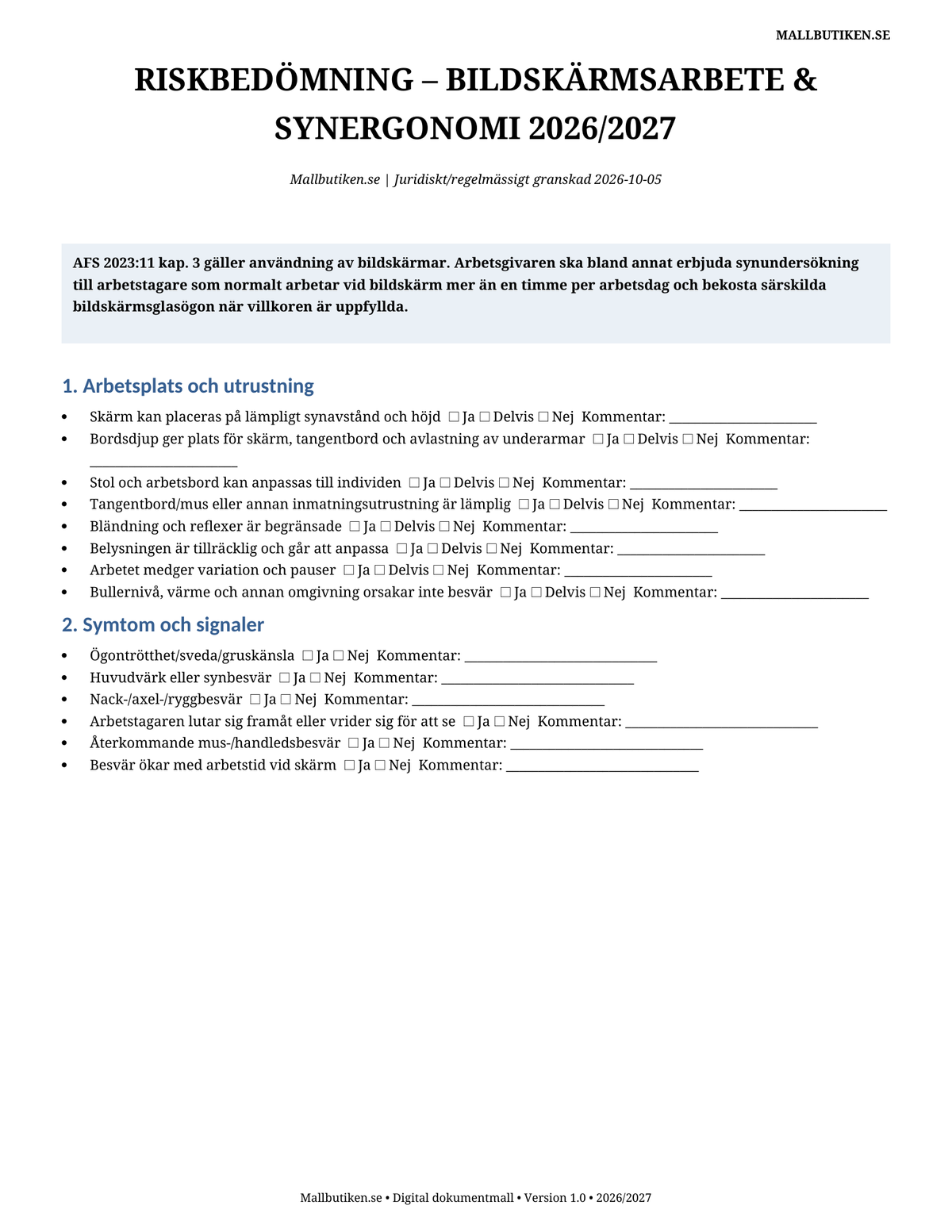
- Risk Assessment – Display Screen Work & Visual Ergonomics – 2 pages.
- Safety Instruction – Lifting, Carrying, Pushing & Pulling – 2 pages.
- Detailed User Guide – 2 pages.
What does ergonomics cover?
AFS 2023:10 ch. 6 applies to operations where employees may be exposed to loads or other conditions that may negatively affect the musculoskeletal system or vocal cords.
In the investigation, the employer must pay particular attention to:
- working postures,
- work movements,
- manual handling,
- repetitive work,
- hand-intensive work,
- visual conditions that may affect working postures and work movements.
Duration, frequency, and intensity
The risk assessment must not only ask if a load exists. It must also consider how long, how often, and how much the employee is exposed. Therefore, the main template contains separate fields for duration, frequency, and intensity.
The package also takes into account that physical, organizational, and social conditions can amplify the load, such as highly controlled work pace, insufficient recovery, lack of autonomy, or inadequate staffing.
Working postures and work movements
The risk assessment helps the employer to identify, among other things:
- prolonged or recurring work with a bent or twisted torso,
- work with hands above shoulder level or below knee level,
- force exertion in unfavorable working postures,
- static work,
- extreme or repetitive movements,
- visual conditions that cause the employee to compensate with poor working postures.
Manual handling – more than just heavy lifting
Manual handling includes all types of transport or movement of loads where the employee, for example, lifts, sets down, pushes, pulls, carries, or moves a load.
The separate checklist is built around the factors in AFS 2023:10 Appendix 5 and helps the operation assess:
- weight, size, stability, and grip of the load,
- distance between the load and the body,
- twisting of the torso,
- balance and footing,
- workspace and working height,
- carrying distance and level differences,
- frequency and duration,
- recovery and work pace,
- technical aids,
- individual and organizational factors.
No universal "maximum weight"
A single kilogram limit is not sufficient to determine if a lift is safe. The same weight can entail completely different levels of load depending on grip, working height, distance from the body, twisting, frequency, work environment, and the employee's physical capacity.
The template is therefore designed for a comprehensive assessment instead of providing a simplified universal maximum weight.
Measures should start at the source
The package follows the Swedish Work Environment Authority's basic prioritization. The employer should primarily:
- avoid health-hazardous or unnecessarily fatiguing manual handling,
- use technical aids and improve workplace design,
- review work organization, work pace, variation, and recovery,
- train and inform the employees.
The safety instruction does not, therefore, replace the need to technically and organizationally reduce the load.
Repetitive, highly controlled, or constrained work
AFS 2023:10 states that such work should normally not occur. When it must be performed, the employer shall prevent health-hazardous or unnecessarily fatiguing loads through, for example:
- job rotation,
- job enlargement,
- breaks and recovery,
- increased variation in physical load,
- greater opportunity to influence planning and execution.
Separate action plan
Once risks have been identified, decided measures need to be followed from decision to actual effect. The action plan therefore contains fields for:
- identified risk or deficiency,
- technical or organizational measure,
- person responsible,
- start and deadline,
- priority,
- follow-up date,
- effect on exposure and symptoms,
- any new risks.
Display screen work & visual ergonomics
The package also includes a separate risk assessment for computer and display screen work. It covers, among other things:
- screen height and viewing distance,
- desk depth and forearm support,
- chair and desk,
- keyboard, mouse, and other input equipment,
- glare and reflections,
- lighting,
- variation and breaks,
- eye, head, neck, shoulder, and wrist complaints.
Eye examination for display screen work
AFS 2023:11 contains specific rules on eye examinations for display screen work. The employer shall offer an eye examination to employees who normally work at a display screen for more than one hour per workday, arrange regular examinations, and offer a new examination when symptoms may be related to the visual requirements of the work.
Special display screen glasses
If the eye examination shows that the employee needs special glasses fitted for display screen work and the glasses normally used do not work for the job, the employer must cover the cost according to the regulations.
This is handled in the template as a separate control point so that the vision issue is not overlooked in the other ergonomic assessments.
Safety Instruction – Lifting, Carrying, Pushing & Pulling
The practical instruction can be used for specific work tasks and contains control points for:
- load weight, shape, and stability,
- planning of route and destination,
- technical aids,
- working height and space,
- coordinated lifting,
- pushing and pulling,
- stop criteria,
- documented briefing with affected employees.
When should work be stopped or reconsidered?
The instruction contains specific stop criteria for situations where:
- aids are missing or broken,
- the load is unstable or unknown,
- the route or surface is unsuitable,
- the force required is greater than planned,
- pain, numbness, or other symptoms occur,
- the work deviates from the risk assessment.
When should an expert ergonomist be consulted?
Occupational health services, an ergonomist, or other expert help should be used when one's own competence is insufficient, when employees already have symptoms, when the load is complex, or when a more advanced evidence-based assessment method needs to be used.
Which businesses is the package suitable for?
The templates can be adapted for many industries, such as:
- industry and production,
- warehousing and logistics,
- construction and civil engineering,
- healthcare and care,
- retail and service,
- transport,
- office and administrative work,
- remote and hybrid work,
- workshop and maintenance.
Legally/regularly reviewed for 2026/2027
The documents were reviewed on October 5, 2026, based on, among other things:
- AFS 2023:10 ch. 6 – Ergonomics.
- AFS 2023:10 Appendix 5 – Influencing factors for manual handling.
- AFS 2023:11 ch. 3 – Use of display screens.
- AFS 2023:1 – Systematic work environment management.
- The Work Environment Act (1977:1160).
Format and delivery
- 6 documents.
- 12 files in total.
- Word (DOCX) + PDF.
- 12 A4 pages per format series.
- Digital product – no physical item is sent.
Frequently asked questions
Must the risk assessment be in writing?
Work environment risks must be handled within the scope of systematic work environment management, and risk assessments must be documented in writing according to AFS 2023:1.
Is there a fixed maximum weight for lifting?
Not as a universal rule. The risk assessment must weigh several factors simultaneously.
Is manual handling included?
Yes. A separate two-page checklist based on the factors in AFS 2023:10 Appendix 5 is included.
Is display screen work included?
Yes. The package contains a separate risk assessment for display screen work and visual ergonomics.
When should the employer offer an eye examination?
The Swedish Work Environment Authority states that those who normally work at a computer or display screen for at least one hour per day must be offered an eye examination.
Does the package replace an ergonomist?
No. For complicated loads or symptoms, expert ergonomic competence may be needed.
Important
The templates are general work environment documents and must be adapted to the actual workplace, work tasks, and employee exposure. In the case of complex or serious load risks, occupational health services, an ergonomist, or other expert help should be used.