Svenska Dokumentmallar
Noise & Vibrations in the Work Environment 2026/2027 – Risk Assessment, Exposure Register & Action Plan Word/PDF
Noise & Vibrations in the Work Environment 2026/2027 – Risk Assessment, Exposure Register & Action Plan Word/PDF
- File format
- DOCX, PDF
- Document language
- Swedish
- Number of files
- 6
Digital download. No physical product is shipped.
Couldn't load pickup availability
About this template
Noise & Vibrations in the Work Environment 2026/2027 – Risk Assessment, Exposure Register & Action Plan
This is a complete work environment package for employers who need to assess, perform risk assessments, measure, document, and reduce exposure to noise and vibrations. The package covers noise, hand-arm vibrations, and whole-body vibrations, and is designed to be used as a practical component of systematic work environment management.
The template package was regularly reviewed on October 5, 2026, primarily against AFS 2023:10 ch. 2–3, AFS 2023:15 regarding medical check-ups for vibrations, and AFS 2023:1 regarding systematic work environment management.
Delivery: 6 separate documents in both Word (DOCX) and PDF – a total of 12 files and 12 A4 pages per format series.
Included in this package
- Risk Assessment – Noise & Vibrations – 2 pages.
- Noise Exposure – Measurement & Action Register – 2 pages.
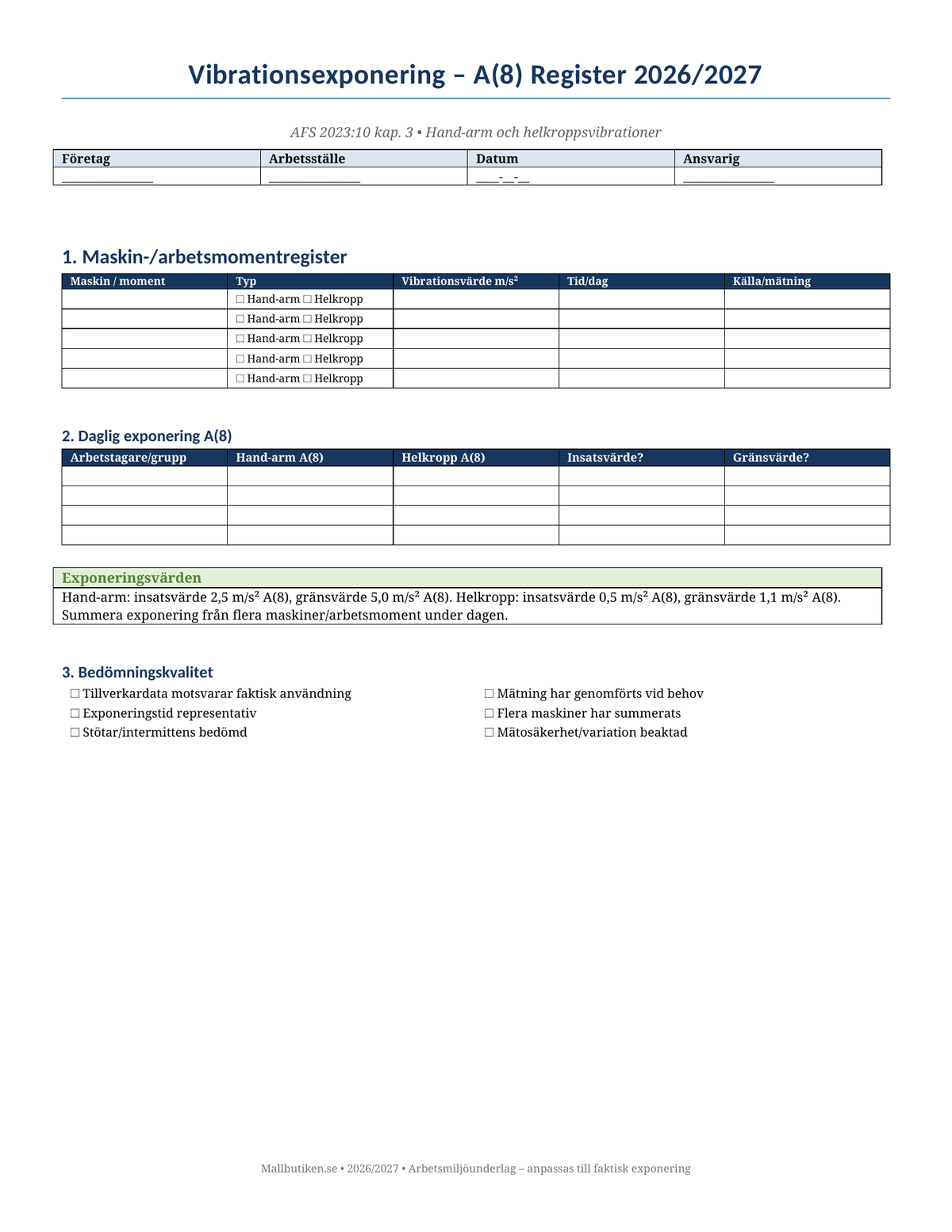
- Vibration Exposure – A(8) Register – 2 pages.
- Action Plan – Noise & Vibrations – 2 pages.
- Safety Instruction – Noise & Vibrations – 2 pages.
- Detailed User Guide – 2 pages.
Noise – action values and limit values
AFS 2023:10 contains clear exposure values for noise. The package includes these directly in the templates:
- Daily noise exposure level LEX,8h: lower action value 80 dB, upper action value 85 dB, and limit value 85 dB.
- Maximum A-weighted sound pressure level LpAFmax: upper action value 115 dB and limit value 115 dB.
- Peak value LpCpeak: action value 135 dB and limit value 135 dB.
When assessing against action values, the employer must not subtract the attenuation of hearing protection. When assessing against limit values, the attenuation of hearing protection may be taken into account when hearing protection is worn.
Measurement and exposure assessment
The employer must assess noise exposure and, if necessary, conduct measurements to clarify whether action values or limit values are reached or exceeded.
The noise register therefore contains fields for:
- work tasks and location,
- LEX,8h,
- LpAFmax,
- LpCpeak,
- measurement method and date,
- classification against action and limit values.
The risk assessment covers more than decibels
In the noise risk assessment, the employer also needs to consider:
- level, type, and duration, including impulse noise,
- particularly sensitive employees,
- interaction between noise and ototoxic substances,
- interaction between noise and vibrations,
- risk of masking warning signals or other important communication,
- manufacturer data and the possibility of choosing quieter equipment,
- results from hearing tests,
- selection and attenuation of hearing protection.
Lower action value – information and access to protection
When noise exposure reaches or exceeds the lower action value, the employer must provide the affected employees with information and training on the risks and how to prevent them.
If the risks cannot be prevented in other ways, hearing protection must be made available from the lower action value.
Upper action value – active action level
When exposure reaches or exceeds any of the upper action values, the employer must investigate the cause and take measures to reduce the exposure.
At this level, the following must be done, among other things:
- hearing protection must be used when risks cannot be prevented in other ways,
- mandatory signs for hearing protection must be present where the requirements are met,
- the area should be cordoned off and access limited if possible,
- hearing tests must be offered to affected employees.
Hearing test
The employer must offer a hearing test to employees exposed to noise that reaches or exceeds any of the upper action values.
Hearing tests should also be offered at levels from the lower action value when the risk assessment and exposure assessment indicate a risk of hearing damage.
The package's noise register therefore contains a separate follow-up section for offered hearing tests, results accessible to the employer, and decided work environment measures.
If hearing damage is detected
If a hearing test shows hearing damage and it is assessed as likely due to noise at work, the employer needs to, among other things, revise the risk assessment and measures, consider other employment without continued harmful exposure, and manage the need for examinations for other employees with similar exposure.
Vibrations – hand-arm and whole-body
AFS 2023:10 specifies the following daily exposure values A(8):
- Hand-arm vibrations: action value 2.5 m/s² and limit value 5.0 m/s².
- Whole-body vibrations: action value 0.5 m/s² and limit value 1.1 m/s².
The package's vibration register has specific sections for both hand-arm and whole-body.
Calculate the total daily A(8) exposure
An employee may use several vibrating machines or vehicles during the same workday. Exposure therefore needs to be assessed for each part-task and then combined into the total daily A(8) exposure.
The register contains fields for:
- machine or work task,
- type of vibration,
- vibration value,
- usage time per day,
- source or measurement,
- final A(8) assessment per employee or group.
Manufacturer data or measurement?
Vibration exposure can, under certain conditions, be estimated based on relevant manufacturer data combined with the actual usage time. If the data is not representative or if the uncertainty is too high, measurement may be needed.
The template therefore contains checkpoints for:
- whether manufacturer data corresponds to actual usage,
- whether measurement has been carried out where necessary,
- whether exposure time is representative,
- whether several machines have been summed up,
- whether shocks and intermittent exposure have been considered.
Measures for vibrations
When vibration exposure exceeds the action value, or when the risk assessment otherwise warrants it, the employer must reduce the exposure.
Examples of measures that the template package helps to plan:
- alternative work methods,
- equipment with a lower vibration level,
- damping seats or handles,
- maintenance of equipment and workspace,
- improved workplace design,
- training in correct use,
- limited exposure time and job rotation,
- sufficient rest periods,
- protection against cold and moisture during hand-arm exposure.
Limit values must not be exceeded
If a vibration limit value is exceeded nonetheless, the employer must immediately:
- reduce exposure so that it is below the limit value,
- investigate the cause of the exceedance,
- take measures to prevent it from happening again.
The same basic principle applies to noise: employees must not be exposed above noise limit values.
Medical check-up for hand-arm vibrations
AFS 2023:15 requires a medical check-up for employees exposed to hand-arm vibrations when:
- exposure exceeds the action value of 2.5 m/s² A(8),
- exposure occurs in a way that gives reason to suspect a risk of ill health, or
- similar exposure has caused or given reason to suspect a vibration injury in another employee.
According to the regulation, the check-up should normally be carried out before the employee is assigned to the work and thereafter periodically at intervals of no more than three years. For new or worsening signs of vibration injury, there are specific time requirements.
Specific symptoms to report
The safety instruction reminds employees to report, among other things:
- numbness and tingling,
- white fingers,
- impaired sensation,
- pain in hands/arms,
- back or neck problems with whole-body vibrations,
- tinnitus or other new/worsened hearing impairment.
Action hierarchy – start at the source
The separate action plan prioritizes:
- eliminate or replace noisy/vibrating methods,
- technical measures,
- organizational measures,
- personal protective equipment for remaining noise risk.
Hearing protection is important when needed but should not be used as a substitute for technical and organizational measures that can reasonably be implemented.
Effect check after measures
The package contains specific fields for comparing pre- and post-values and documenting whether the measure has actually reduced exposure. This turns the action plan into an active work environment tool instead of a list of completed activities.
Complements Medical Check-ups in Working Life
This product focuses on risk assessment, exposure assessment, measurement, and actions. It complements the Mallbutiken separate product Medical Check-ups in Working Life 2026/2027, which focuses on administration, registers, ordering documentation, and follow-up of medical check-ups and fitness certificates.
Legally/regulation-wise reviewed for 2026/2027
The documents were reviewed on October 5, 2026, based on, among others:
- AFS 2023:10 ch. 2 – noise.
- AFS 2023:10 ch. 3 – vibrations.
- AFS 2023:10 appendix 2–4 – calculation and exposure values for vibrations.
- AFS 2023:15 ch. 3 §§ 1–3 – medical check-ups for vibrations.
- AFS 2023:1 – systematic work environment management.
- The Work Environment Act (1977:1160).
Format and delivery
- 6 documents.
- 12 files in total.
- Word (DOCX) + PDF.
- 12 A4 pages per format series.
- Digital product – no physical item is sent.
Frequently asked questions
Is 85 dB always allowed if hearing protection is used?
No. 85 dB is both the upper action value and limit value for daily noise exposure, but the rules differ between how action values and limit values are assessed. For action values, hearing protection attenuation is disregarded.
Must noise always be measured?
The employer must assess the exposure and take measurements to the extent necessary to determine whether action values or limit values are reached or exceeded.
Can manufacturer data be used for vibrations?
Yes, when the data is relevant to the actual usage. Otherwise, measurement or other better exposure assessments may be needed.
Must several vibrating machines be added together?
Yes. The total daily exposure must be assessed when the employee uses several vibrating machines or vehicles.
When is a medical check-up required for vibrations?
Among other instances, when hand-arm exposure exceeds the action value or when there are specific reasons to suspect vibration-related ill health.
Does the package replace professional measurement?
No. When the operation's own assessment is not sufficient, expert measurement or occupational health services should be used.
Important
The templates are general work environment materials. The actual assessment must be adapted to work tasks, machines, exposure patterns, measurement uncertainty, and the employees' individual conditions. In cases of complicated exposures or values close to action/limit values, competent measurement expertise or occupational medical assistance should be sought.