Svenska Dokumentmallar
Drinking Water Seals 2026/2032 – EU Positive List, Migration Test & Supplier Certificate | Word/PDF/Excel
Drinking Water Seals 2026/2032 – EU Positive List, Migration Test & Supplier Certificate | Word/PDF/Excel
- File format
- DOCX, PDF, XLSX
- Document language
- Five Swedish work templates one Swedish user guide and English User Guide; Excel in Swedish
- Number of files
- 7
Digital download. No physical product is shipped.
Couldn't load pickup availability
About this template
Do you manufacture, import or sell rubber seals, O-rings and gaskets for drinking water? From 31 December 2026, a common EU system for hygiene requirements, approved substances, testing of finished materials and conformity assessment will begin to apply. This affects supplier certificates for, for example, seals in mixers, valves, pipe fittings, pumps and water meters. At the same time, there are special, conditional transitional rules until 31 December 2032 that are often misunderstood.
This niche document package in Word, PDF and Excel has been developed to collect and review EU positive list items for rubber recipes, testing documentation for primary/secondary amines and N-nitrosamines, national certificates, model and batch tracking, and control of recipe changes. It does not replace laboratory tests, a valid national/EU hygiene certificate or a formal EU declaration of conformity.
Quick Facts
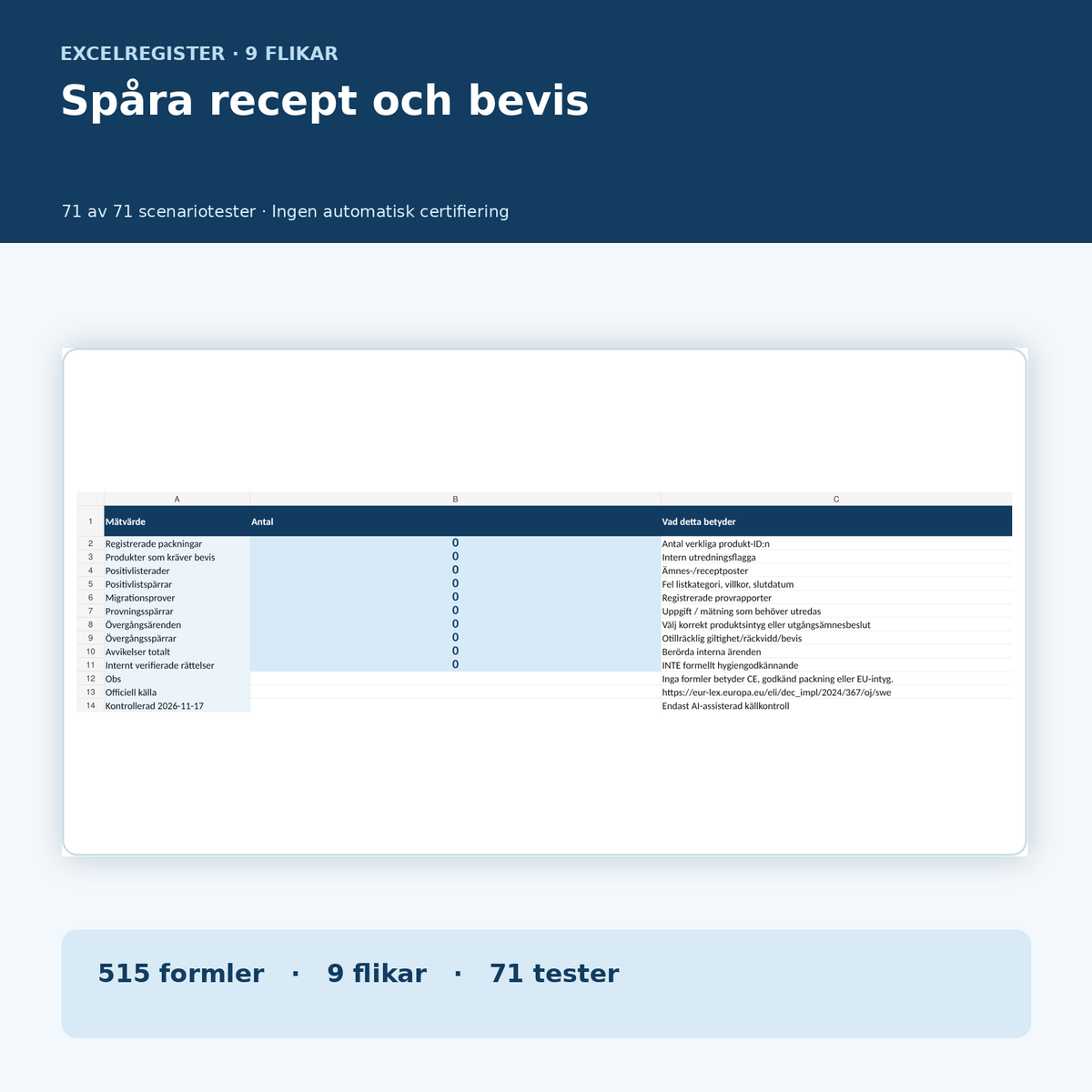
SEK 79 · Digital download (ZIP) · 15 customer files. Five Swedish work templates, one Swedish user guide and one English User Guide – all seven documents in editable Word (DOCX) and searchable, printable PDF. In addition, a Swedish Excel register with nine tabs and 515 control formulas. Total 7 DOCX + 7 PDF + 1 XLSX. The PDF copies are not electronically fillable; the English guide provides instructions for the Swedish work templates, not additional English work forms.
01. Package Contents
Five Swedish operational documents for product scope, EUPL recipe control, rubber-specific migration tests, supplier certificates, and non-conformance/batch blocking. One Swedish guide, one English guide, and an Excel register with nine tabs. The documents are available in 7 Word, 7 searchable PDF and 1 Excel, totaling 15 actual customer files.
02. What the Files Contain
Fields for gasket model, SKU, material family, supplier, recipe revision, EUPL number, CAS/EC number, approved material category, substance conditions, migration test, PAA, N-nitrosamines, secondary amines, test group, national product certificate validity, national substance decision, batch number, correction, and independent verifier. Excel provides administrative flags such as “BLOCK – POSITIVE LIST”, “BLOCK – RUBBER TEST”, “INVESTIGATE – TRANSITION” and “RUBBER TEST – MANUAL”, never automatic approval.
Who Needs the Template?
For Swedish plumbing importers, sanitary ware manufacturers, seal manufacturers, rubber companies, suppliers of O-rings and spare parts, quality managers, buyers and wholesalers who need to show what data they have requested and verified for gasket materials in contact with drinking water. The product is particularly suitable when a sub-supplier provides a general material certificate for “EPDM” without full traceability between the recipe, substance items, tested gasket variant, and its actual product batch.
All Files
| File | Practical Function | Format |
|---|---|---|
| 01. Scope and Product | Gasket, lot, material family, water contact, first EU market, and separate 2026/2032 testing. | Word + searchable PDF (Swedish) |
| 02. Positive List and Recipe | CAS, EUPL number, material category, conditions of use, expiry date, and supplier evidence for the relevant constituent substance. | Word + searchable PDF (Swedish) |
| 03. Rubber Migration and Nitrosamines | Test plan, PAA, secondary amines, N-nitrosamines, risk group, TOC, EMG, and laboratory references. | Word + searchable PDF (Swedish) |
| 04. Supplier Request and Transition | Formal supplier letter regarding model-unique test reports, national hygiene certificate, and EU declaration where relevant. | Word + searchable PDF (Swedish) |
| 05. Non-conformance and Internal Block | Recipe change, affected batches, actions, verifier, evidence ID, and independent release testing. | Word + searchable PDF (Swedish) |
| 06. Swedish User Guide | Legal dates, difference between two transitional rules, five scenarios, and workflow. | Word + searchable PDF (Swedish) |
| 07. English User Guide | English instructions for the Swedish work templates and Excel register. | Word + searchable PDF (English Guide) |
| 08. Excel Register | Nine tabs: Read Me, Overview, Rules, Gaskets, Positive List, Testing, Transition, Non-conformances, and Evidence. | XLSX (Swedish) |
What New EU Rules Apply from 31 December 2026?
EU 2024/367 – Positive List for Organic Substances
Implementing Decision (EU) 2024/367 specifies the European positive lists for, among other things, substances in organic materials. Annex I contains individual substances and substance groups with information on the EUPL number, identity, permitted material category (e.g., rubber), conditions of use, any limits, and the date the list item ceases. A substance may be included for a certain material category but not necessarily for another. Ingredients in a gasket mixture must also be assessed.
Important difference: the presence of an ingredient on the EU positive list does not mean that the entire rubber recipe or the finished O-ring is approved. The template therefore keeps the recipe and substance evidence separate from the final material's laboratory report and the finished product's formal documents.
EU 2024/368 – Migration and Testing of Finished Rubber
Implementing Decision (EU) 2024/368, Annex I, specifies the testing and acceptance of finished organic materials used in products in contact with water. Depending on the product and risk group, this includes, among other things, recipe review, migration of relevant and unexpected substances, total organic carbon (TOC), odor/taste, color/turbidity, enhanced microbial growth (EMG), and residues.
For rubber, Annex I, Table 3 contains specific criteria for three substance groups:
- Primary aromatic amines (PAA): the sum must not be detectable at LOD 0.1 µg/l.
- Secondary amines: the sum's MTCtap is 250 µg/l.
- N-nitrosamines: the sum must not be detectable at LOD 0.1 µg/l.
These are legal testing criteria, not finished measurements for a customer's product. MTCtap is an assessment value at the tap; an arbitrary laboratory concentration in mg/kg or µg/l cannot be compared without a relevant testing method, risk group, water contact geometry, and expert assessment. Excel flags documentation deficiencies and visible limit value issues but does not perform accredited testing or complete MTCtap calculation.
EU 2024/370 – Finished Product Conformity
Delegated Regulation (EU) 2024/370 regulates procedures for assessing product conformity and the bodies concerned. It applies from 31 December 2026, with a special conditional exemption in Article 11 for certain products with a national hygiene certificate. The regulation's annex contains a model for an EU declaration that requires, among other things, an identifiable product, manufacturer, applicable specifications, and relevant information about the notified body.
Two Completely Different Transitional Rules Until 2032
1. Existing National PRODUCT Certificate – Article 11 in 2024/370
For a product that has been assessed according to national hygiene requirements, and whose national certificate of conformity is still valid on 31 December 2026, 2024/370 may only begin to apply to the product from 31 December 2032. Control is required of the certificate's actual validity, exactly which material/product model the certificate covers, and other applicable conditions. An old quote, invoice, or brochure is not sufficient as a national product certificate.
2. Nationally Approved SUBSTANCE – Article 3 in 2024/367
A separate rule applies to substances, mixtures, or components that were approved by the competent member state authority during the period 13 July 2021–31 December 2026. Under the conditions in Article 3, such substances may be used until 31 December 2032, among other things, provided that the parameter value for lead at the tap, 5 µg/l, is met. This is not the same as a valid national certificate for the finished product.
Boverket also states that the regulations cover materials to be used in new installations as well as the repair/reconstruction of installations for the extraction, preparation, storage, and distribution of drinking water. There is no general requirement to replace already installed materials simply because of the new product rules.
Excel – Nine Tabs, 515 Formulas, and 71 Tests
Read Me · Overview · Rules · Gaskets · Positive List · Testing · Transition · Non-conformances · Evidence. The workbook has 515 formulas and prepared rows for the customer's actual data. The positive list tab separates the EUPL reference, material category, conditions of use, and list item date. The testing tab handles separate data on PAA/N-nitrosamines that are not detectable at the specified LOD, as well as the expertly assessed sum of secondary amines. The transition tab keeps the national product certificate separate from the national substance decision. Even if all administrative fields are filled in, the status concludes with “MANUAL” for expert review.
71 out of 71 scenario tests are approved. Among others, the limits of 0.1 µg/l and 250 µg/l, missing laboratory evidence, elevated LOD values, incorrect positive list category, expired certificate, and changed recipe have been tested. The test data are not included in the customer file.
How to Use the Package
- Identify the actual gasket model, material family, batch, water contact, and first EU market placement.
- Request recipe and substance documentation, CAS/EC, EUPL number, and list version.
- Verify the correct material category, conditions, and expiry date for relevant substances.
- Request testing of finished organic material according to the actual product's risk group.
- For rubber: specifically check PAA, secondary amines, and N-nitrosamines, as well as the laboratory method and LOD.
- Verify whether an actually valid national product certification or an actual national substance approval can support the correct transitional rule.
- Record evidence, product batches, and changes in Excel.
- Block non-conforming batches and have an independent control function verify the completed actions before a separate formal decision.
Frequently Asked Questions
Are all EPDM gaskets approved for drinking water?
No. EPDM is a material family, not an approval of a specific recipe or a finished gasket. For the product in question, relevant substances, their material categories, and the testing/conformity of the finished product need to be verified.
Is 0.1 µg/l a generally permitted concentration for all nitrosamines?
No. For rubber, Annex I, Table 3 prescribes that the sum of N-nitrosamines must be not detectable at LOD 0.1 µg/l. It is not a generally permitted concentration value or a requirement that can be verified by writing zero in Excel.
What is the limit for secondary amines?
Annex I, Table 3 specifies MTCtap 250 µg/l for the sum of secondary amines. The value must be assessed using the correct method and water contact scenario, not just from a standalone laboratory result.
Can we continue to sell gaskets with old Swedish certificates until 2032?
Only if the actual product and a valid national hygiene certificate meet the transitional rule in Article 11 of 2024/370. Check that the certificate was still valid on 31 December 2026 and that the correct model is covered. There is no automatic time limit for all older stock.
Can a positive-listed substance replace testing of finished rubber?
No. The substances on the positive list according to 2024/367, testing of finished material according to 2024/368, and product conformity according to 2024/370 are different control steps.
Does the property owner need to replace all already installed gaskets?
No, according to Boverket's guidance, there is no general requirement to replace already installed materials solely because of these new rules. The rules do, however, cover affected materials in new installations and during repair/reconstruction.
Is Excel a valid hygiene certificate or testing certificate?
No. The register compiles evidence and warning flags. It does not perform laboratory analysis, issue an EU declaration, or verify a notified body's decision.
Related Mallbutiken Products
Drinking Water Marking 2026/2032 – Hygiene Certificates, Mixers, and Batch Blocking covers hygiene certificates and drinking water marking for, among other things, mixers. Shut-off Valves and Valve Marking – Control Log covers the operation and control log for valves. Legionella Control and Hot Water Log covers legionella and hot water operation. This product is specifically focused on rubber O-rings, the positive list, amine/nitrosamine migration, and the supplier's model-unique chemical evidence.
Sources, Version Date, and Limitations
Version 1.0 · AI-assisted legal source review November 17, 2026. Legal sources: Decision 2024/367, Articles 1–4 and Annex I; Decision 2024/368, Annex I and rubber-specific Table 3; Regulation 2024/370, Article 11 and Annex; Boverket's information on materials in contact with drinking water. No external legal review, accredited laboratory testing, actual EU hygiene certification, market surveillance, or assessment of an actual product has been performed. Always assess current Swedish/EU law and the actual product's material, contact environment, and certificates. Digital delivery as a ZIP without authority integration.