Svenska Dokumentmallar
DSA Article 24.5 – transparency database, personal data verification and proof of submission | Word/PDF/Excel
DSA Article 24.5 – transparency database, personal data verification and proof of submission | Word/PDF/Excel
- File format
- DOCX, PDF, XLSX
- Document language
- Five Swedish operational templates in DOCX/PDF Swedish user guide DOCX/PDF and separate English User Guide DOCX/PDF. Swedish Excel workbook with nine tabs. No full English version of the operational templates.
- Number of files
- 7
Digital download. No physical product is shipped.
Couldn't load pickup availability
About this template
How does an online platform document that moderation decisions and statements of reasons have actually been submitted to the EU Commission's DSA Transparency Database? This package is designed for compliance officers, moderation teams, security functions, and data protection officers at online platforms covered by DSA Article 24.5.
The practical work involves more than writing a decision: the online platform must assess which decisions should be submitted, map them to the Commission's current technical schema, ensure that no personal data is transferred, use the correct production channel, and verify the Commission's actual receipt. The templates are a manual documentation aid, not software that sends or automatically anonymizes data.
Package contents
7 Word + 7 PDF + 1 Excel = 15 customer files. Five Swedish working templates (scope/onboarding, decisions and schema fields, PII check, submission/receipt, and error handling), a Swedish guide, and a separate English User Guide. Each document is delivered both as an editable DOCX and as a text-searchable, printable PDF. In addition, there is a Swedish Excel workbook with nine tabs. The PDF versions do not have interactive fillable fields.
What the files contain
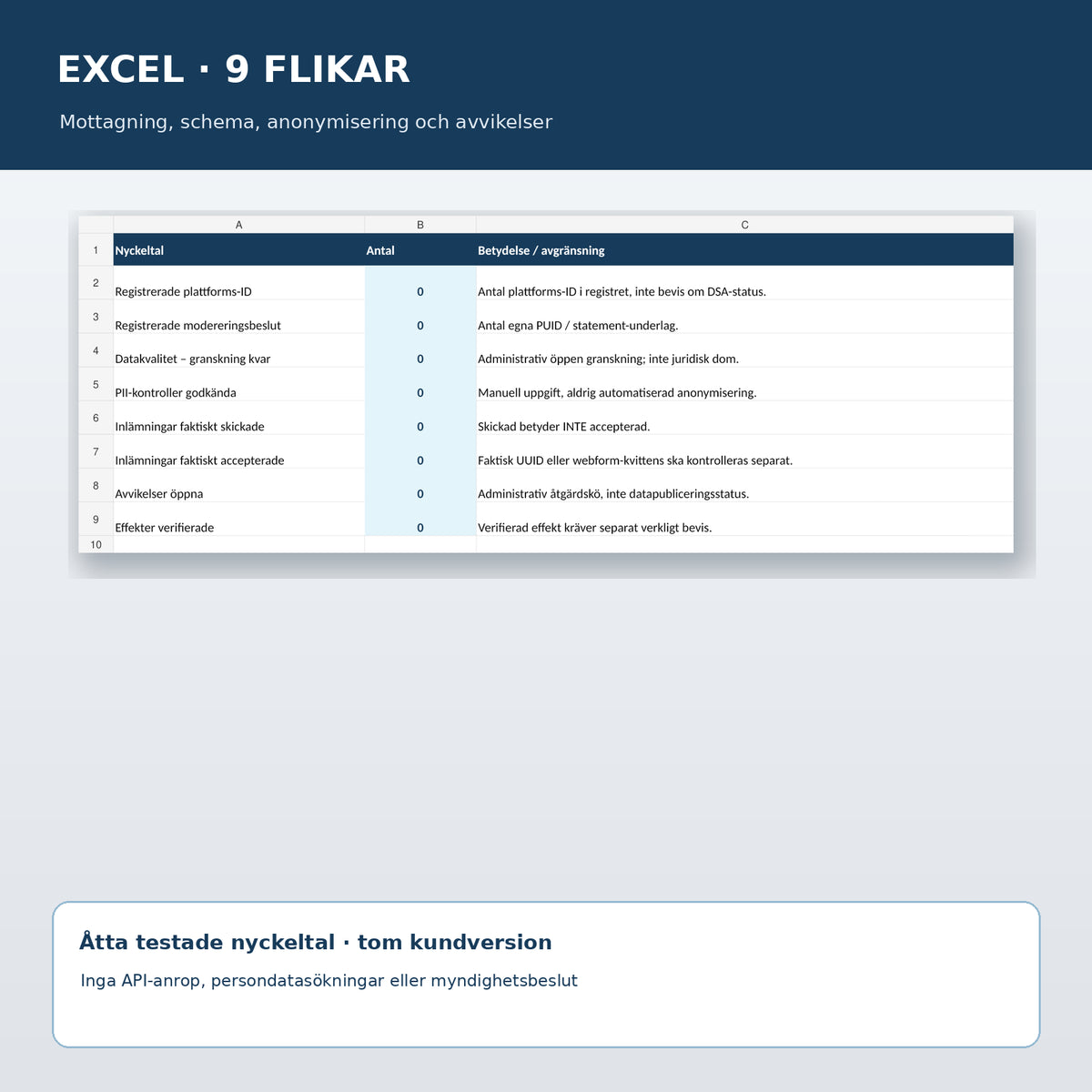
Fields for platform ID, documented Article 19 exemption, EU registration status, Article 17 decision, unique PUID, decision category, factual basis, personal and indirectly identifiable information, technical validation, actual transmission date, confirmed acceptance, UUID, and independently verified correction. Excel provides eight administrative key metrics but does not check legal applicability, personal data, API schema, or regulatory status.
When is this package needed?
Example A – marketplace: An affected trading platform removes a seller's offer due to suspected illegal content. The platform has already prepared and submitted a statement of reasons to the recipient official under Article 17, but also needs to ensure that the decision is submitted to the Commission's special database without personal data.
Example B – forum or social platform: The company has several products/platforms, different moderation decisions, and many free-text fields. The team needs separate onboarding and a unified field and receipt register per platform.
Example C – rejected technical submission: An API call has failed or incorrect data has been detected. The team must distinguish between "sent" and "accepted", handle possible duplicates, correct the error, and check the actual outcome.
Which online platforms are covered?
The Article 19 exemption is crucial: The special obligations under Article 24.5 normally do not apply to online platforms belonging to micro or small enterprises under the EU definition. However, the exemption does not apply to designated very large online platforms (VLOPs). Therefore, company size, corporate group conditions, and the platform's actual function must be assessed before the product is used for a mandatory submission. A regular online store is not automatically an online platform under the DSA. Read Regulation (EU) 2022/2065, Articles 3, 17, 19, and 24.
The documents, file by file
| Document | Practical work | Language | Delivery format |
|---|---|---|---|
| Applicability assessment and onboarding | Identify the online platform and any Article 19 exemption. Follow onboarding per platform. | Swedish | DOCX + searchable PDF (non-interactive) |
| Schema fields and decision mapping | Link Article 17 decisions to PUID, decision codes, actions, reasons, and the current database schema. | Swedish | DOCX + searchable PDF (non-interactive) |
| Personal data check | Manual review of free text, indirect identifiers, de-identification, and signed release. | Swedish | DOCX + searchable PDF (non-interactive) |
| Submission and receipt | Separate sandbox and production, and transmission, actual 201 Created, and received UUID. | Swedish | DOCX + searchable PDF (non-interactive) |
| Error handling and correction | Handling of API errors, personal data findings, duplicates, correction, and verified effect. | Swedish | DOCX + searchable PDF (non-interactive) |
| Swedish user guide | Step-by-step guide with limitations and official legal sources. | Swedish | DOCX + searchable PDF (non-interactive) |
| English User Guide | English guidance for the five Swedish operational templates. | English | DOCX + searchable PDF (non-interactive) |
| Excel register with nine tabs | Compilation of platforms, decisions, data quality, anonymization, submissions, and deviations. | Swedish | XLSX |
How to use the document package
- Assess the obligation: Classify the activity under the DSA and check exemptions under Article 19. Document in particular whether any platform is designated as a VLOP.
- Register the platform: Follow the Commission's current onboarding via the Digital Services Coordinator or designated procedure. Create separate sandbox and production accounts according to its instructions. If you have multiple platforms, onboarding is required per platform.
- Keep Article 17 and 24.5 separate: The decision and the individual statement of reasons to the user must exist, but the Commission's database is a separate submission obligation. Use the Commission's current technical field descriptions.
- Check PUID and code fields: Register a unique platform identifier for each statement, relevant restriction, time, geographic scope, decision basis, and discovery source. Code values and mandatory fields may evolve.
- Remove personal data: Manually ensure that neither directly nor indirectly identifying personal data is included in the text, identifiers, or other open fields. Stop the submission in case of uncertainty.
- Submit via the proper channel: Use the Commission's actual web form or API and check technical acceptance. For API calls, the documentation indicates 201 Created for a correctly successful submission. Register only actual UUIDs/permalinks.
- Follow up and correct: Separate drafts, actually sent, accepted, under troubleshooting, and verified. Preserve evidence and handle any personal data incidents in the regular security process.
Excel register with nine tabs
Read me, Overview, Platforms, Decisions, Data Quality, Anonymization, Submissions, Deviations, and Sources. The eight tested compilations include the number of registered platforms, PUID, open schema reviews, manually approved anonymizations, actually sent versus accepted submissions, open deviations, and verified effects.
A status of Sent is not the same as Accepted. A local Excel value of Approved does not prove that a PII scanner has been used or that the EU Commission has accepted the data. The workbook is delivered empty, and neither user data, API token, nor dummy data is in the customer file.
The legal difference: Article 17 versus 24.5
Article 17 concerns clear and specific statements of reasons to affected users in certain cases of restrictions on content, accounts, services, or payments. Article 24.5 obliges relevant online platform providers to submit decisions and the reasons under Article 17.1 to the EU Commission's public machine-readable database without undue delay. The platform must ensure that the transfer does not contain personal data. Official DSA legal text.
The EU database is not an individual decision review: The Commission states that it does not review each individual submitted statement of reasons on its merits. The database is a transparency instrument. The database does not contain the same individual rights information as the user's Article 17 notice. Legal information about the database.
Onboarding, API, and receipt of submission
According to the Commission's onboarding documentation, each platform must be registered separately. The entity registered through the relevant DSC will first get access to a test environment and then, once tests are approved, the opportunity to submit in the production environment. There are both web forms and APIs; the choice depends on volume and technical conditions. The published API documentation describes the transmission of individual or aggregated statements and received UUIDs. The service, schema, and code values must be checked against the current Commission version before use.
Difference from other DSA products
DSA Article 17 – Statement of Reasons deals with the original justification to the user. DSA Article 20 – Internal Complaint Handling deals with the user's subsequent review. DSA Transparency Report deals with aggregated reporting. This product concerns Article 24.5's special database submission and privacy check and is therefore a complementary working aid.
Frequently Asked Questions
Must all small websites send decisions to the EU database?
No. First determine whether the activity is an online platform within the meaning of the DSA, and then assess the Article 19 exemption for micro and small enterprises. Designated VLOPs are not covered by the exemption.
Is notifying the user the same as reporting to the database?
No. The Article 17 notice to the user and the Article 24.5 submission to the Commission's database are two separate steps, even though they are based on the same moderation decision.
Can we enter usernames, personal identification numbers, or email addresses in the database?
No. Article 24.5 states that submitted data must not contain personal data. Even indirect identifiers and identifying free text need to be reviewed.
Does the Excel file automatically send JSON via the API?
No. Excel is an internal manual register. The package does not guarantee valid JSON payloads, does not handle login credentials, and does not make regulatory submissions.
How can we see that a submission has actually gone through?
Check the actual response from the Commission's production environment, for example 201 Created for a documented successful API call, and save the received UUID or other official receipt.
Can we use the package for multiple platforms?
Yes, as an internal register. But the Commission's onboarding must be completed separately for each online platform, and database details, permissions, and receipts must be kept separate.
Can a registered entry contain personal data if the Commission does not respond?
No. The platform is responsible for ensuring that personal data is not sent. The absence of an automatic objection does not mean that the data is permitted.
Is the package legally reviewed, and is there a full English version?
No. An internal AI-assisted source check and technical file QA have been carried out, not an external legal or security review. The five operational working templates and Excel are in Swedish, with a separate English User Guide.
Sources and version
Version 1.0, November 17, 2026. Official sources: DSA (EU) 2022/2065, EU Commission onboarding, database schema, API documentation, legal information and privacy, and DSA Database FAQ. No independent legal review, regulatory certification, actual API testing, or approved submission is included.