Svenska Dokumentmallar
EED Article 26 – district heating 5 MW test, five-year plan and network losses | Word/PDF/Excel
EED Article 26 – district heating 5 MW test, five-year plan and network losses | Word/PDF/Excel
- File format
- DOCX, PDF, XLSX
- Document language
- Five Swedish operational templates and one Swedish user guide all as DOCX/PDF; separate English User Guide DOCX/PDF; Swedish Excel workbook with nine tabs. No full English translation of the operational templates.
- Number of files
- 7
Digital download. No physical product is shipped.
Couldn't load pickup availability
About this template
Do you operate a district heating or cooling system and need to prepare for the EED's stricter efficiency requirements? The EU's revised energy efficiency directive, (EU) 2023/1791 Article 26.5, includes a specific planning track for existing networks with a total output heat and cooling capacity exceeding 5 MW that do not meet relevant efficiency criteria. The system operator must be able to document its system boundaries, energy mix, network losses, and a concrete improvement plan. This template package brings together the working documents in Word, PDF, and Excel.
Important for Swedish customers: In the Swedish Government Legal Council referral from 20 August 2026, national supplementary rules are proposed to enter into force on 1 January 2027. During the product's internal source control on 17 November 2026, the proposal had not been confirmed as adopted Swedish law. This is a tool for preparation and traceable documentation, not evidence that a particular requirement or regulatory procedure already applies in Sweden.
Package contents
15 customer files: five Swedish working templates, a Swedish user guide, and a separate English User Guide. All seven documents are available as editable Word (DOCX) and matching searchable PDF. In addition, 1 Swedish Excel workbook with nine tabs is included. Total: 7 Word + 7 PDF + 1 Excel. The PDF files are printable but lack interactive fillable fields; only the guide, not the five working templates, is in English.
What the files contain
Documentation to identify the network operator and actual system boundaries, measurement of total output capacity (MW), comparable MWh for supply and delivery, technically reconciled distribution losses, separate data on renewable heat, waste heat, and highly efficient combined heat and power, the correct criterion year, decided actions, and actually verified effects. A special protocol keeps planned, submitted, acknowledged, and formally approved by the authority separate.
Who benefits from the product?
District heating operators: a municipal or private operator may have several adjacent networks and needs to first assess each system's actual boundary and total output capacity. Technical operations: energy flows from heat production and waste heat suppliers must be reconciled against district heating deliveries, measurement boundaries, and network losses. Business and sustainability managers: a five-year plan for network measures, renewable heat, and waste heat connection needs to be able to be followed up through actual decisions and achieved effects.
District cooling systems may also be covered. The product is not intended as a general residential energy calculation, an operating log for a district heating plant, ISO 50001 certification, or energy mapping of companies at 10 or 85 TJ according to EED Article 11.
All files
| File | Work step | Format |
|---|---|---|
| Applicability and system boundary | Assess actual output capacity over 5 MW, network boundary, operator, and current criteria. | SV DOCX/PDF |
| Energy balance and network losses | Measurement boundaries, supply, deliveries, reconciliation, loss difference, and uncertainty. | SV DOCX/PDF |
| Energy mix and efficiency criteria | Separate renewable heat, waste heat, and combined heat and power; avoid double counting. | SV DOCX/PDF |
| Five-year plan and measures | Assess possible investments, budget, responsibility, stages, and actual benefit. | SV DOCX/PDF |
| Regulatory review and acknowledgment | Follow Swedish legislative status and keep drafts, submitted, acknowledgment, and approval separate. | SV DOCX/PDF |
| Swedish user guide | Eight control steps with EU and Swedish legal sources, as well as clear boundaries. | SV DOCX/PDF |
| English User Guide | English instructions for the Swedish working templates and Excel register. | EN DOCX/PDF |
| Excel register with nine tabs | Systems, energy flows, energy mix, criterion assessment, five-year plan, approvals, and sources. | SV XLSX |
How to use the working templates
- Define the system. Enter the network's name, boundaries, operator, available network maps, capacity sources, and relevant responsible person. Assess whether the total output heat and cooling capacity actually exceeds 5 MW, with a verifiable technical source.
- Keep different regulatory boundaries separate. The 5 MW capacity threshold according to Article 26 is not the 10/85 TJ company boundaries according to Article 11. Separate purchased electricity capacity, network capacity, annual supplied energy, and delivered energy.
- Establish an energy balance. Collect time-stamped, comparable MWh for supply to the network and deliveries within the same measurement boundary. Note internal consumption, energy storage, and measurement uncertainty. A negative difference should be investigated, not automatically considered a negative network loss.
- Classify the energy sources. Identify renewable energy, waste heat, combined heat and power, purchased heat, and other sources separately. Prevent double counting of the same heat delivery and state actual measurement and certification sources.
- Assess the correct criterion year. The directive has a criterion up to 2027 and other criteria from 2028, 2035, and later. Always check the time-bound wording and national law before classifying the system as efficient.
- Create a five-year plan. Prioritize technically and economically assessed measures for lower distribution losses, better primary energy efficiency, and an increased share of renewable energy/waste heat. Add responsibility, expected effect, budget, timeline, and actual management decision.
- Verify the regulatory path. According to Article 26.5, the plan must presuppose approval from the competent authority. First establish what final Swedish law states, the correct authority, which annexes are required, and actual acknowledgment. An internal plan or sent email is not regulatory approval.
- Follow up on actual effect. Decided measure, technically performed measure, and energy result confirmed by measurement should be registered separately.
What applies according to EED Article 26?
Efficient system – Article 26.1: The EU directive specifies a gradual tightening of the criteria for how district heating and cooling systems can be classified as efficient. Up to 31 December 2027, this includes, among other things, certain levels of renewable energy, waste heat, and combined heat and power; from 2028, other alternative combinations and later tightenings are added. The actual classification requires technical assessment and applicable definitions. Read the official Swedish EU text.
Planning obligation – Article 26.5: the directive prescribes that from 1 January 2025 and every five years thereafter, member states shall ensure plans for affected existing systems over 5 MW that do not meet the criteria in point 1(b–e). A plan shall cover more efficient primary energy use, reduced distribution losses, and an increased renewable share, and be approved by the competent authority. The Commission's recommendation (EU) 2024/2395 provides non-binding interpretive guidance.
Sweden – rules still proposed: The government presented a Government Legal Council referral on 20 August 2026 with a proposal for planning requirements for inefficient district heating and cooling systems and planned entry into force on 1 January 2027. The regulation and its regulatory provisions must be rechecked before actual use. The obligation of the member state under the EU directive must not be incorrectly described as an identical already entered into force Swedish obligation for every individual company.
Excel with nine tabs and controlled formulas
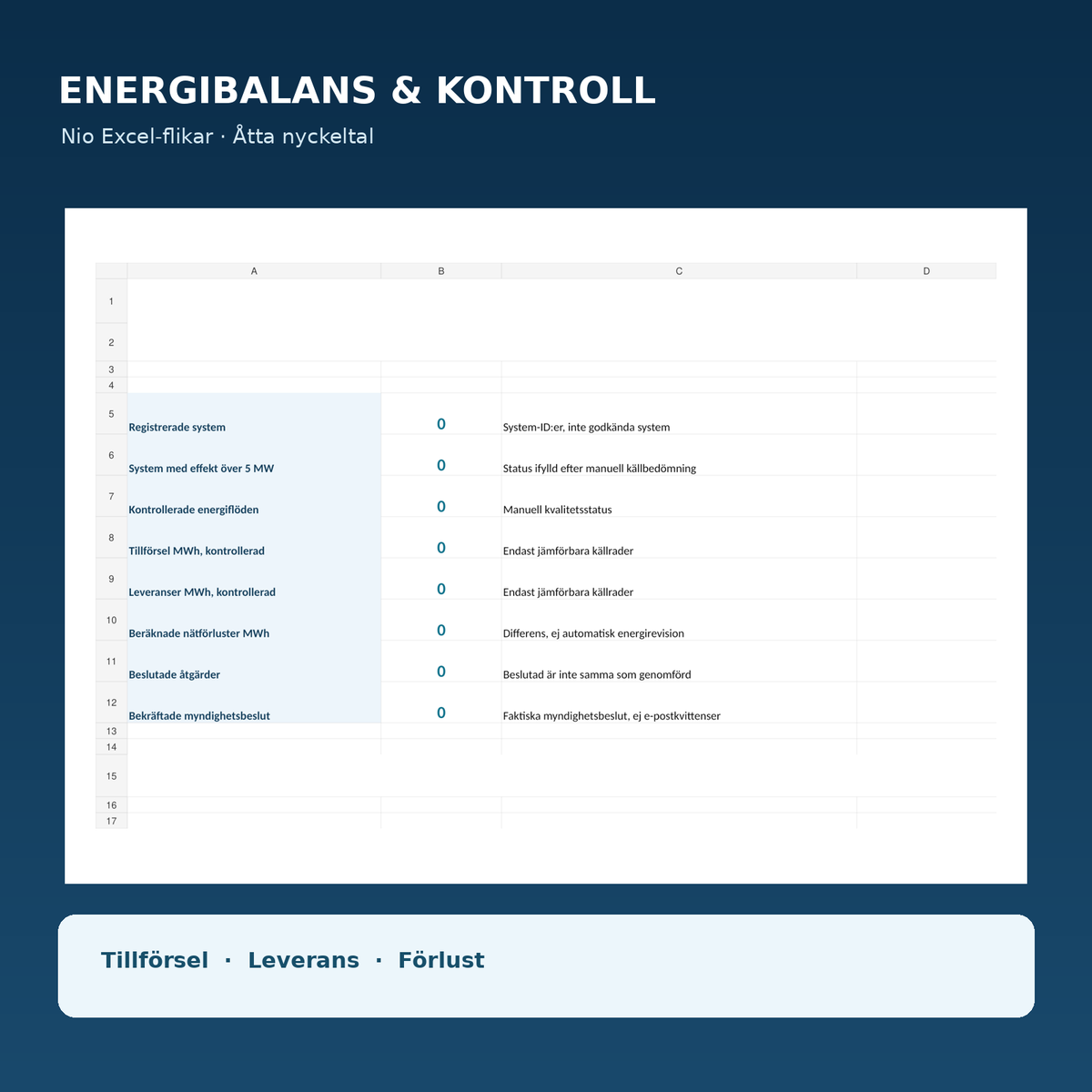
Read me, Overview, System, Energy Flows, Energy Mix, Criterion Assessment, Five-Year Plan, Approvals, and Sources. Eight compilations follow registered systems, manually classified systems over 5 MW, controlled energy flows, total supply, total deliveries, calculated MWh difference, decided actions, and actually confirmed regulatory decisions. The workbook has 368 formulas and has been tested with eight fictitious key figure outcomes, before the customer version was saved without test cases.
For comparable measurement boundaries, supplied energy minus delivered energy is used as an administrative indication of network loss. It is not the same as independent measurement inspection, primary energy calculation, or legal classification. Excel provides no automatic 5 MW assessment, no guarantee of correctness for source data, and no official regulatory decision.
Frequently Asked Questions
Does EED Article 26 apply the same as energy mapping at 10 or 85 TJ?
No. Article 26 applies to efficient district heating and cooling systems and may entail five-year planning over 5 MW. Companies' energy mapping and energy management systems according to Article 11 use other energy use thresholds instead.
Is the Swedish law already decided in November 2026?
At the internal control on 17 November 2026, there is a Government Legal Council referral with proposed entry into force on 1 January 2027. It is not sufficient grounds to claim that the legislation already applies. Check parliamentary decisions and final regulations.
If our network has exactly 5 MW, is it covered by the Article 26.5 threshold?
The wording of the directive states that the total output capacity must exceed 5 MW. Exactly 5 MW therefore does not pass the boundary according to its wording; however, check the actual definition and national application.
Can Excel determine if a district heating system is efficient?
No. The efficiency criteria change over time and require technically controlled data on energy sources, combined heat and power, waste heat, network boundary, and defined calculation rules.
What happens if deliveries are greater than registered supply?
The workbook can show a negative difference. It is a deviation signal that must be investigated based on measurement boundaries, internal flows, storage, external supply, and measurement quality; it does not prove a physical negative loss.
Must a plan be approved by an authority?
Article 26.5 prescribes that plans shall presuppose approval by the competent authority. Which Swedish authority and which exact national procedures apply must be checked when Swedish law and regulation are decided.
Are all documents in English?
No. The five operational templates, the Swedish guide, and the Excel register are in Swedish. English User Guide is a separate user instruction in English; operational templates are not fully translated.
Has the package been certified by an energy expert or lawyer?
No. Internal AI-assisted legal source control and technical file/formula tests have been carried out. External legal, energy-technical, regulatory, or ISO review is not included.
Sources, delivery, and version
Product version 1.0 · 17 November 2026. Legal sources: EED (EU) 2023/1791, Article 26, the Commission's recommendation (EU) 2024/2395, the government's Swedish Government Legal Council referral, and the Swedish Energy Agency's information on ongoing implementation work. See also the Template Store's separate EED template for the company boundaries 10/85 TJ. No regulatory registration or program connection is included.