Svenska Dokumentmallar
Self-inspection construction 2026/2027 – Swedish + English | Inspection records, non-conformities & Excel
Self-inspection construction 2026/2027 – Swedish + English | Inspection records, non-conformities & Excel
- File format
- DOCX, PDF, XLSX
- Document language
- Swedish
- Number of files
- 5
Digital download. No physical product is shipped.
Couldn't load pickup availability
About this template
Construction Self-Inspection 2026/2027 is a professional document package for contractors, subcontractors, developers, and project organizations needing to document construction project quality controls in a traceable and uniform manner. The package includes Swedish and English Word/PDF versions as well as an Excel register with a dashboard for control status, non-conformances, deadlines, and follow-up.
The template is designed for practical use out in the field: each check can be linked to a clear requirement, the correct document and revision, the chosen inspection method, actual result or measurement value, evidence, and any non-conformance. It is intended as support for documented self-inspection and does not replace the control plan that the building committee may establish according to the Planning and Building Act (PBL).
About the document template: What's included · How to use it · Legal basis · Common pitfalls · FAQ
Adapted to Swedish conditions 2026/2027 and updated to account for changes in the PBL control system that came into effect on July 1, 2026, and the fact that Boverket’s new building regulations now apply fully to new cases.
What is included in the package
| 1. Egenkontroll bygg – Swedish | Editable Word (DOCX) + PDF |
| 2. Construction Self-Inspection – English | English version adapted to Swedish conditions, Word + PDF |
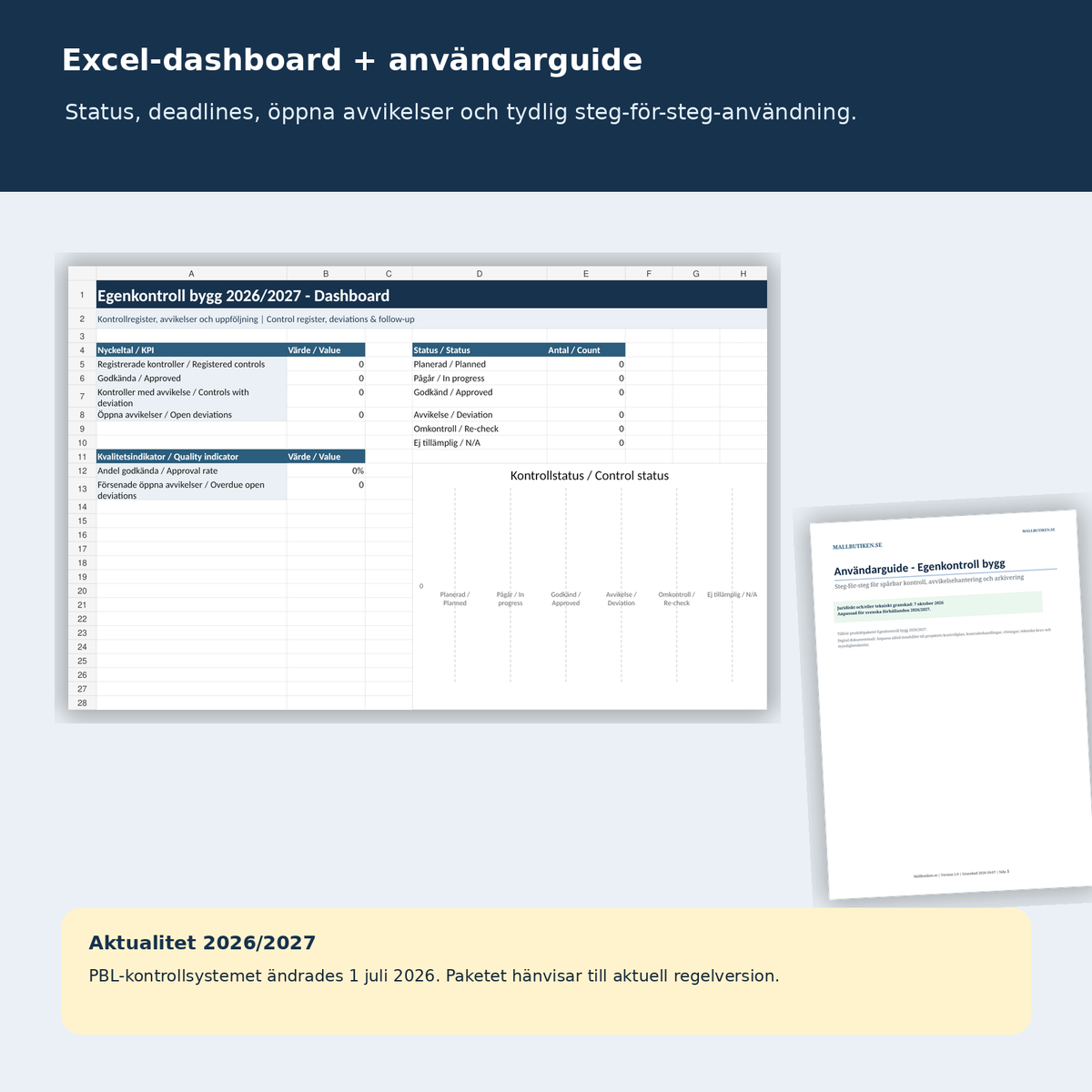
| 3. Användarguide – Swedish | Step-by-step guide in Word + PDF |
| 4. User Guide – English | English user guide in Word + PDF |
| 5. Excel register | Control register, non-conformance register, dashboard, instructions, and source sheets in XLSX |
What the inspection template contains
The Word/PDF template is structured as a practical project protocol containing project details, control register, detailed inspection log, non-conformance and action report, and final summary. Each check can be documented with, among other things:
- unique control ID,
- work task and location,
- requirement or acceptance criteria,
- reference document and revision,
- inspection method,
- result or actual measurement value,
- status,
- photo/attachment ID and other evidence,
- non-conformance ID,
- responsible party, date, and verification.
Excel register with dashboard
The Excel file makes the package more useful in larger or recurring projects. It contains separate sheets for the control register and non-conformances, status lists with data validation, deadline fields, automatic follow-up, and a dashboard showing registered checks, approved checks, checks with non-conformances, open non-conformances, approval rate, and overdue open non-conformances.
How to use the template
- Gather governing documents. Identify the control plan, commencement notice, contracts, latest drawings, and technical requirements.
- Build the control register. Assign each check a unique code and specify exactly what the check should verify.
- Determine method. Examples could include visual inspection, measurement, testing, functional check, or document review.
- Document actual results. Record measurements or observations when the check requires it – not just “OK”.
- Register non-conformances. Link the non-conformance to the control ID, responsible party, deadline, and corrective action.
- Verify closure. A non-conformance should not be marked as closed until the action has been verified and evidence is documented.
- Archive in a structured manner. Save protocols, photographs, measurement logs, and version references together with the project's other quality documents.
Legal and technical basis 2026/2027
For measures requiring a permit or notification, the primary responsibility lies with the developer. The Planning and Building Act (PBL) includes requirements for a control plan in situations where such is required and specifies, among other things, which checks are to be made, which requirements they should refer to, who is to perform them, and how they are to be carried out.
On July 1, 2026, parts of the PBL control system were changed. Simultaneously, the transition period for the older BBR/EKS regulations ended, and Boverket’s new building regulations now apply fully to new cases. For older projects, transitional provisions may mean that older rules are still relevant. Therefore, the package contains no claims that one single general checklist fits all projects.
Primary sources: Boverket’s PBL Knowledge Bank, the Planning and Building Act (2010:900), and Boverket’s information on new building regulations.
Who is this product for?
- construction contractors and smaller building companies,
- subcontractors,
- project managers and site managers,
- developers and property owners,
- KMA/quality managers,
- companies needing a uniform template for recurring checks,
- projects with Swedish and English-speaking staff or documentation.
Common risks and pitfalls
- control points without clear requirement references,
- using “OK” where an actual measurement value is required,
- checking against old drawings or the wrong revision,
- non-conformances that are fixed but never verified and closed,
- photos or attachments lacking a link to the control ID,
- confusing self-inspection, the control plan, and inspection reports,
- reusing generic control points without a project-specific assessment.
Frequently asked questions
Is this the same thing as a control plan under PBL?
No. The product is a document support tool for the project’s documented self-inspections. It does not replace the control plan that may be required under PBL and which is established by the building committee in the commencement notice.
Can the template be used by both the contractor and the subcontractor?
Yes. Project details, inspection responsibilities, and control IDs can be adapted to the organization and the specific work portion being followed up.
Are pre-filled control points included for all building disciplines?
No, and this is intentional. Control points need to be adapted to the project's actual requirements, documents, and risks. The guide shows how to formulate effective control points, and the Excel register makes them easy to organize.
Why are both Swedish and English included?
English documentation can be practical in projects with international suppliers or teams. The English version is a translation and adaptation to Swedish conditions – not a template for foreign law.
Can the Excel file be used separately?
Yes. It functions as an independent control and non-conformance register, but is designed to complement the Word/PDF protocols.
Format and delivery
Digital product with immediate file-based delivery once the file is linked in Shopify Digital Products. The package contains DOCX, PDF, and XLSX and works on standard computer platforms with compatible Office/PDF software.
Disclaimer
The template is a general document support tool and does not constitute legal, building-technical, or project-specific advice. Control points and acceptance criteria must be determined for the individual project by persons with the appropriate expertise. In case of uncertainty, a qualified control officer, designer, inspector, lawyer, or other relevant specialist should be consulted.
Related guides: Self-inspection in construction 2026 – the difference between self-inspection and inspection plans according to the Planning and Building Act (PBL) · Construction & Contracting 2026 – documentation, extra work (ÄTA), self-inspection, and work environment.