Svenska Dokumentmallar
Self-care in school – collaboration plan, staff handover and security check | Word/PDF/Excel
Self-care in school – collaboration plan, staff handover and security check | Word/PDF/Excel
- File format
- DOCX, PDF, XLSX
- Document language
- Five Swedish working documents Swedish User Guide and English User Guide; Swedish Excel workbook
- Number of files
- 7
Digital download. No physical product is shipped.
Couldn't load pickup availability
About this template
Do you need to coordinate agreed self-care in a preschool, school, or after-school program? This practical template package helps principals, school authorities, staff, and guardians document organizational responsibility, access to treatment instructions, staff briefings, substitute handovers, and follow-up. The package is based on the Self-Care Act (2022:1250) and the Swedish National Agency for Education's guidance, updated on July 15, 2026.
Patient safety limit: Only qualified healthcare professionals providing treatment can assess whether a measure may be carried out as self-care. The templates do not contain medication dosages, treatment instructions, self-issued care assessments, or medical delegations. They are administrative tools for organizing already assessed self-care.
Digital package: 7 editable Word files (DOCX), 7 corresponding searchable and printable PDF files, and a Swedish Excel register (XLSX) with nine tabs. Five working documents are in Swedish, and the package includes one Swedish and one English user guide. Total 15 files in a ZIP. No physical shipping. The PDF files are not interactively fillable.
Package contents
01. Check of the healthcare provider's self-care assessment and supporting documentation. 02. Collaboration plan and responsibility matrix for school–healthcare–home. 03. Staff competence, instruction, and acknowledgment. 04. Substitute, field trip, and after-school program handover. 05. Organizational deviations and changed circumstances. 06. Swedish user guide. 07. English User Guide. All seven are available in both DOCX and PDF. 08. Excel workbook with nine tabs.
What the files contain
Editable checklists for documenting references to the healthcare provider's actual assessment, the principal's organized staffing, secure communication, the introduction of relevant staff, staff acknowledgment, backup staffing, changes in activities, and contact in case of uncertainty. The Excel file only records internal case IDs and organizational status values. No personal identification numbers, diagnoses, medication dosages, or care measures should be stored in the spreadsheet. A status indicator is not a certificate of medical suitability.
Who is the template package for?
Principals and school authorities: document how already assessed self-care is organized, who has received information, and how substitutes receive the correct instructions. Preschool and after-school program staff: document organizational handovers and who is contacted when staff or circumstances change. Guardians: prepare collaboration meetings with the school and healthcare provider without having to design a medical prescription themselves.
Example A – new student with planned self-care: the school checks whether an actual assessment exists from the healthcare provider, how the school obtains the necessary instructions, and who the principal assigns to provide support. Example B – substitute during a field trip: availability, staff acknowledgment, and secure contact methods need to be reconfirmed. Example C – changed needs: an organizational deviation is documented, and the school contacts the healthcare provider if a new assessment or clarification is needed.
This is not an instruction for emergency treatment, a diabetes dosing table, a medical emergency plan, a medication prescription, authorization to administer a specific medication, or a guarantee that the organization meets healthcare requirements. Always follow the individual instructions of the healthcare provider and the organization's emergency procedures. Call 112 in case of immediate life-threatening danger.
File list and practical use
| File | Content and use | Language | Format |
|---|---|---|---|
| 01 Check of care assessment | Confirm actual assessing healthcare contact, source reference, document version, uncertainties, and secure storage. | Swedish | DOCX + searchable PDF |
| 02 Collaboration and responsibility matrix | Organization, principal's decision, contact with healthcare and home, staffing allocation, and follow-up. | Swedish | DOCX + PDF |
| 03 Staff competence and acknowledgment | Document actual introduction, access to instructions, substitutes, and remaining training needs. | Swedish | DOCX + PDF |
| 04 Substitute and field trip | Check before changed staff, school day, sports, field trip, and after-school activities. | Swedish | DOCX + PDF |
| 05 Deviations and changed needs | Organizational deviation, escalation to principal/healthcare, correction, and actual follow-up. | Swedish | DOCX + PDF |
| 06 Swedish user guide | Twelve practical sections on responsibility, assessment, training, privacy, and legal sources. | Swedish | DOCX + PDF |
| 07 English User Guide | English instructions for the Swedish non-clinical school coordination templates. | English | DOCX + PDF |
| 08 Administrative Excel register | Nine tabs, filtering, status selection, warning logic, and overview. | Swedish | XLSX |
Excel: nine tabs and administrative security checks
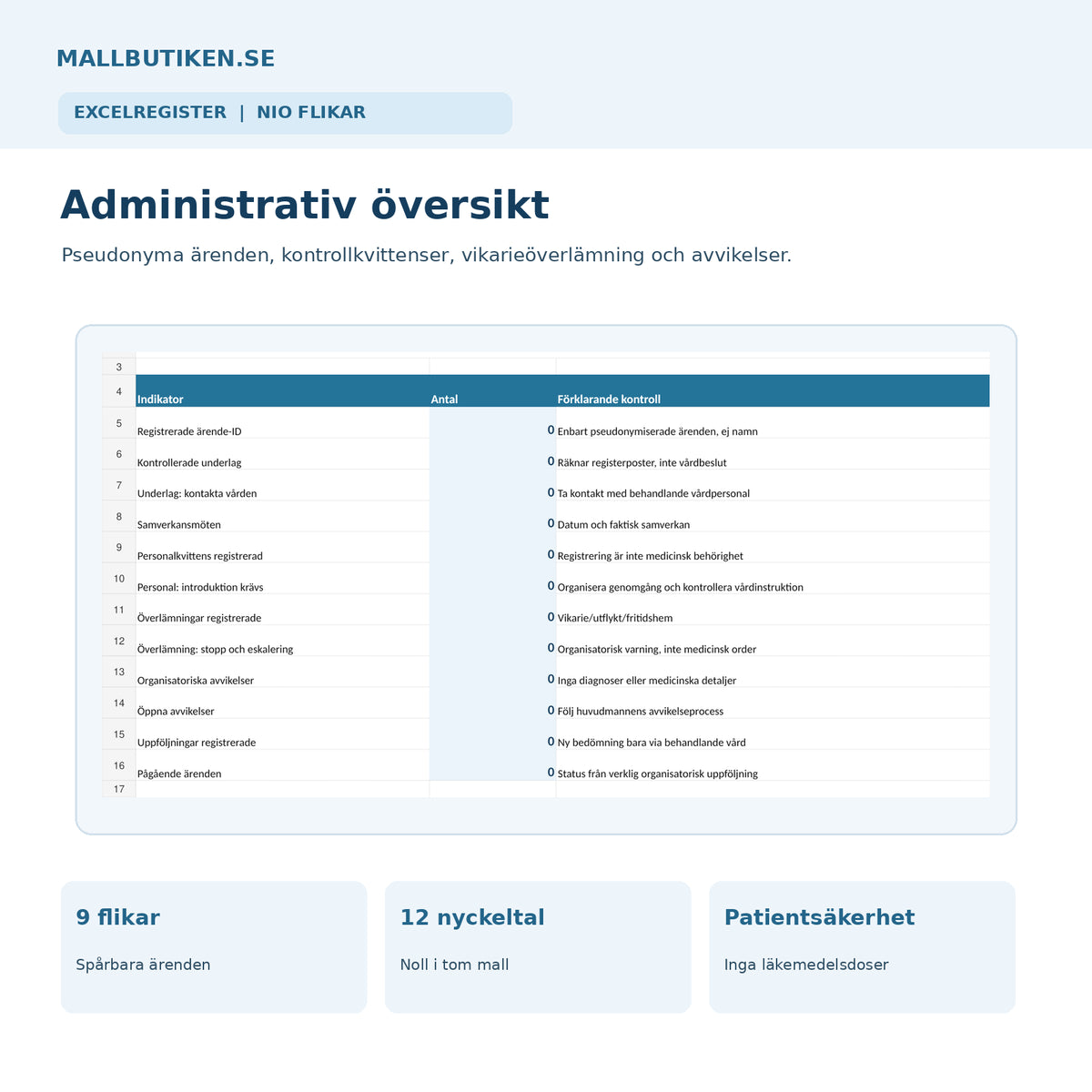
The workbook has the tabs Cases, Supporting Documentation, Collaboration, Staff, Handover, Deviations, Follow-up, Overview, and Read Me. The seven registers have 100 prepared rows, and the overview shows twelve organizational key figures. Only pseudonymized IDs are used as primary keys – actual personal data or medical documentation should be kept in a separate approved solution with appropriate access controls.
Three examples: Missing reference to the healthcare provider's instructions gives “CONTACT HEALTHCARE”; a person who has not yet gone through the briefing gives “INTRODUCTION REQUIRED”; substitute handover without verified staffing gives “STOP – ESCALATE TO PRINCIPAL”. The signals are administrative reminders, not medical decisions or automatic approvals.
Step-by-step: how the templates are used
- Start with an actual self-care assessment: check the healthcare provider, supporting documentation reference, and what the healthcare provider has actually assessed.
- Coordinate with guardians and healthcare: document contact methods and questions that need clarification without writing your own treatment instructions.
- Organize the school's responsibility: the principal and school authority ensure resource allocation, access to the correct instructions, and secure procedures.
- Introduce the staff: note who has actually received the briefing and what needs remain.
- Check changed situations: conduct an organizational review before substitute shifts, after-school programs, sports, and field trips.
- Escalate uncertainty: in case of missing documentation or inadequate circumstances, contact the principal and healthcare provider for clarification/new planning.
- Document follow-up: refer to the healthcare provider's original document, save organizational evidence, and manage health data in protected systems.
Legal background – current regulations 2026
Self-Care Act (2022:1250), especially Sections 2–5: Self-care is a healthcare measure that qualified healthcare professionals providing treatment have assessed a patient can perform themselves or with assistance. Self-care assessment, planning, and healthcare follow-up are healthcare, while the actual performance of self-care is not covered by the Health and Medical Care Act in the same way. Swedish text of the Act at the Swedish Parliament.
Swedish National Agency for Education guidance, updated July 15, 2026: When a child is in a preschool, school, or after-school program, the school authority within its supervisory responsibility is responsible for ensuring that internal procedures ensure that assistance with agreed self-care is provided in a safe and appropriate manner. The principal organizes the operations and allocates resources. Self-care is not regulated as a specific task for school health services in the Education Act. Current guidance from the Swedish National Agency for Education.
Written certificates: The Swedish National Board of Health and Welfare explains that a certificate is not generally required for every self-care assessment. In some situations, a certificate may be needed as supporting documentation, and when the patient requests a certificate, it may need to be issued according to the Patient Data Act and certificate regulations. The product's first document is a check of actual supporting documentation, not its own medical certificate. Knowledge support from the Swedish National Board of Health and Welfare.
Repealed regulation: SOSFS 2009:6 on the assessment of self-care was repealed by HSLF-FS 2023:2. It is no longer a current regulation that should be stated as the primary rule for today's self-care. Repeal regulation from the Swedish National Board of Health and Welfare.
Personal data: The school's handling of children's health data requires a specific privacy assessment according to applicable GDPR, confidentiality, and documentation rules. Avoid placing personal identification numbers, diagnoses, medication dosages, or other sensitive health data in open spreadsheets. Pseudonymized data may still be personal data.
Frequently Asked Questions (FAQ)
Who decides that a child can receive self-care in school?
Only qualified healthcare professionals providing treatment make the actual self-care assessment. The school can organize support but cannot prescribe or reclassify a healthcare measure itself.
Is the principal or the school nurse responsible for self-care?
The school authority is responsible for secure procedures during the period of supervision, and the principal organizes resources. Self-care is not automatically a specific task for the medical intervention of school health services.
Must healthcare always write a self-care certificate?
No, there is no general requirement for a certificate for every self-care assessment. Written documentation may still be needed in practice so that the school can arrange safe assistance. Check the healthcare provider's procedure and the current situation.
Can the parent enter medication dosages directly into this template?
No. The product's templates are intentionally designed for administrative references. Prescriptions and individual medical instructions should be obtained from the healthcare provider and handled securely.
Is a staff member's signature the same as delegation?
No. The acknowledgment confirms that an administrative review has taken place. It does not mean medical authorization, medical delegation, or the independent right to change the treatment.
What happens when the regular staff is sick or the child goes on a field trip?
The school must check whether the current organization provides secure conditions, who has received instructions, and who contacts healthcare in case of uncertainty. The template package provides a checklist for the organizational review.
Can Excel guarantee that self-care is carried out in a patient-safe manner?
No. Excel only provides warnings about administrative gaps and counts status items. It must not be used for healthcare decisions, treatment routines, or as a substitute for expert assessment.
Do the documents also apply to preschools and after-school programs?
Yes. The package is intended to organize self-care that has already been assessed by healthcare in preschools, schools, and after-school programs, with adaptation to the procedures of each respective operation.
Does the package contain fillable PDFs or complete English templates?
The five working documents are in Swedish. The English guide explains how they are used. The PDF versions are searchable and printable, not interactive forms; Word and Excel are editable.
Is the product approved by the Swedish National Agency for Education or the Swedish National Board of Health and Welfare?
No. It is a privately developed administrative working document and has not been certified or approved by the authorities, healthcare professionals, or an independent lawyer.
Version, quality, and transparency
Version 1.0 – November 20, 2026. AI-assisted source check against the Self-Care Act (2022:1250), the Swedish National Agency for Education guidance (updated July 15, 2026), and knowledge support from the Swedish National Board of Health and Welfare. Internal review of DOCX/PDF, Excel formulas, nine register tabs, searchable PDF, and ZIP integrity has been carried out. No external medical, legal, or authority review has been carried out. The working template does not replace healthcare, the school authority's responsibility, local safety procedures, or an individual document from healthcare. The compatibility of the files has not been tested separately in an installed Microsoft Office environment.