Svenska Dokumentmallar
Lone Working 2026/2027 – Risk Assessment, Alarm Plan & Safety Procedures Word/PDF
Lone Working 2026/2027 – Risk Assessment, Alarm Plan & Safety Procedures Word/PDF
- File format
- DOCX, PDF
- Document language
- Swedish
- Number of files
- 5
Digital download. No physical product is shipped.
Couldn't load pickup availability
About this template
Lone Working 2026/2027 – Risk Assessment, Alarm Plan & Safety Procedures
This is a complete document package for employers who need to plan, assess risks, and organize lone work in accordance with Swedish work environment law. The package is designed for both physically isolated work and situations where other people are nearby but where the employee cannot be certain of receiving help in a critical situation.
The template package was legally reviewed on October 4, 2026, against AFS 2023:2, AFS 2023:1, and the Work Environment Act. It includes both the fundamental written risk assessment and the practical procedures required for alarms, check-ins, rapid assistance, cessation criteria, and follow-up.
Digital delivery: a ZIP file. The previous product list specifies 5 documents in Word/PDF (10 internal format files, 11 pages per format series), but the contents of the ZIP file have not been inventoried separately.
This is included in the package
Verified download item: a ZIP file, Ensamarbete_2026_2027_Mallpaket.zip.
The older product list specifies 5 document types, each in Word and PDF (a total of 10 internal format files, 11 pages per format series). The internal files of the archive have not been independently inventoried.
A ZIP download is verified – not 10 separate download links.
What the files contain
Risk Assessment: workplace, tasks, risk of physical injury, and violence/threats. Alarm and Contact Plan: contact chain, check-in, and escalation. Safety Procedures: instructions and cessation criteria. Start Checklist and Guide: preparation and follow-up.
In the event of a significant risk of violence or threats, lone work may be prohibited. A template does not make lone work safe in itself without implemented protective measures and a functional ability to obtain help.
Documents according to the table of contents
- Risk Assessment – Lone Work 2026/2027 – 4 pages.
- Alarm & Contact Plan – Lone Work – 2 pages.
- Procedure & Safety Instruction – Lone Work – 2 pages.
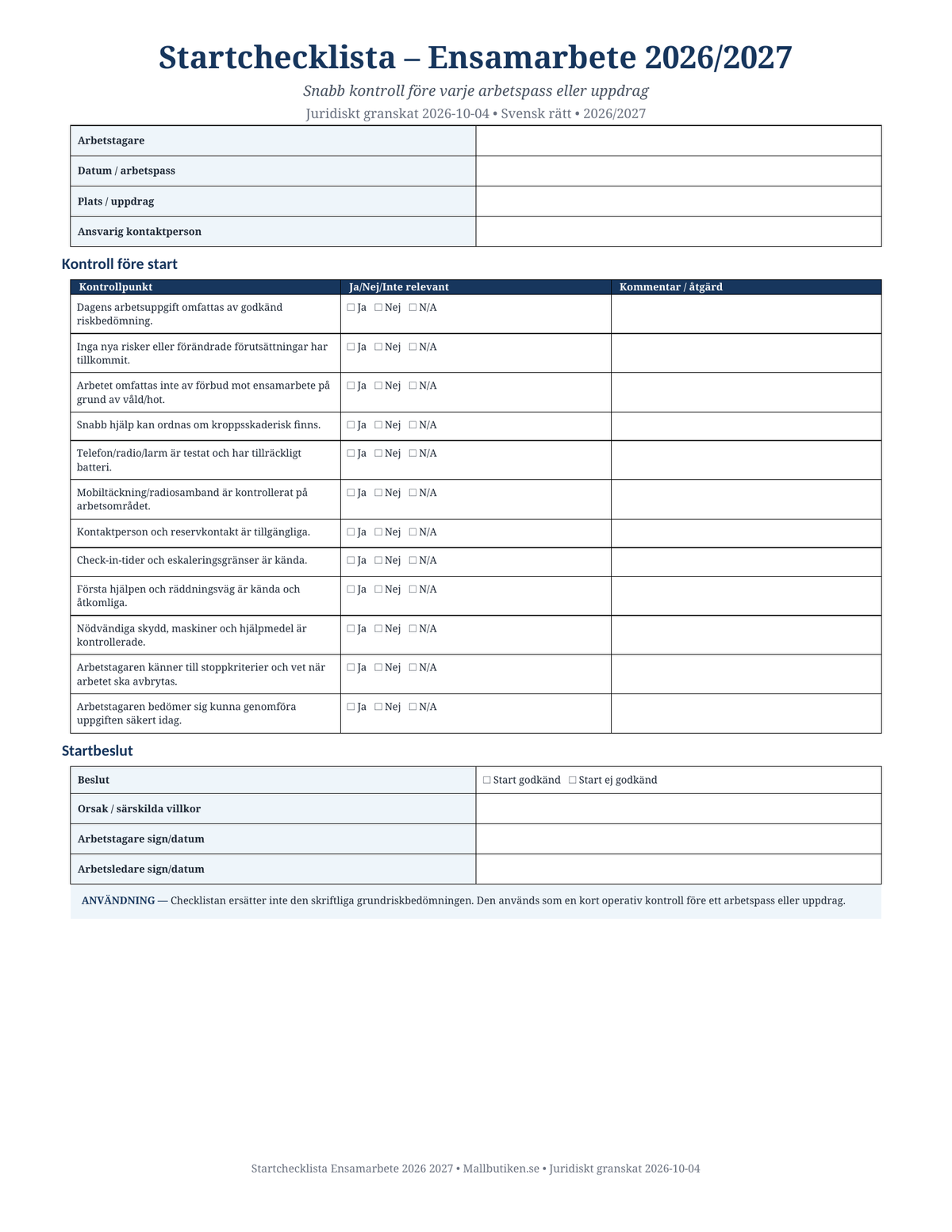
- Start Checklist – Lone Work – 1 page.
- Detailed User Guide – 2 pages.
What is classified as lone work?
AFS 2023:2 Ch. 6 covers lone work when an employee:
- is physically isolated and requires a phone, radio, or other technical communication to contact other people, or
- has people nearby but cannot be certain of receiving help in a critical situation.
This means that lone work is not just about being alone in a building. Work at a client's site, in vehicles, on night shifts, at a remote location, or in a part of the operation where rapid assistance cannot be guaranteed may also be covered.
Written risk assessment
The Work Environment Act requires the employer to consider the specific risk of ill health and accidents that may result from work being performed alone. According to AFS 2023:1, risk assessments must always be documented in writing and show what the risks are and whether they are serious.
The risk assessment template therefore includes, among other things:
- work task, location, and time period,
- type of physical or social isolation,
- risk of accidents and physical injury,
- violence and threats,
- mental strain and prolonged isolation,
- working hours, night work, and recovery,
- communication and mobile coverage,
- rescue and response time,
- competence and introduction,
- individual physical and mental conditions.
Risk of violence or threats – lone work may be prohibited
If a work task involves a significant risk of violence or threats of violence, the employer must not, according to AFS 2023:2, allow the employee to perform the work as lone work.
The risk assessment must be based on the actual situation. Examples of factors are previous threats or incidents, working hours, the environment at the site, previous contacts with the person or group, and the employee's knowledge and competence.
The template therefore has a clear stop rule so that this risk is not confused with situations where an alarm alone would be considered sufficient.
Significant risk of physical injury
If the lone work involves a significant risk of physical injury due to accidents, the employer must ensure that the employee can receive rapid assistance in an emergency situation.
Depending on the risk profile, this may require, for example:
- communication equipment,
- personal alarm or fall alarm,
- frequent contact or check-ins,
- periodic visits by another person,
- nearby standby,
- a specific rescue plan.
If acceptable safety cannot be arranged, the work must, according to the regulations, not be performed as lone work.
Alarm & Contact Plan
A separate alarm plan is included to translate the risk assessment into a concrete way of working. It contains fields for:
- primary contact person and reserve contact,
- phone, radio, or other channel,
- initial and recurring check-ins,
- final check-in / check-out,
- personal alarm, assault alarm, or fall alarm,
- escalation steps in case of missed contact,
- when to contact 112,
- exact address, position, or GPS data,
- access for ambulance/rescue services,
- testing and practicing the alarm procedure.
An alarm must have a functional chain
The technology itself is not enough. The alarm chain must work in practice. The employer needs to know who receives the alarm, what the recipient must do, how quickly someone can reach the employee, and what happens if the first communication route fails.
When working with a risk of violence or threats, AFS 2023:2 also sets special requirements regarding, among other things, alarms, receiving procedures, practice, and equipment testing.
Strong mental strain
If lone work involves strong mental strain, the employer should strive to ensure that the employee can have direct contact with colleagues or other people.
In the case of prolonged lone work, it may be appropriate to break the isolation through:
- job rotation,
- planned breaks or pauses,
- contact with a colleague or management,
- other organization that reduces social isolation.
Procedure & Safety Instruction
The separate safety procedure gives the employer a ready-made structure for what should apply before, during, and after lone work.
It includes, among other things:
- which work tasks are covered,
- which work tasks may never be performed alone,
- competence and introduction requirements,
- requirements for alarms and check-ins,
- control of equipment and workplace,
- cessation criteria,
- escalation in case of no contact,
- reporting of deviations and incidents.
Start checklist before each shift or assignment
The risk profile can change from day to day. Therefore, a compact one-page checklist is included that can be used before each lone shift or assignment.
It checks, for example, that:
- the basic risk assessment is still valid,
- no new threats or other risks have emerged,
- alarm, radio, or phone are working,
- contact persons are actually available,
- rapid help can be arranged,
- first aid and rescue routes are known,
- the employee knows the cessation criteria.
First aid and crisis support
AFS 2023:2 requires the employer to have the preparedness and procedures for first aid and crisis support necessary based on the nature, scope, and specific risks of the operations.
For lone work, the employer needs to pay particular attention to:
- how an injured or ill person is discovered,
- distance and response time to medical care,
- whether rescue personnel can find and reach the site,
- whether a sufficient number of people with first aid competence are actually available during working hours.
Safety representatives
When the employer arranges lone work that involves strong mental strain or a significant risk of physical injury according to AFS 2023:2 Ch. 6 §§ 5–6, safety representatives must be notified.
The template therefore contains specific fields for documenting the notification.
Minors
Minors may not be employed for lone work covered by Ch. 6 §§ 5–6. AFS 2023:2 also contains additional special provisions regarding the work environment of minors and prohibited work tasks.
Individual conditions
Anyone planning and organizing lone work must take special account of the employee's physical and mental conditions. This must be done objectively and with a focus on the work environment.
The package recommends that the employer document necessary work environment measures but avoid entering more sensitive personal data than is necessary.
When should the work be interrupted?
The safety procedure contains clear cessation criteria. Lone work should not continue when, for example:
- a significant risk of violence or threats arises,
- rapid assistance can no longer be ensured in the event of a risk of physical injury,
- alarm or necessary communication fails,
- working conditions change so that the risk assessment is no longer valid,
- any other change makes safety insufficient.
For which businesses is the package suitable?
The templates can be adapted for many industries, such as:
- industry, maintenance, and technical service,
- warehousing and logistics,
- real estate and on-call work,
- care, social services, and home visits,
- retail, reception, and customer-facing operations,
- transport and field work,
- forestry and contracting,
- work at remote work sites.
Legally reviewed for 2026/2027
The documents were reviewed on October 4, 2026, based on, among other things:
- The Work Environment Act (1977:1160), especially Ch. 3 §§ 2 and 2a.
- AFS 2023:1 on systematic work environment management, especially § 11 on written risk assessment.
- AFS 2023:2 Ch. 6 on lone work.
- AFS 2023:2 Ch. 5 on violence and threats of violence.
- AFS 2023:2 Ch. 4 on first aid and crisis support.
Format and delivery
Verified delivery: a ZIP file. The product list specifies 10 internal Word/PDF files, but the archive has not been separately checked.
- 5 documents.
- 10 files in total.
- Word (DOCX) + PDF.
- 11 A4 pages per format series.
- Digital product – no physical item is sent.
Guides and related risk areas
Read the guide on lone work and alarm plans, the guide on violence and threats, the guide on SAM and risk assessment.
Common questions
How are the various documents delivered?
A ZIP file is verified as a download item. The table of contents specifies 5 document types in Word/PDF (a total of 10 internal format files), but the archive's internal file list has not been inventoried separately.
Is lone work always prohibited?
No. But risks must be assessed and work organized so that safety is acceptable.
When is lone work prohibited due to violence?
When the work task involves a significant risk of violence or threats of violence, it may not be performed as lone work.
What applies in case of accident risk?
In the event of a significant risk of physical injury, the employee must be able to receive rapid assistance. If acceptable safety cannot be arranged, the work may not be performed alone.
Must the risk assessment be written?
Yes. AFS 2023:1 states that risk assessments must always be documented in writing.
Do safety representatives need to be informed?
Yes, in the case of lone work referred to in AFS 2023:2 Ch. 6 §§ 5–6.
Is an alarm plan included?
Yes. A separate alarm and contact plan with check-in and escalation steps is included.
Important
The templates are general work environment documentation. Industry-specific risk regulations may contain additional or stricter rules for certain work tasks. The documents must therefore always be adapted to the actual business and the current risk profile.