Svenska Dokumentmallar
EU Forced Labour Regulation 2027 – Swedish + English | Risk Assessment, DDQ & Supply Chain Word/PDF/Excel
EU Forced Labour Regulation 2027 – Swedish + English | Risk Assessment, DDQ & Supply Chain Word/PDF/Excel
- File format
- DOCX, PDF, XLSX
- Document language
- Swedish
- Number of files
- 17
Digital download. No physical product is shipped.
Couldn't load pickup availability
About this template
EU Forced Labour Regulation 2027 – complete compliance package in Swedish + English
A practical work and documentation package for companies looking to prepare their products and supply chains for Regulation (EU) 2024/3015 on prohibiting products made with forced labour. The regulation will be fully applicable from 14 December 2027 and covers products manufactured in the EU, imported into the EU, or exported from the EU.
The package is specifically designed for manufacturers, importers, distributors, retailers, e-commerce companies, procurement organizations, compliance functions, ESG teams, and advisors who need to create a structured and verifiable working process before the rules take effect.
Important: The Forced Labour Regulation is fundamentally a product ban. The regulation does not introduce a generally mandatory system of annual reporting or specific mandatory audits for all companies. Therefore, the templates are designed for risk-based preparation, traceability, evidence, and authority readiness – not to create requirements that do not exist in the regulation.
Included in this package
- Compliance Plan – responsibilities, scope, product groups, control steps, and internal governance.
- Product & Forced-Labour Risk Assessment – screening of product, geography, production stages, recruitment risk, migrant labour, overtime, wages, ID management, and subcontractor transparency.
- Supply-chain mapping & traceability – mapping from finished product to suppliers, factories, components, raw materials, and production stages.
- Supplier DDQ – structured request for information regarding recruitment fees, identity documents, freedom of movement, wages, working hours, migrant labour, subcontractors, and grievance/remediation.
- Evidence File & Authority Readiness – index for risk assessments, supplier responses, agreements, audit documentation, worker evidence, CAP, and decision logs.
- Remediation & Corrective Action Plan – risk mitigation, remediation, supplier commitments, deadlines, and verification.
- Authority Request & Investigation Response – checklists for scope, legal hold, information gathering, fact-checking, and submission.
- User Guide – practical workflow and legal boundaries.
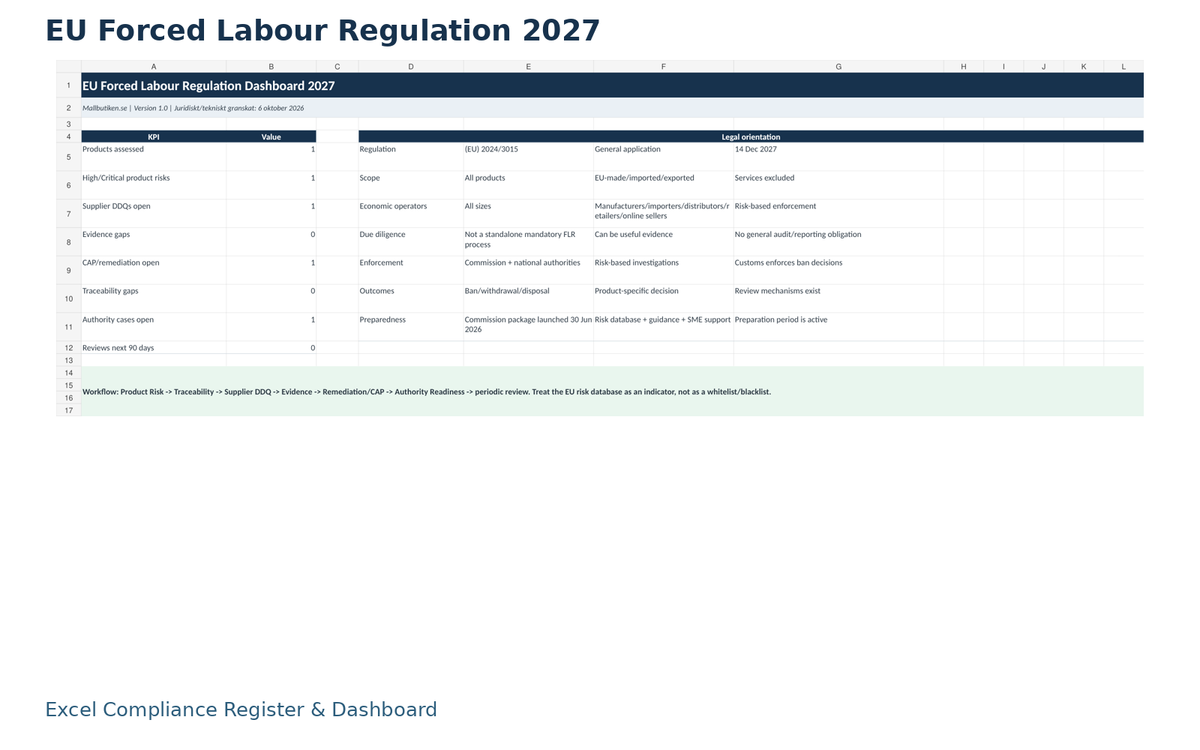
- Excel Compliance Register – dashboard and register for product risk, supply-chain traceability, DDQ, risk indicators, evidence, remediation, authority cases, and legal status.
Format and language
The package contains 16 editable Word files, 16 ready-to-use PDF files, and 1 Excel register. All document templates are provided in both a Swedish and an English version where relevant.
Who is covered?
The regulation is broadly aimed at economic operators who place products on the market, make products available on the EU market, or export products from the EU. It covers products regardless of origin and companies of all sizes. Services, however, are not covered as such.
The work of the authorities is risk-based. This means that companies should be able to demonstrate how they have identified and managed relevant risks in their specific products and supply chains. The Commission's Forced Labour Single Portal and risk database are important support tools, but a risk database should not be treated as a simple blacklist or whitelist.
How to use the package
- Register products and product groups in the Excel register.
- Assess risk based on product, geography, production stages, and labour factors.
- Map relevant suppliers, production sites, raw materials, and sub-tiers.
- Send the Supplier DDQ where information is missing or where the risk warrants further investigation.
- Save verifiable documentation in the evidence file and document information gaps.
- If a risk is identified: create a CAP/remediation plan and document decisions.
- Conduct periodic reviews and update the documentation in the event of changes to suppliers, products, or risks.
- In case of contact from authorities: secure version history and relevant evidence before providing a response.
The regulation and due diligence
The Forced Labour Regulation does not in itself introduce a standalone mandatory due diligence procedure equivalent to the CSDDD. However, a functioning risk and due diligence process can be important evidence in an authority assessment. The package can therefore be used in parallel with Mallbutiken's CSDDD/ESG, EUDR, and other supply-chain compliance packages without confusing the legal grounds.
What can happen during an investigation?
The European Commission handles cases involving suspected forced labour outside the EU, while national competent authorities handle relevant cases within their territories. The process may include risk assessment, a preliminary phase, a formal investigation, decisions, and enforcement. If a product is determined to have been manufactured with forced labour, measures may include bans, withdrawal, and disposal in accordance with the regulation's rules.
The Excel register
The Excel file serves as the ongoing master control. The dashboard displays, among other things, the number of assessed products, high/critical risks, open DDQs, evidence gaps, CAP/remediation, traceability gaps, authority cases, and upcoming reviews.
Legal status and review
Legally and technically reviewed: 6 October 2026. The package is based on Regulation (EU) 2024/3015 and the European Commission's official Forced Labour Regulation material and 2026 preparedness package. Users should always check for new guidance, national supervisory arrangements, and any implementing acts before using the material in a concrete authority case.
Important limitations
The templates do not replace individual legal advice, social audits, worker interviews, or other actual verification where needed. A completed form does not in itself prove that a product is free from forced labour. The documentation must be adapted to the actual risk profile of the product, supply chain, and business.
Primary legal sources
- Regulation (EU) 2024/3015 on prohibiting products made with forced labour on the Union market.
- European Commission's Forced Labour Single Portal and official implementation guidance.
- Commission's risk-based guidance and support resources for companies and SMEs.
Frequently asked questions
Must all companies conduct a special Forced Labour audit?
No. The regulation does not contain a general mandatory audit requirement for all companies. However, the company needs to be able to manage the product ban and should work proportionately and on a risk-based approach.
Do the rules apply to small companies?
Yes, the product ban applies to companies of all sizes, while the work of the authorities is risk-based and the EU offers specific support for SMEs.
Can I just check the EU risk database?
No. The database is a tool and is not exhaustive. It should be combined with actual product and supplier information.
Can this package be used with CSDDD or ESG due diligence?
Yes. The processes can complement each other, but the legal requirements should be kept separate.