

Svenska Dokumentmallar
Fall Risk & Work at Height 2026/2027 – Risk Assessment, Fall Protection Plan & Rescue Plan Word/PDF
Fall Risk & Work at Height 2026/2027 – Risk Assessment, Fall Protection Plan & Rescue Plan Word/PDF
 Downloading the template is available immediately after purchase. Our document templates are always delivered in customizable formats.
 If you are unsure which template is appropriate or how you should complete it, please see the relevant information under the 'Legal Information' tab in our main menu.
 Our templates are designed in accordance with current legislation and practice in each area to ensure that the documents you create are legally correct.


Couldn't load pickup availability
Fall Risk & Working at Heights 2026/2027 – Risk Assessment, Fall Protection Plan & Rescue Plan
This is a comprehensive work environment package for employers, contractors, and supervisors who need to plan, assess risks for, and document work where falls to a lower level may occur. The package is particularly useful in construction, civil engineering, industry, maintenance, property management, installation, and technical service.
The template package was regularly reviewed on October 5, 2026, primarily against AFS 2023:13 concerning risks in certain types of work and fall risks in construction and civil engineering work, AFS 2023:11 concerning work equipment and personal protective equipment, and AFS 2023:1 concerning systematic work environment management.
Delivery: 6 separate documents in both Word (DOCX) and PDF – a total of 12 files and 12 A4 pages per format series.
Included in this package
- Risk Assessment – Fall Risk & Working at Heights – 2 pages.
- Fall Protection Plan – Working at Heights – 2 pages.
- Inspection Log – Personal Fall Protection – 2 pages.
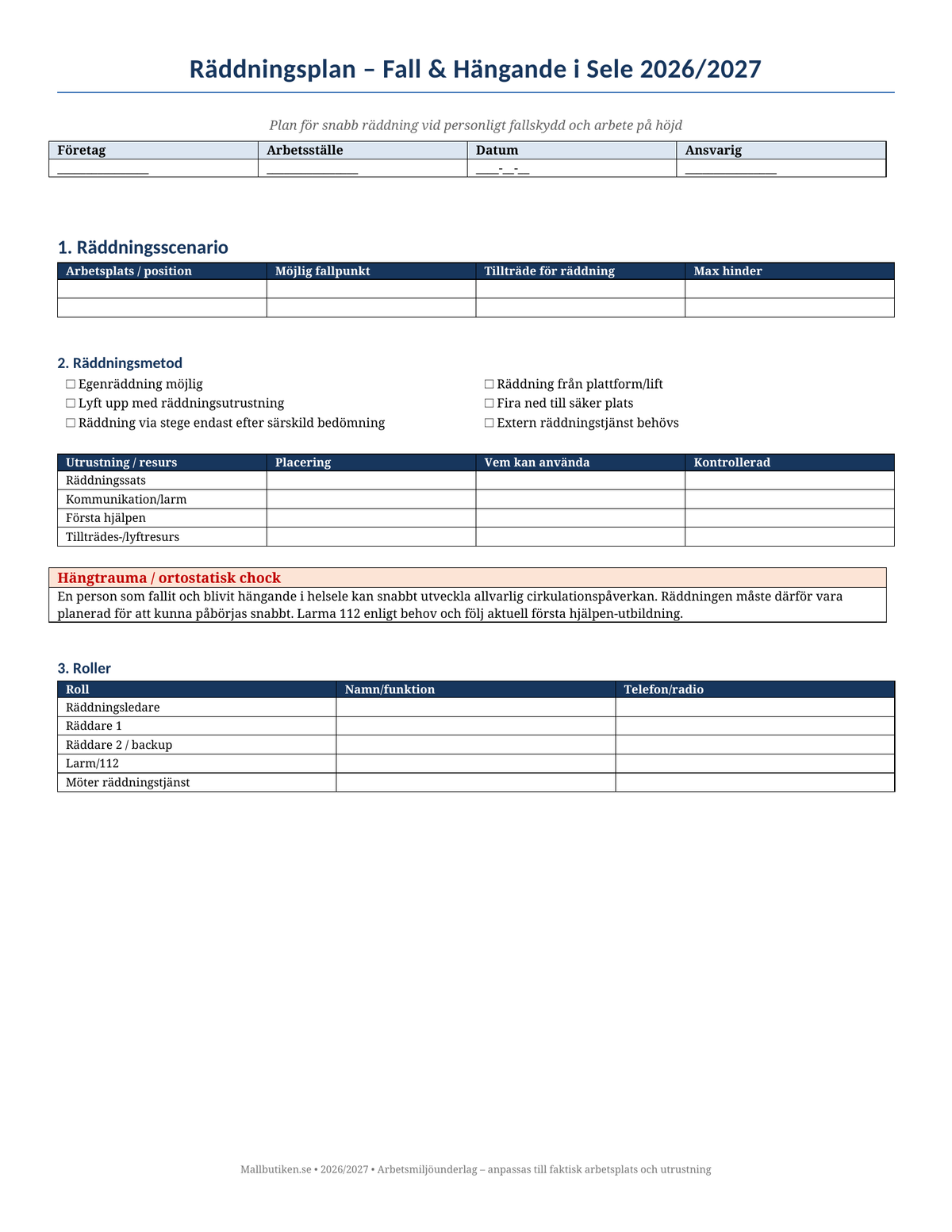
- Rescue Plan – Fall & Suspension in Harness – 2 pages.
- Start-up Checklist – Working at Heights – 2 pages.
- Detailed User Guide – 2 pages.
Fall risks must be prevented at the planning stage
The employer shall organize the work so that the risk of falling is prevented. For construction and civil engineering work, AFS 2023:13 states that the risk of falling to a lower level must be prevented both during the work itself and during movements related to the work.
The risk assessment helps you document, for example:
- open edges and roof edges,
- holes and openings in floor structures or roofs,
- steep, slippery, or fragile roofs,
- ladders, trestles, and scaffolding,
- work platforms, lifts, and work baskets,
- climbing, poles, and masts,
- weather, wind, ice, and rain,
- pendulum falls and sharp edges,
- falling objects,
- access, movement, and simultaneous work.
Two meters – an important limit but not a general "free zone" below two meters
In construction and civil engineering work, fall risks at a height of 2 meters or more must normally be prevented with collective fall protection devices.
This does not mean that falls from below two meters are automatically harmless. A lower fall height can still pose a serious risk depending on, for example, the surface, water, machinery, protruding objects, or other circumstances. The package therefore clearly distinguishes between the 2-meter rule itself and the broader obligation to assess fall risks.
Collective fall protection should be chosen first
Collective fall protection protects several people simultaneously and should normally be prioritized over personal fall protection.
Examples of collective solutions:
- guardrails,
- fixed or mobile work platforms,
- work baskets,
- scaffolding with guardrails,
- fall arrest nets.
The fall protection plan contains a clear hierarchy of measures: eliminate the fall risk → collective fall protection → personal fall protection → administrative supplements.
Guardrails and openings
AFS 2023:13 contains specific requirements for guardrails in construction and civil engineering work. Guardrails must be sturdy and normally at least 1 meter high, and must include a toeboard, an intermediate rail, and a top rail, or equivalent protection.
Openings and holes in floor structures, roofs, or similar areas where someone could fall or step through must be provided without delay with guardrails or protective covers that cannot be unintentionally displaced.
Personal fall protection – only after the correct risk assessment
Personal fall protection should not be the primary solution when collective protection is possible. When personal fall protection is used, the employer needs to ensure, among other things:
- that the system is correct for the specific task,
- that the components may be combined according to the user instructions,
- that the anchor device or anchor point is suitable,
- that pendulum falls have been assessed,
- that the minimum clearance below the user is sufficient,
- that sharp edges, heat, and chemicals have been considered,
- that the user has the correct training and practical experience.
Fall restraint or fall arrest systems?
The package distinguishes between several types of personal systems:
- Fall restraint system – limits movement so the user cannot reach the fall edge.
- Fall arrest system – stops and brakes a fall and requires sufficient clearance below the user.
- Work positioning – provides support in the work position but must be combined with other fall protection when there is a risk of falling.
- Rope access – a special method with separate working and safety lines and specific competence requirements.
Anchoring and clearance
The manufacturer's user instructions are crucial. They specify, among other things, how the equipment may be anchored and the minimum clearance required for a fall to be arrested without the user hitting the ground or obstacles.
The fall protection plan therefore contains fields for:
- location of the anchor point,
- anchor height,
- required clearance according to user instructions,
- actual available clearance,
- pendulum fall,
- edge loading and specific limitations.
Inspection log for personal fall protection equipment
The employer is responsible for ensuring that personal protective equipment is maintained, inspected, repaired, and stored so that its protective effect is retained. Damaged equipment or equipment suspected of having insufficient protective effect must not be used.
The inspection log documents, among other things:
- harness, lanyards, energy absorbers, and fall arrest blocks,
- connectors and carabiners,
- anchor devices,
- serial number and equipment ID,
- inspections and maintenance,
- incidents where the equipment was loaded,
- storage and disposal.
Inspection before each use
The Swedish Work Environment Authority's guidance states that the user should inspect their fall protection equipment before each use according to the manufacturer's user instructions. The package therefore contains checkpoints for seams, webbing, lanyards, metal components, locking functions, labeling, and visible damage.
Rescue must be planned
Personal fall protection stops a fall but does not mean that the suspended person is safe. A person suspended in a full-body harness can be subjected to serious circulatory effects, often called suspension trauma or orthostatic shock.
The separate rescue plan helps the employer decide in advance:
- how to reach the person,
- whether the person should be lifted or lowered,
- what rescue equipment is available,
- who leads the rescue,
- who calls 112,
- who meets the emergency services,
- how the rescue can be carried out without exposing the rescuer to a new fall risk.
Personal fall protection and lone working
The Swedish Work Environment Authority's guidance states that work using personal fall protection equipment should not be performed as lone work. The package therefore contains an explicit checkpoint to ensure that rescue resources and backup are actually available when personal fall protection is used.
Ladders and trestles
AFS 2023:11 states that ladders and trestles may only be used as access routes and for short-term work when the risks are so low that safer equipment is not justified.
The start-up checklist therefore checks, among other things:
- if a ladder is truly the correct work equipment,
- that the ladder has the correct length and height,
- that it stands stably,
- that the user can stand firmly and hold on safely,
- that only light tools and loads are handled on the ladder.
Scaffolding
Scaffolding is covered by special rules concerning design, guardrails, training, and inspection. The package can be used for the general fall risk assessment but does not replace specific scaffolding documents or requirements for assembly and use.
Start-up checklist before any height work
The risk profile can change quickly. The separate start-up checklist verifies before start that:
- the risk assessment is current,
- fall protection is in place,
- holes and openings are secured,
- the surface is load-bearing,
- weather and wind are acceptable,
- anchoring and clearance are verified,
- the equipment has been inspected,
- competence and instructions are available,
- rescue preparedness is functional.
Clear stop criteria
The package contains stop rules for, for example:
- missing or moved fall protection,
- deteriorated weather or strong wind,
- insufficient anchoring or clearance,
- damaged fall protection equipment,
- new opening or fall edge,
- lack of rescue preparedness,
- deviation from the planned work method.
Complements the Mallbutiken construction and work environment products
The product complements, among others, Work Environment Plan 2026/2027 and Work Preparation Construction & Civil Engineering 2026/2027. This product goes deeper into fall risk, fall protection equipment, anchoring, and rescue after a fall.
Legally/regularly reviewed for 2026/2027
The documents were reviewed on October 5, 2026, based on, among others:
- AFS 2023:13 – especially the rules on the risk of falling to a lower level and roof work.
- AFS 2023:11 – including ladders, scaffolding, and personal protective equipment.
- AFS 2023:1 – systematic work environment management.
- Work Environment Act (1977:1160).
- The Swedish Work Environment Authority's current guidance on personal fall protection and work involving fall risks.
Format and delivery
- 6 documents.
- 12 files in total.
- Word (DOCX) + PDF.
- 12 A4 pages per format series.
- Digital product – no physical item will be shipped.
Frequently asked questions
Does a 2-meter limit always apply?
Two meters is a central threshold for construction and civil engineering work, but even lower falls can pose a serious risk and require protection after a risk assessment.
Should personal fall protection be used first?
No. Collective fall protection should normally be chosen first. Personal fall protection is a secondary solution when collective protection is not possible or not reasonable for certain roof work.
Is a rescue plan included?
Yes. A separate two-page rescue plan for falls and suspension in a harness is included.
Is an inspection log for fall protection included?
Yes. It covers harnesses, lanyards, fall arrest blocks, connectors, anchoring, maintenance, storage, and incidents.
Can the template be used for scaffolding work?
Yes, as a fall risk and work preparation basis. However, it does not replace the specific training, planning, and inspection requirements that apply to scaffolding.
Can the template be used for personal fall protection on roofs?
Yes. It includes checks for anchoring, clearance, pendulum fall, system type, rescue, and competence.
Important
The templates are general work environment documents. The actual fall protection solution must be sized and chosen for the specific workplace, work task, and equipment. Always follow the manufacturer's user instructions and consult expert competence when risks or technology require it.