Svenska Dokumentmallar
Chemical Risks 2026/2027 – Risk Assessment, Chemical Inventory & Safety Instructions Word/PDF
Chemical Risks 2026/2027 – Risk Assessment, Chemical Inventory & Safety Instructions Word/PDF
- File format
- DOCX, PDF
- Document language
- Swedish
- Number of files
- 6
Digital download. No physical product is shipped.
Couldn't load pickup availability
About this template
Chemical Risks 2026/2027 – Risk Assessment, Chemical Inventory & Protection Instructions
This is a complete work environment package for businesses that handle or generate chemical risk sources. The package helps the employer move from inventory and listing to actual risk assessment, decided measures, handling instructions, exposure control, and preparedness for spills or accidents.
The template package was legally reviewed on October 4, 2026, against the Swedish Work Environment Authority's current regulations, primarily AFS 2023:10 on risks in the work environment, AFS 2023:14 on limit values for respiratory exposure, and AFS 2023:1 on systematic work environment management.
Digital delivery: a ZIP file. Previous product listing indicates 6 documents in Word/PDF (12 internal format files, 12 pages per format series), but the ZIP contents have not been separately inventoried.
This is included in the package
Verified download object: a ZIP file, Chemical_Risks_2026_2027_Template_Package.zip.
The older product listing specifies 6 document types, each in Word and PDF (a total of 12 internal format files, 12 pages per format series). The archive's internal files have not been independently inventoried.
A ZIP download is verified – not 12 separate download links.
What the files contain
Chemical inventory: chemical products and risk sources generated at work. Chemical risk assessment: actual exposure and control of limit values. Action and exposure plan: risk reduction and follow-up. Instructions and preparedness: safe handling, spills, accidents, and user guide.
Occupational exposure limits must be checked against current regulatory provisions. Actual chemical risks, CMR substances, measurement needs, and safety data sheets must be assessed at the workplace.
Documents according to the table of contents
- Chemical Inventory – Chemical risk sources – 2 pages.
- Chemical Risk Assessment – 2 pages.
- Action & Exposure Plan – 2 pages.
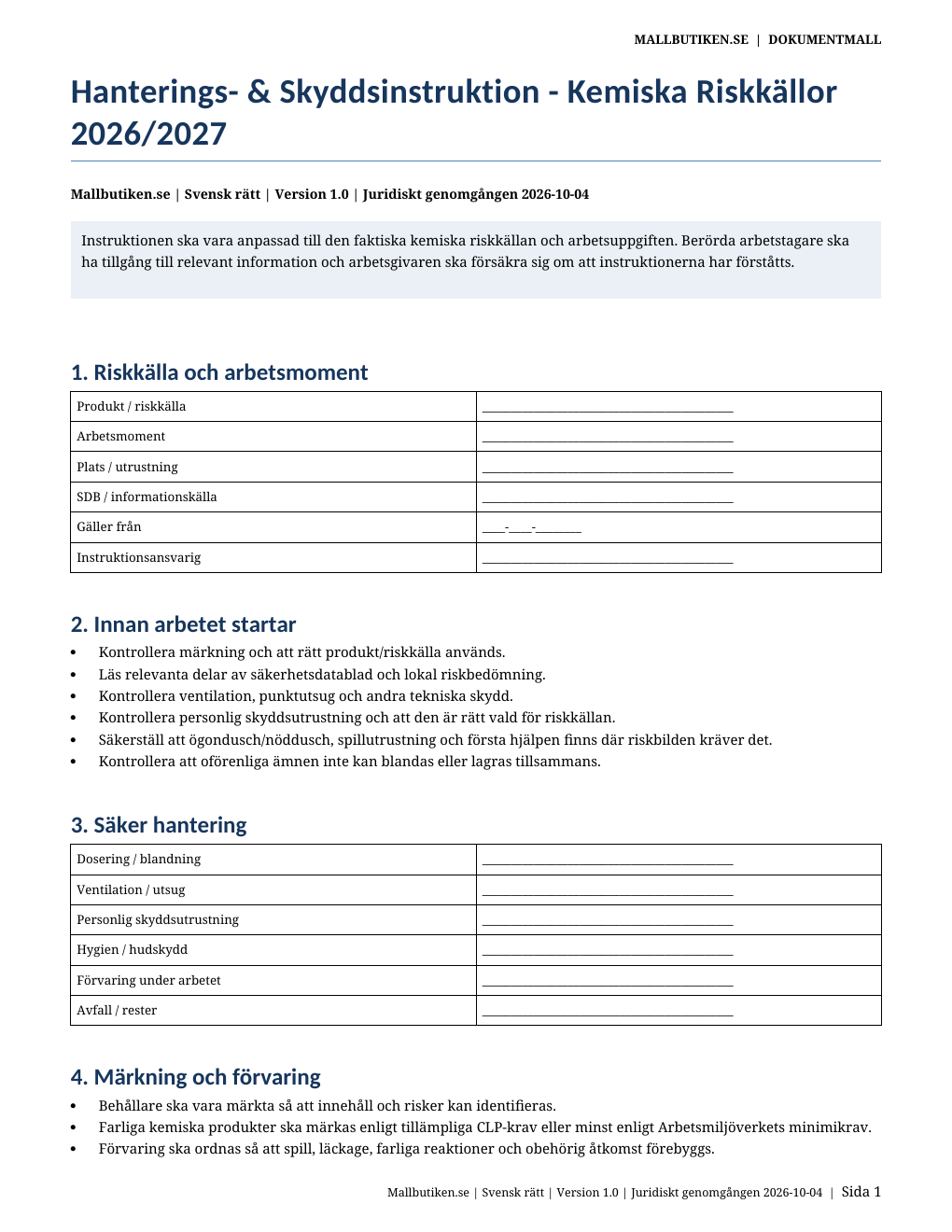
- Handling & Protection Instruction – 2 pages.
- Preparedness Plan – Spills, exposure & chemical accidents – 2 pages.
- Detailed User Guide – 2 pages.
Not just purchased chemicals
A chemical risk source can be much more than just a labeled chemical product. AFS 2023:10 also covers risk sources that are generated at work or acquire hazardous properties through the process.
Examples include:
- welding fumes,
- exhaust gases,
- quartz dust and other dust,
- vapors and aerosols,
- hot liquids,
- oxygen-deficient atmosphere,
- substances arising from heating, decomposition, or chemical reaction.
Chemical inventory according to AFS 2023:10
The employer must list the chemical risk sources that are handled or generated in the operation. The inventory in the package is structured to document the information required by the regulations, including:
- name of the risk source,
- hazardous properties and relevant hazard statements,
- where the risk source is stored, used, or generated,
- if an occupational exposure limit exists,
- which specific work environment rules apply,
- safety data sheet and information source,
- date of last update.
The template also serves as a reminder that the name of the risk source must match the labeling used in the operation.
Specific substance groups captured
The inventory includes check points for, among other things:
- sensitizing substances,
- carcinogenic substances,
- mutagenic substances,
- reprotoxic substances,
- substances with requirements for medical surveillance,
- substances subject to authorization or prohibition,
- substances and processes covered by special REACH or work environment regulations.
Chemical risk assessment – from product to actual exposure
The risk assessment is designed to evaluate how the work is actually performed, not just what is stated on the product label. The template helps the employer document:
- quantity and concentration,
- exposure route – inhalation, skin, mouth, or other contact,
- frequency and duration of exposure,
- simultaneous exposure to multiple substances,
- spills, leaks, and splashes,
- heating, grinding, spraying, welding, and other processes that generate air pollutants,
- fire and explosion risk,
- oxygen deficiency and confined spaces,
- maintenance, cleaning, sampling, and filter replacement,
- waste and contaminated materials.
Occupational exposure limits according to AFS 2023:14
The package contains specific fields to check if the risk source has an occupational exposure limit and if occupational hygiene measurements need to be conducted.
AFS 2023:14 is a consolidated limit value regulation that has also been amended during 2026. Therefore, the documents are deliberately designed so that the user fills in the current limit value at the time of assessment instead of hardcoding values that may later become outdated.
Occupational hygiene measurement
If exposure cannot be assessed safely enough in other ways, measurements may be necessary. The separate Action & Exposure Plan includes fields for:
- substance or risk source,
- measurement method,
- expert or measurement company,
- measurement date,
- results,
- comparison with current AFS 2023:14,
- decided measures.
Risk matrix and serious risks
The chemical risk assessment contains a practical risk matrix with probability, consequence, risk value, and separate marking if the risk is assessed as serious.
The risk matrix can be adapted to the company's existing methodology. The purpose is to document the assessment clearly – not to replace expert assessment when required.
Measures in the correct order
The package follows the basic hierarchy of controls. The employer should primarily:
- eliminate the risk source or work task,
- replace with a less hazardous product or method,
- use technical or collective protection such as a closed system or local exhaust ventilation,
- organize work to reduce exposure time and the number of exposed persons,
- use personal protective equipment for remaining risks.
Action & Exposure Plan
Decisions resulting from the risk assessment are documented in a separate plan with:
- risk or deficiency,
- decided measure,
- responsible person,
- status,
- deadline,
- follow-up date,
- effect of the measure,
- check if new risks have been created.
Handling & Protection Instruction
For work tasks where clear instructions are needed, a separate instruction is included that can be filled out for a specific product, risk source, or process.
It covers, among other things:
- labeling and identification,
- safety data sheets,
- ventilation and local exhaust,
- personal protective equipment,
- skin protection and hygiene,
- storage,
- waste and residues,
- measures for spills, splashes, inhalation, and fire,
- documented review with affected employees.
Labeling and storage
AFS 2023:10 requires that containers can be identified and risks are clear. For hazardous chemical products, CLP-based labeling applies, or at least the specific requirements set out by the Swedish Work Environment Authority's regulations.
The package therefore helps the company ensure that secondary containers are not used unlabeled and that storage is arranged to prevent spills, leaks, unauthorized access, and dangerous reactions.
Preparedness plan for spills and chemical accidents
A separate preparedness plan is included for realistic emergencies such as:
- spills and leaks,
- fire or explosion,
- acute inhalation,
- skin or eye exposure,
- oxygen deficiency or work in confined spaces,
- dangerous chemical reaction or gas formation.
The plan contains contact routes, alarms, evacuation, placement of spill equipment, eye wash/emergency shower, first aid, respiratory protection, and planned drills and revisions.
Documentation and information to employees
AFS 2023:10 requires that relevant documentation be accessible to affected employees and that the employer ensures that handling and protection instructions have been understood.
The separate instruction template therefore includes signature fields for documented review.
When should the risk assessment be updated?
The guide specifies clear triggers, such as:
- new chemical risk source or new work task,
- changed product, process, quantity, or ventilation,
- new safety data sheet,
- new risk information,
- changed occupational exposure limit,
- incidents, accidents, or ill-health,
- measurement results showing that previous assessment is insufficient,
- regular review.
Specially regulated risk sources
AFS 2023:10 contains additional requirements for several types of substances and work. The package therefore alerts the user that special rules may apply to, for example:
- sensitizing substances,
- CMR substances,
- substances subject to authorization,
- work in confined spaces,
- fire and explosion hazardous environments,
- quartz, lead batteries, pesticides, and cytostatics.
Recommended workflow
- List all chemical risk sources.
- Collect safety data sheets and other relevant documentation.
- Conduct chemical risk assessment for each relevant process.
- Determine protection measures according to the hierarchy of controls.
- Transfer measures to the Action & Exposure Plan.
- Establish Handling & Protection Instruction where needed.
- Adapt the Preparedness Plan to realistic emergencies.
- Inform and train affected employees.
- Follow up and revise when conditions change.
Legally reviewed for 2026/2027
The documents were reviewed on October 4, 2026, based on, among others:
- AFS 2023:10 on risks in the work environment, especially Section V and Chapters 7–10 on chemical risk sources.
- AFS 2023:14 on limit values for respiratory exposure in the work environment, current consolidated version.
- AFS 2023:1 on systematic work environment management.
- The Work Environment Act (1977:1160).
- CLP and REACH regulations where applicable.
Format and delivery
Verified delivery: a ZIP file. The product list specifies 12 internal Word/PDF files, but the archive has not been separately checked.
- 6 documents.
- 12 files in total.
- Word (DOCX) + PDF.
- 12 A4 pages per format series.
- Digital product – no physical item is sent.
Guides and related risk areas
Read the guide on chemical risk sources and listing, guide on systematic work environment management, guide on other exposure risks in the work environment.
Frequently Asked Questions
How are the various documents delivered?
A ZIP file is verified as the download object. The table of contents specifies 6 document types in Word/PDF (a total of 12 internal format files), but the archive's internal file list has not been separately inventoried.
Does the employer have to have a chemical inventory?
The employer must list the chemical risk sources handled or generated in the operation and document the information required by AFS 2023:10.
Is the safety data sheet enough as a risk assessment?
No. The safety data sheet is an important foundation, but the risk assessment must take into account the actual handling, quantity, process, and exposure at the workplace.
Are occupational exposure limits included in the template?
The template contains fields for current limit values and checks against AFS 2023:14. The actual figure must be retrieved from the current consolidated version at the time of assessment.
Can the template be used for welding fumes or quartz dust?
Yes, as a basic structure. Such risk sources may simultaneously be covered by additional specific rules that must be checked.
Is a spill plan included?
Yes. A separate preparedness plan for spills, exposure, and chemical accidents is included.
Does the package replace the company's SAM?
No. The package is a chemical-specific part of the work environment management and complements the systematic work environment management.
Important
The templates are general work environment materials. For CMR substances, sensitizing substances, uncertain exposure, confined spaces, fire/explosion risk, or complicated processes, occupational health services, industrial hygienists, or other special expertise may need to be consulted.