

Svenska Dokumentmallar
Sales Contract Motorcycle / Moped 2026/2027 – Word/PDF + User Guide
Sales Contract Motorcycle / Moped 2026/2027 – Word/PDF + User Guide
 Downloading the template is available immediately after purchase. Our document templates are always delivered in customizable formats.
 If you are unsure which template is appropriate or how you should complete it, please see the relevant information under the 'Legal Information' tab in our main menu.
 Our templates are designed in accordance with current legislation and practice in each area to ensure that the documents you create are legally correct.


Couldn't load pickup availability
Sales Contract Motorcycle / Moped 2026/2027 – Word/PDF + User Guide
This is a complete and professional sales contract for motorcycles and mopeds compliant with Swedish law. The same template can be used for motorcycles, moped class I / EU-mopeds, and moped class II, though the document distinguishes between the regulations applicable to each vehicle type.
The template package was legally reviewed on October 4, 2026, and designed for both private sales between individuals and sales where a trader sells to a consumer. It covers aspects including vehicle identity, registration, change of ownership, third-party liability insurance, inspection, tuning/modifications, technical condition, payment, and handover.
Delivery: Sales contract in Word and PDF, as well as a separate detailed user guide in Word and PDF – a total of 4 files and 10 A4 pages.
Included in this package
- Sales Contract Motorcycle / Moped 2026/2027 – 8 A4 pages.
- Detailed User Guide – 2 A4 pages.
- Appendix A – Handover Protocol.
- Appendix B – Technical Checklist for Motorcycle / Moped.
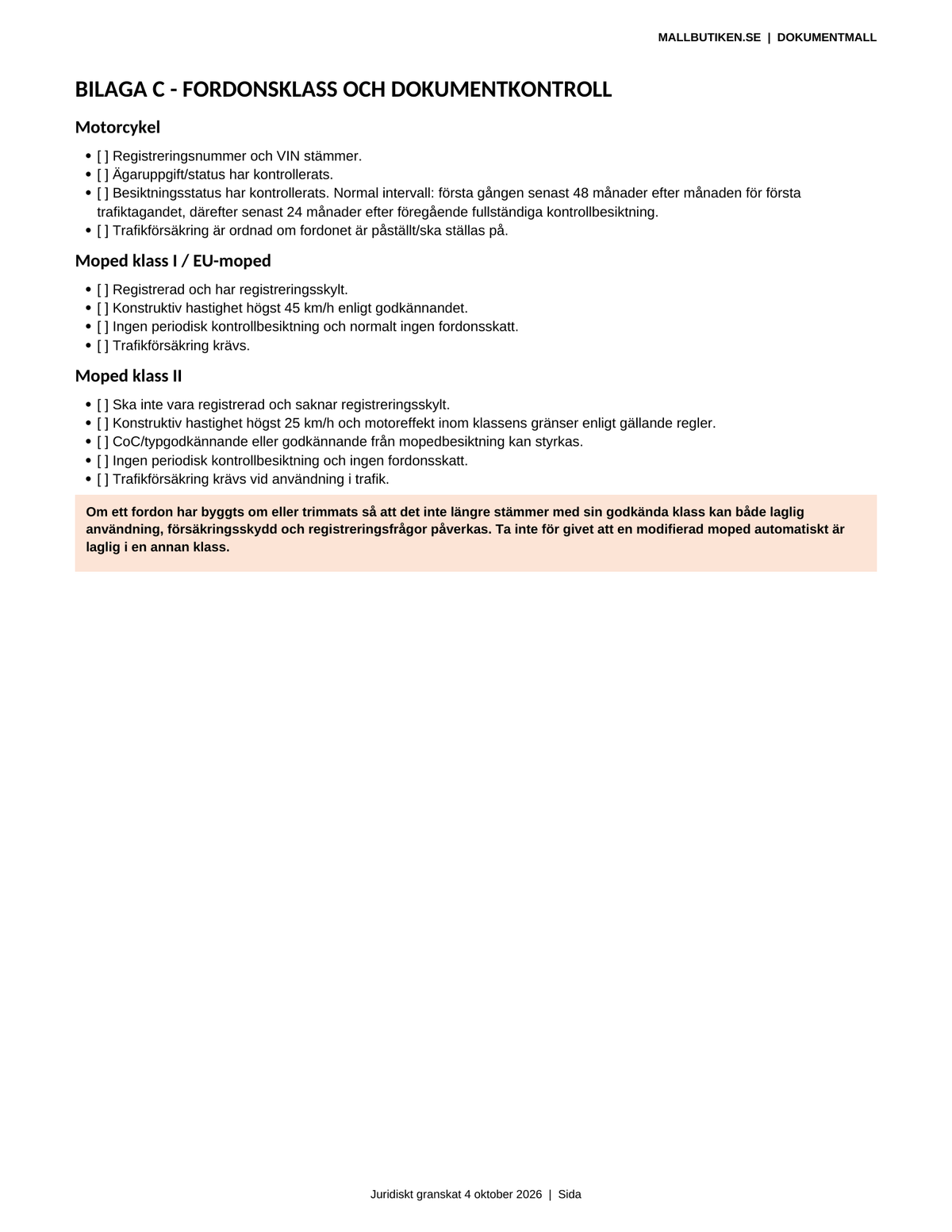
- Appendix C – Vehicle Class and Document Check.
- Word (DOCX) and PDF.
For three different vehicle types
The agreement includes a clear selection between:
- Motorcycle (MC)
- Moped Class I / EU-moped
- Moped Class II
This is essential because registration, inspection, and documentation requirements differ between these vehicles.
Moped Class I
Moped Class I must be registered and display a registration plate. The design speed is a maximum of 45 km/h according to the approval. Periodic vehicle inspection is generally not required, and vehicle tax is not normally charged, but third-party liability insurance is mandatory.
The template therefore includes fields for the registration number, registered owner, vehicle status, registration certificate, and change of ownership.
Moped Class II
Moped Class II does not generally need to be registered and therefore lacks a registration plate and a formal change of ownership process via the Swedish Transport Agency. The vehicle must meet the technical requirements of its class, including a design speed of maximum 25 km/h and applicable power limits.
For Class II, the agreement includes specific fields for:
- frame/chassis number,
- CoC/type certificate,
- moped inspection certificate,
- seller's proof of ownership and previous documentation,
- third-party liability insurance before use on public roads.
Motorcycle – inspection status check
For motorcycles, there are specific fields for the latest inspection and the next inspection date. A motorcycle must generally undergo its first inspection no later than 48 months after the month it was first put into service, and subsequently no later than 24 months after the previous full inspection.
Older motorcycles may be exempt from inspection under certain conditions. The template therefore includes a specific checkbox for this.
Private sale or consumer purchase?
Private individual to private individual: The terms agreed upon by the parties take precedence. The Sale of Goods Act (1990:931) serves as supplementary law.
Trader to consumer: The Consumer Sales Act (2022:260) applies and is primarily mandatory in the consumer's favor.
Three-year liability for defects in consumer purchases
In consumer purchases, the trader is liable for original defects that appear within three years after delivery. As a general rule, defects appearing within two years are considered the trader's responsibility unless proven otherwise or if the presumption is incompatible with the nature of the goods or the defect.
A complaint made within two months of the consumer discovering the defect is always considered to have been made on time.
"As is" condition in private sales
The template allows for the vehicle to be sold "as is." However, such a general disclaimer does not exempt the seller from liability in all situations. The vehicle may still be considered defective if, for example, the seller's information was incorrect, a significant known condition was withheld, or the vehicle is in significantly worse condition than the buyer could have reasonably expected.
Vehicle identity
The agreement documents, among other things:
- registration number where relevant,
- frame/chassis number or VIN,
- make and model,
- model year and date first put into service,
- engine, displacement, and power,
- odometer reading,
- color and distinct features,
- CoC/type certificate for Moped Class II.
Ownership, financing, and vehicle status
In the agreement, the seller can disclose information about:
- leasing or installment plans,
- retention of title,
- other financing,
- vehicle-related debts,
- driving or usage bans.
For registered vehicles, it is recommended that the buyer verifies the current registered owner and vehicle status before payment.
Modifications and tuning
Motorcycles and mopeds are often modified with components such as:
- exhaust systems,
- ECU or ignition,
- cylinder,
- variator,
- gearing or transmission,
- frame or chassis alterations.
Such changes can affect the vehicle's approval, registered data, insurance, and legal use. The template therefore requires that known modifications be explicitly documented.
Technical condition
The main agreement and the separate technical checklist cover, among other things:
- engine and cold start,
- clutch and gearbox,
- chain/belt and sprockets,
- brakes and ABS,
- tires and rims,
- fork, shock absorbers, and steering head bearings,
- battery and charging,
- lights and instruments,
- frame, corrosion, and signs of previous accidents,
- controls,
- exhaust system and tuning.
Buyer's inspection
The agreement includes specific options regarding whether the buyer has:
- test-driven the vehicle,
- waived the test drive,
- consulted a workshop or inspector,
- reviewed service and repair history.
Purchase price, deposit, and receipt
The document includes clear fields for the total purchase price, deposit, final payment, payment date, and method of payment. The agreement can also serve as a receipt once full payment has been confirmed.
Change of ownership
For motorcycles and Moped Class I, individuals can often process the change of ownership via the Swedish Transport Agency's "My Pages." When at least one party is a company, different procedures may apply, and the registration certificate Part 2 may need to be used.
For written notification of ownership change, the notification must generally be received within ten days for the specified transfer date to be registered as the official date of change.
Minor buyer
Since moped buyers are often under 18, the user guide also covers the Swedish Transport Agency's specific rules. If the minor has the appropriate driving license for the vehicle, registration can usually be handled as normal. If such qualifications are lacking, parental consent and registration of the responsible guardian may be required.
Third-party liability insurance
For a registered vehicle that is in service, or will be put into service in connection with the ownership change, the new owner must have third-party liability insurance from the date of the ownership change.
Moped Class II is also subject to requirements for third-party liability insurance when used in traffic.
Handover protocol
Appendix A helps the parties confirm:
- frame/VIN and registration data,
- odometer reading,
- payment,
- keys,
- registration certificate, service book, and CoC/type certificate,
- accessories,
- change of ownership,
- insurance.
Vehicle class and document check
Appendix C contains separate checklists for motorcycles, Moped Class I, and Moped Class II. This reduces the risk of a buyer mistakenly using registration procedures for a Class II moped or failing to obtain a CoC/type certificate.
Detailed user guide included
The guide provides a step-by-step walkthrough of:
- choosing the correct vehicle class,
- private vs. consumer purchases,
- identity verification,
- debts and financing,
- inspection,
- modifications and tuning,
- technical check,
- "as is" condition,
- the Consumer Sales Act,
- change of ownership and minors,
- third-party liability insurance,
- handover.
Legally reviewed for 2026/2027
The documents were reviewed on October 4, 2026, based on, among other things:
- Sale of Goods Act (1990:931).
- Consumer Sales Act (2022:260).
- The Swedish Transport Agency's current information on change of ownership.
- The Swedish Transport Agency's rules on third-party liability insurance.
- The Swedish Transport Agency's inspection rules for motorcycles.
- The Swedish Transport Agency's rules and information regarding Moped Class I and II.
Format and digital delivery
- Word (DOCX) – fully editable.
- PDF – print-ready A4 format.
- 2 documents / 4 files / 10 A4 pages.
- Digital product – no physical item will be shipped.
FAQ
Can the same template be used for both motorcycles and mopeds?
Yes. The agreement contains separate options and checklists for motorcycles, Moped Class I, and Moped Class II.
Does Moped Class I need to be registered?
Yes. It must be registered and display a registration plate.
Does Moped Class II need to be registered?
No. It does not normally need to be registered and does not have a registration plate.
Does a moped require a periodic inspection?
Moped Class I and II are generally not subject to periodic vehicle inspection.
Does a motorcycle require a periodic inspection?
Yes, generally according to the intervals listed above, with special rules for older motorcycles, among others.
Can a dealer use this template?
Yes, but the mandatory rules of the Consumer Sales Act apply when the buyer is a consumer.
Is a technical check included?
Yes, a separate detailed technical checklist is included. However, it does not replace a professional workshop inspection.
Important
The template is a professional general document foundation. For modified, imported, rebuilt, or technically uncertain vehicles, the Swedish Transport Agency's current information and, if necessary, a workshop/inspection body should be consulted before purchase.