Svenska Dokumentmallar
B2B Customer Agreement Template Package 2026/2027 – Word/PDF + English | Swedish Law
B2B Customer Agreement Template Package 2026/2027 – Word/PDF + English | Swedish Law
- File format
- DOCX, PDF
- Document language
- Swedish and English (Swedish law)
- Number of files
- 3
Digital download. No physical product is shipped.
Couldn't load pickup availability
About this template
B2B Customer Agreement Template Package 2026/2027 – Word/PDF in Swedish and English
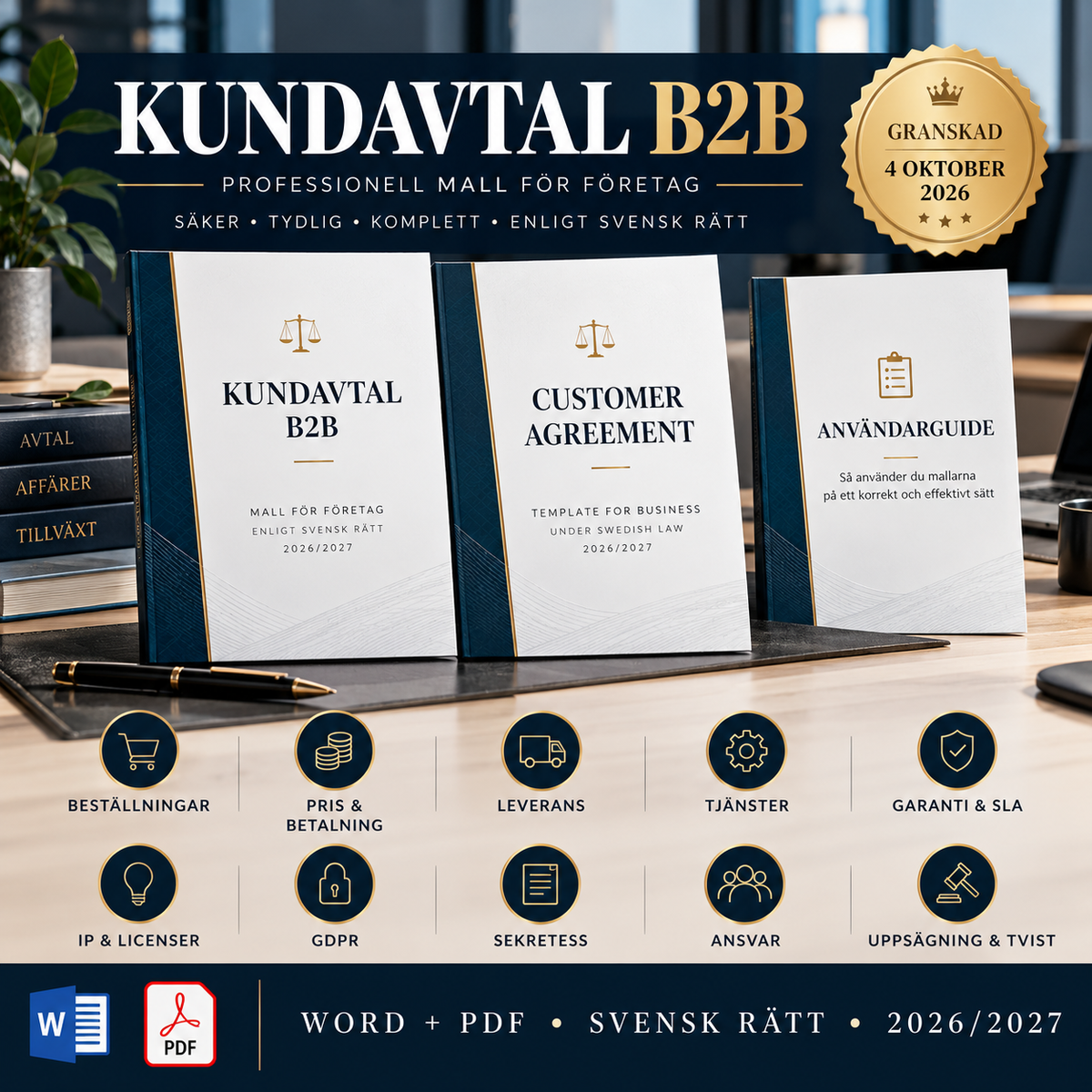
This is a complete and professional Customer Agreement for B2B relationships where a company sells and delivers goods and/or services to an identified business customer. The agreement is designed to consolidate the most important commercial and legal terms into a clear document: orders, pricing, payment, delivery, services, acceptance, warranty, SLA, intellectual property, GDPR, confidentiality, liability, term, termination, and dispute resolution.
The template package is reviewed against current Swedish law as of October 4, 2026 and developed for practical use during 2026/2027. The package includes both a Swedish B2B version and a complete English-language Customer Agreement based on Swedish law, as well as a separate detailed user guide.
Delivery: a ZIP file. The previous product list specifies three document types in Word/PDF (six internal files and 43 pages) with ten contract appendices. The internal content of the ZIP file has not been inventoried separately. No physical goods are shipped.
Included in the package
Verified download item: a ZIP file, Kundavtal_B2B_Mallpaket_2026_2027.zip.
The product's table of contents specifies three document types: Swedish B2B customer agreement, English Customer Agreement based on Swedish law, and user guide. Word and PDF versions are indicated for each document (six internal files, 43 A4 pages). The ZIP file's internal content has not been inspected separately. The ten appendices are indicated as integrated parts of the agreement.
Swedish and English. One ZIP file is linked to the delivery, not six separate download items.
What the files contain
Swedish customer agreement: parties, orders, price, payment, delivery of goods and services, acceptance, liability, data protection, and disputes. English version: Customer Agreement in English based on Swedish law. Guide: how to select and adapt the agreement and its appendices. The appendices can, for example, be used for price lists, SLAs, IP, and security requirements.
The template is intended for business-to-business use, not as a consumer agreement. Terms regarding payment and interest on late payments must be adapted to the specific business and applicable law.
Documents according to the table of contents
- Customer Agreement B2B 2026/2027 – Swedish version, 19 pages with 22 contract sections and 10 appendices.
- Customer Agreement 2026/2027 – English / Swedish law, 19 pages with a corresponding structure and 10 schedules.
- Detailed user guide, 5 pages with step-by-step instructions, legal checkpoints, and a pre-signature checklist.
When is the Customer Agreement suitable?
The template is suitable when the supplier has an identified business customer and the parties want a cohesive agreement for the entire customer relationship. This may, for example, apply to ongoing sales of products, machinery, components, or consumables, consultancy and service provision, support, installation, digital deliveries, or combinations of goods and services.
For relationships with many separate call-offs, multiple delivery locations, or very comprehensive framework terms, a separate Framework Agreement may be more suitable. The Customer Agreement, however, is ideal when the parties want a clear master agreement for a specific customer relationship with the option to make individual Orders under the agreement.
Important limitation – B2B, not a consumer agreement
This template is developed for agreements between businesses. It should not be used unchanged in consumer relationships, where mandatory consumer protection regulations may apply.
For sales of goods between businesses, the Sale of Goods Act (Köplagen) may apply. The Sale of Goods Act is largely dispositive, meaning that the parties can determine other terms through the agreement. If the service component is the predominant part of the supplier's commitment, however, the Sale of Goods Act does not normally apply to the mixed delivery. The Customer Agreement is therefore structured so that goods and services can be regulated separately.
22 contract sections
The master agreement includes, among other things:
- parties and the purpose of the agreement,
- contract documents and order of priority,
- scope and orders,
- prices, taxes, and price changes,
- invoicing and payment,
- delivery of goods,
- services and deliverables,
- inspection, acceptance, and claims,
- defects and remediation,
- warranty and support,
- intellectual property rights,
- confidentiality and trade secrets,
- personal data and information security,
- compliance and marketing,
- liability and limitation of liability,
- insurance,
- force majeure,
- term and termination,
- consequences of termination,
- Swedish law and international sales,
- dispute resolution,
- miscellaneous provisions.
10 practical appendices / schedules
- Products and Services – exactly what the agreement covers.
- Ordering process – who is authorized to order and when an order becomes binding.
- Price list and price changes – prices, currency, discount, fees, index, and notification period.
- Terms of delivery for goods – place of delivery, Incoterms, transfer of risk, packaging, and warranty.
- Services and acceptance – deliverables, staffing, milestones, and acceptance criteria.
- Warranty, SLA, and support – warranty and service levels with measurable times.
- IP and licenses – background material, standard products, customer material, and specially developed results.
- GDPR and information security – roles, systems, access, incidents, and security requirements.
- Compliance requirements – for example, regulatory requirements, security, anti-corruption, and other relevant requirements.
- Liability, term, termination, CISG, and dispute – liability caps, insurance, duration, termination, and forum.
Orders and conclusion of agreement
Appendix 2 is used to establish how Orders are to be placed, which individuals are authorized to order, and when an order becomes binding. This reduces the risk that an oral order, an email, or a purchase order unintentionally creates different terms than those intended by the parties.
The agreement also includes a clear order of priority between the master agreement, appendices, Orders, and subsequent written amendments.
Prices and price changes
Appendix 3 makes it possible to specify fixed prices, unit prices, currency, discounts, indexes, or other price adjustment models. The supplier cannot automatically refer to a future price list without support in the model that the parties have filled in.
In this way, it becomes clear how price adjustments may be made, how far in advance they must be communicated, and which fees may actually be charged.
Invoicing, 30 days, and interest on late payments
The base template uses 30-day payment terms. For B2B receivables for payment for goods or services, the Interest Act (Räntelagen) stipulates that a payment term longer than 30 days requires the creditor to explicitly approve the longer period.
The template therefore states that a longer payment term must be explicitly agreed upon. In the event of late payment, interest on late payment according to the Interest Act may be applicable. The statutory calculation is the reference rate applicable at any given time, plus eight percentage points, unless otherwise validly follows from the agreement or law.
If the statutory conditions are met, the supplier may also be entitled to compensation for late payment according to the Act on Compensation for Debt Collection Costs, etc.
Delivery of goods and the Sale of Goods Act
For goods, the place of delivery, transport liability, transfer of risk, and any Incoterms are regulated in Appendix 4. The goods must correspond to the agreed specification and the warranties that the parties have filled in.
The Sale of Goods Act (1990:931) applies to the sale of personal property but is essentially dispositive. The agreement can therefore be used to create more precise rules regarding inspection, complaints, remediation, redelivery, price reduction, and cancellation than what would otherwise follow from the Act's standard rules.
Services and acceptance
For services and digital deliverables, the parties can use Appendix 5 to define deliverables, milestones, staffing, and acceptance criteria. This is particularly useful when the agreement includes projects, installation, consultancy services, support, or other performances where "delivery" cannot be assessed in the same way as a physical good.
Warranty, SLA, and support
Appendix 6 makes it possible to specify warranty periods, availability, support hours, response time, correction time, and other service levels. The formulations are intentionally measurable so that it is possible to determine whether the delivery actually meets the agreed level.
Intellectual property rights
Appendix 7 distinguishes between the supplier's background material, standard products, customer material, and specially developed results. There, the parties can specify who owns each part and what license or right of use the customer receives.
This is particularly relevant for, for example, software, design, drawings, documentation, training material, databases, technical solutions, and consultancy deliveries.
GDPR and data processing agreements
Appendix 8 helps the parties identify personal data roles, systems, access, security requirements, and incident management. If the supplier processes personal data on behalf of the customer, the processing normally needs to be regulated through a separate data processing agreement in accordance with Article 28 of the GDPR.
The Customer Agreement therefore does not claim that a short standard clause replaces a complete DPA. Instead, there is a clear instruction on when a separate agreement needs to be established.
Confidentiality and trade secrets
The agreement includes confidentiality rules and refers to the protection of trade secrets. The parties can use the agreement to protect, for example, price lists, customer data, technical information, business plans, product information, documentation, and other non-public information shared during the cooperation.
Liability and limitation of liability
Appendix 10 contains fill-in fields for liability caps, any exceptions to the liability cap, insurance requirements, term, and termination. The levels are deliberately left open because a reasonable liability cap must be assessed in relation to contract value, risk, insurance, and the type of delivery.
Term and termination
The parties can choose a fixed contract period, an ongoing agreement, or another structure and specify the regular notice period. The agreement also contains provisions on material breach of contract, correction periods, and consequences after the agreement has expired.
International sales of goods and CISG
For international sales of goods, the Act (1987:822) on International Sales and the UN Convention on Contracts for the International Sale of Goods (CISG) may be applicable. Appendix 10 therefore contains an explicit choice where the parties can specify whether CISG should apply or be excluded.
English Customer Agreement based on Swedish law
The English version is a complete Customer Agreement with the same structure and 10 schedules. It is intended for business relationships where Swedish rules are to be applied but where the customer, supplier, group functions, owners, or advisors work in English.
The English template is thus adapted to Swedish law and should not be confused with an agreement under British or US law.
Detailed user guide included
The separate guide shows step-by-step how the Customer Agreement is used. It helps the user determine when the Customer Agreement is the right form of contract, how the appendices are filled in, how payment terms should be formulated, how goods and services are distinguished, how GDPR issues are handled, and which checkpoints should be completed before signing.
Reviewed for 2026/2027
The legal review is dated October 4, 2026. The template package has been checked against, among other things:
- the Contracts Act (1915:218),
- the Sale of Goods Act (1990:931),
- the Interest Act (1975:635),
- the Act (1981:739) on Compensation for Debt Collection Costs, etc.,
- the Act (1987:822) on International Sales,
- the General Data Protection Regulation (EU) 2016/679 (GDPR),
- the Act (2018:218) with supplementary provisions to the EU Data Protection Regulation,
- the Trade Secrets Act (2018:558).
The designation 2026/2027 means that the documents have been reviewed against the legal status at the date of review and have been developed for use during these years. In the event of later legislative changes, the template should always be checked against the new legal situation.
Format and delivery
Verified digital delivery: a ZIP archive. According to the product list, three document types, six internal Word/PDF files, and ten appendices (not separately inventoried).
- Word (DOCX) – fully editable.
- PDF – for reference, printing, and layout control.
- Digital delivery – no physical product is sent.
Guides and further reading
Read the guide on customer agreements between companies. For other delivery models, there is the guide on framework agreements and call-offs as well as the guide on service agreements. If the supplier processes the customer's personal data, you should also read the guide on data processing agreements.
Frequently asked questions
Does the same contract template apply to consumers?
No. The product is intended for businesses. When selling to consumers, a special assessment of mandatory consumer law regulations is required.
Is a payment term longer than 30 days permitted between companies?
According to Section 2a of the Interest Act, payment normally applies no later than 30 days after a demand for payment, but between businesses, longer payment terms can be applied if the creditor has explicitly approved this.
Is a short GDPR clause in the customer agreement sufficient?
Not always. If one party processes personal data on behalf of the other party, special terms that meet the requirements of Article 28 of the GDPR are normally required.
Are six individual contract files delivered?
A ZIP file is verified as the download item. The product's file list specifies Swedish agreement, English agreement, and guide in Word/PDF, but the archive has not been inventoried separately.
Important
The template package is a professional general contract basis and does not replace individual legal advice. Large contract values, regulated activities, complicated international deliveries, IT outsourcing, extensive personal data processing, advanced intellectual property arrangements, or unusually high damage risks should be assessed separately by a qualified advisor.