Svenska Dokumentmallar
Cooling towers and Legionella – reporting, self-monitoring and sampling log | Word/PDF/Excel
Cooling towers and Legionella – reporting, self-monitoring and sampling log | Word/PDF/Excel
- File format
- DOCX, PDF, XLSX
- Document language
- Five Swedish working documents Swedish User Guide and English User Guide; Swedish Excel workbook
- Number of files
- 7
Digital download. No physical product is shipped.
Couldn't load pickup availability
About this template
Cooling towers and Legionella – document package for notification and risk-based self-monitoring. For property owners, industrial operators, and those responsible for operation who install, use, or modify cooling towers in Sweden. The package helps you determine notification requirements, document technology and responsibilities, establish self-monitoring, track test results, and notify the supervisory authority of changed conditions. It is not a government form, a laboratory certificate, or an automatic operating approval.
Quick facts: 7 independent documents as 7 editable Word files (DOCX) and 7 corresponding searchable, printable PDF files, plus 1 Excel workbook (XLSX) with 9 tabs – 15 files in total. Five Swedish working documents, a Swedish user guide, and an English User Guide for using the Swedish documents. The PDF files are not interactively fillable. Digital ZIP delivery. No physical shipping.
Package contents
Five Swedish working documents: (1) applicability assessment and notification, (2) risk assessment and self-monitoring, (3) sampling plan and operating log, (4) non-compliance, risk decisions, and verification, and (5) change notification and supervisory response. Two guides: Swedish guide and English User Guide. Each has a DOCX file and a corresponding PDF; plus a Swedish XLSX workbook with nine tabs. 7 DOCX + 7 PDF + 1 XLSX = 15 customer files.
What the files contain
Identify cooling towers and actual aerosol formation; assess the environmental assessment exemption, collect facility drawings and technical appendices; allocate responsibilities and create a risk-based control plan. Document sampling locations, actual laboratory results, actions, authority contacts, and any changed reported conditions. Excel compiles administrative data but never determines safe operation, regulatory approval, or legal compliance.
Who should choose the template – and who needs something else?
Suitable, for example, for a property owner with evaporative cooling who needs to determine whether a cooling tower must be reported to the municipality, or an operating organization that needs to compile a risk assessment, control log, and Legionella tests before inspection. Existing cooling towers also need to be assessed, and the operator may need to show that notification has already been made.
Not suitable as a substitute for an accredited laboratory analysis, a technically validated water treatment plan, a government-prescribed notification form, or expert support in cases of suspected disease transmission. For domestic hot water/HVAC systems only, a separate package for hot water control is more appropriate.
File by file – function, language, and format
| Document | Specific use | Language | Format and function |
|---|---|---|---|
| 01. Applicability and notification | Assess aerosol, 38 c exemption, prior notification, technical data, and appendices | Swedish | Editable DOCX, searchable/printable PDF |
| 02. Risk assessment and self-monitoring | Risk factors, organizational responsibility, maintenance, and chemical management | Swedish | DOCX + PDF |
| 03. Sampling plan and operating log | Sampling points, control occasions, laboratory report, and manual assessment | Swedish | DOCX + PDF |
| 04. Non-compliance and risk decisions | Actual events, action decisions, and verified follow-up | Swedish | DOCX + PDF |
| 05. Change notification and supervisory response | Written notification of changed reported conditions or supplement to a supervisory matter | Swedish | DOCX + PDF |
| 06. User guide | Legal boundaries, step-by-step, and completion checklist | Swedish | DOCX + PDF |
| 07. English User Guide | English instructions for the Swedish documents, not foreign law | English | DOCX + PDF |
| 08. Self-monitoring register | 9 tabs: overview, facilities, notifications, risks, controls, test results, non-compliance, actions, and read me | Swedish | Editable XLSX |
The Excel tool in practice
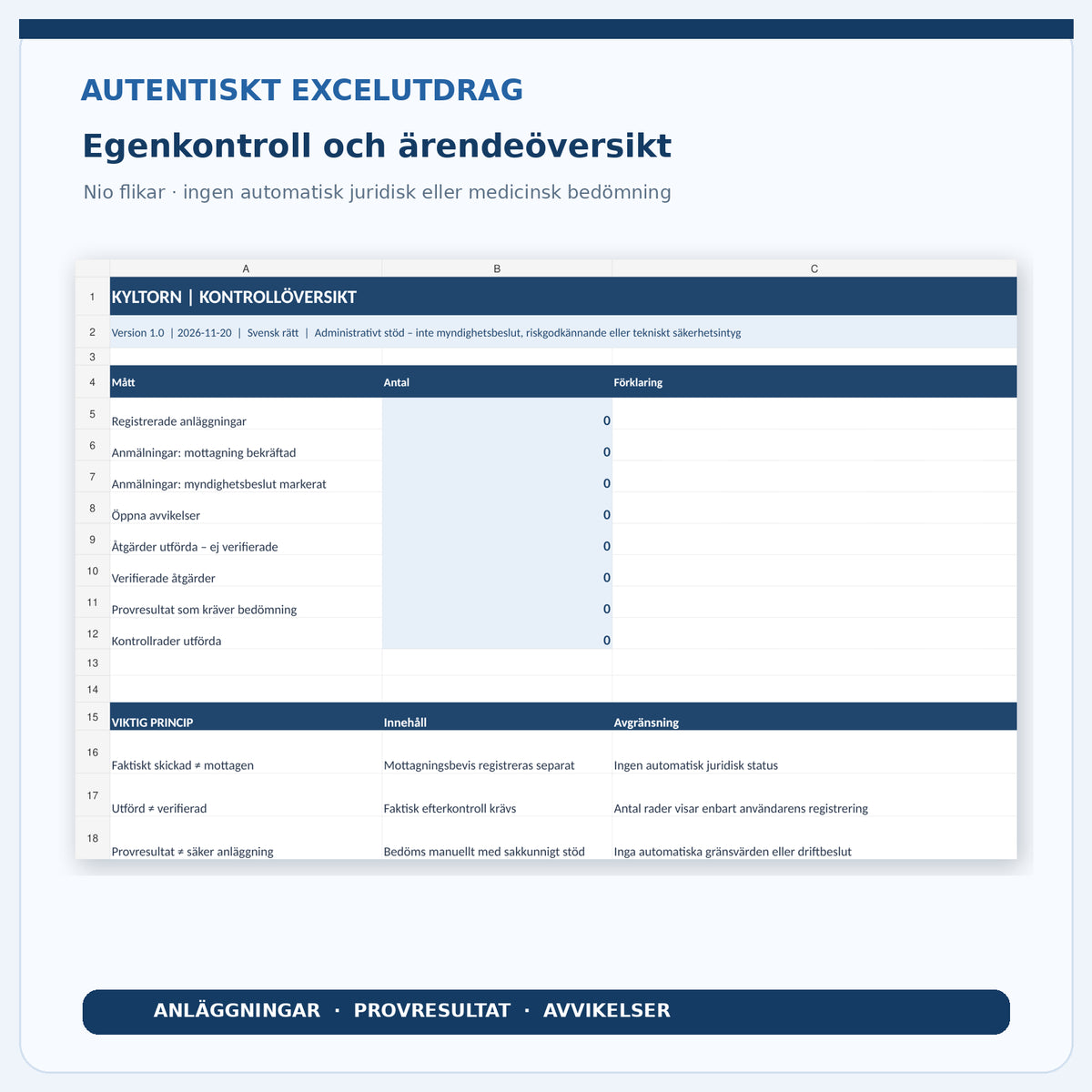
Excel contains filterable registers, ID fields, status selections, and formulas that summarize registered facilities, receipt-confirmed notifications, open non-compliance issues, completed but not yet verified actions, and test results awaiting assessment. The formulas have been tested with fictitious scenarios, and example data has been cleared.
Example: If a test result requires new expert assessment, it can be registered as “Assessment required.” The workbook does not convert the test result to “approved operation” or calculate a legal start date. Submitted notification, proof of receipt, and government decision are kept separate.
Workflow from facility to archiving
- Prepare: find the cooling tower ID, technical function, current drawings, responsible operator, and supervisory authority.
- Assess applicability: investigate aerosol formation, any prior notification, and the exemption under Section 38 c.
- Compile notification materials: select the municipality’s prescribed path/e-service and attach the necessary drawings and technical descriptions.
- Establish self-monitoring: assess local risks, designated persons, and actually suitable control and sampling routines.
- Document operation: enter measurements, laboratory tests, and non-compliance issues with source documentation.
- Decide and follow up: the competent responsible person reviews uncertain results and documents actions and separate follow-up control.
- Notify and archive: when Section 38 b applies, notify changed reported conditions immediately and preserve actual receipts/decisions.
Which law applies?
Notification requirement: According to Section 38 a of the ordinance (1998:899), it is prohibited to install or use a cooling tower covered by the definition without notification. Notification is made to the competent municipal committee or, in some cases, the defense inspector for health and environment. Installation/use may normally begin no earlier than six weeks after notification unless the supervisory authority decides otherwise. If the same cooling tower has been reported previously, another such notification is not required.
Change and exemption: According to Section 38 b, the operator must immediately notify the supervisory authority when a reported condition changes. However, Section 38 c exempts cooling towers that are part of an activity subject to permit or notification requirements under the environmental assessment ordinance (2013:251) from Sections 38 a–b. Other environmental requirements do not disappear. According to Section 46, relevant notifications and notifications must be in writing and contain the necessary information, drawings, and technical descriptions. Read the provisions at the Swedish Parliament.
Self-monitoring: The rules of the Environmental Code and the ordinance (1998:901) on operators’ self-monitoring are relevant for actual risk work, documented allocation of responsibility, and maintenance. Read the self-monitoring ordinance. The Public Health Agency’s supervisory guidance on Legionella in cooling towers explains how risk-based self-monitoring can be designed. Supervisory guidance and proposed action levels are not the same as binding universal laboratory limits.
Compare with related documents
For Legionella control in domestic hot water and HVAC instead of evaporative cooling towers, see Legionella control and hot water log. For broader documentation of events and government contact in environmental matters, see Environmental operational disruption – government notification and evidence log. More related packages are available in Environment and facility control.
Frequently asked questions
Must all cooling towers be reported?
No. Applicability depends, among other things, on whether the cooling tower can form aerosols according to the definition and on the exemption in Section 38 c for certain activities already subject to environmental assessment. Existing cooling towers may also be covered. Find out the actual technical conditions.
Can I start the cooling tower immediately after the notification has been sent?
Normally no. Section 38 a states six weeks from notification as a starting point unless the supervisory authority decides otherwise. A submitted email or a checkmark in Excel is not a government approval.
What should be sent with the notification?
A written notification with the information, drawings, and technical descriptions required to assess the cooling tower according to Section 46. Also check the current municipality’s instructions and e-service.
Does the package apply if I have already reported the cooling tower?
Yes, for ongoing self-monitoring and documentation. The same cooling tower normally does not need to be reported again solely because the template is used, but changed reported conditions may trigger notification under Section 38 b.
Does Excel automatically indicate which Legionella levels are acceptable?
No. Test results, method, need for action, and control intervals must be interpreted with facility-specific and expert support. Excel only summarizes administrative status.
Are the PDF files digitally fillable, or are the documents in English?
The PDF files are searchable and printable but not interactively fillable. Five working documents and Excel are in Swedish; the English User Guide explains the Swedish files without constituting a translation of the main legal documents.
Is it a government-approved basis?
No. The templates are general working documents that must be adapted to the facility’s technology, responsibilities, risks, and the responsible authority’s processing.
Sources, version, and review status
Edition 1.0, November 20, 2026. AI-assisted legal source review has been performed against Sections 38 a–38 c and 46 of the Environmental Code, the self-monitoring ordinance, and the Public Health Agency’s guidance. The actual final documents, PDF renderings, and Excel functions have undergone internal control. No external independent legal, engineering, laboratory, or government review has been performed. This template does not replace advice in cases of suspected disease transmission or extensive technical risks. No guidelines in the templates automate the start of operations or legal compliance.