Svenska Dokumentmallar
County-controlled water during trenching – sampling plan, diversion test and discharge log | Word/PDF/Excel
County-controlled water during trenching – sampling plan, diversion test and discharge log | Word/PDF/Excel
- File format
- DOCX, PDF, XLSX
- Document language
- Five Swedish working documents Swedish User Guide and English User Guide; Swedish Excel workbook
- Number of files
- 7
Digital download. No physical product is shipped.
Couldn't load pickup availability
About this template
Do you need to pump water out of an excavation pit during construction or earthworks? This document package helps contractors, project managers, and environmental coordinators document dewatering water from rain, construction processes, and intruding groundwater – from the initial risk assessment to actual sampling, selection of a discharge route, contact with the water and waste authority, operation log, and non-compliance follow-up.
Three controls must not be confused: (1) whether groundwater dewatering itself may require a permit under Chapter 11 of the Swedish Environmental Code, (2) whether discharge to land or a recipient can be accepted under environmental regulations and actual decisions, and (3) what requirements the water and waste authority sets for connection to a storm or wastewater system. A decision in one of these areas never automatically constitutes approval in the others.
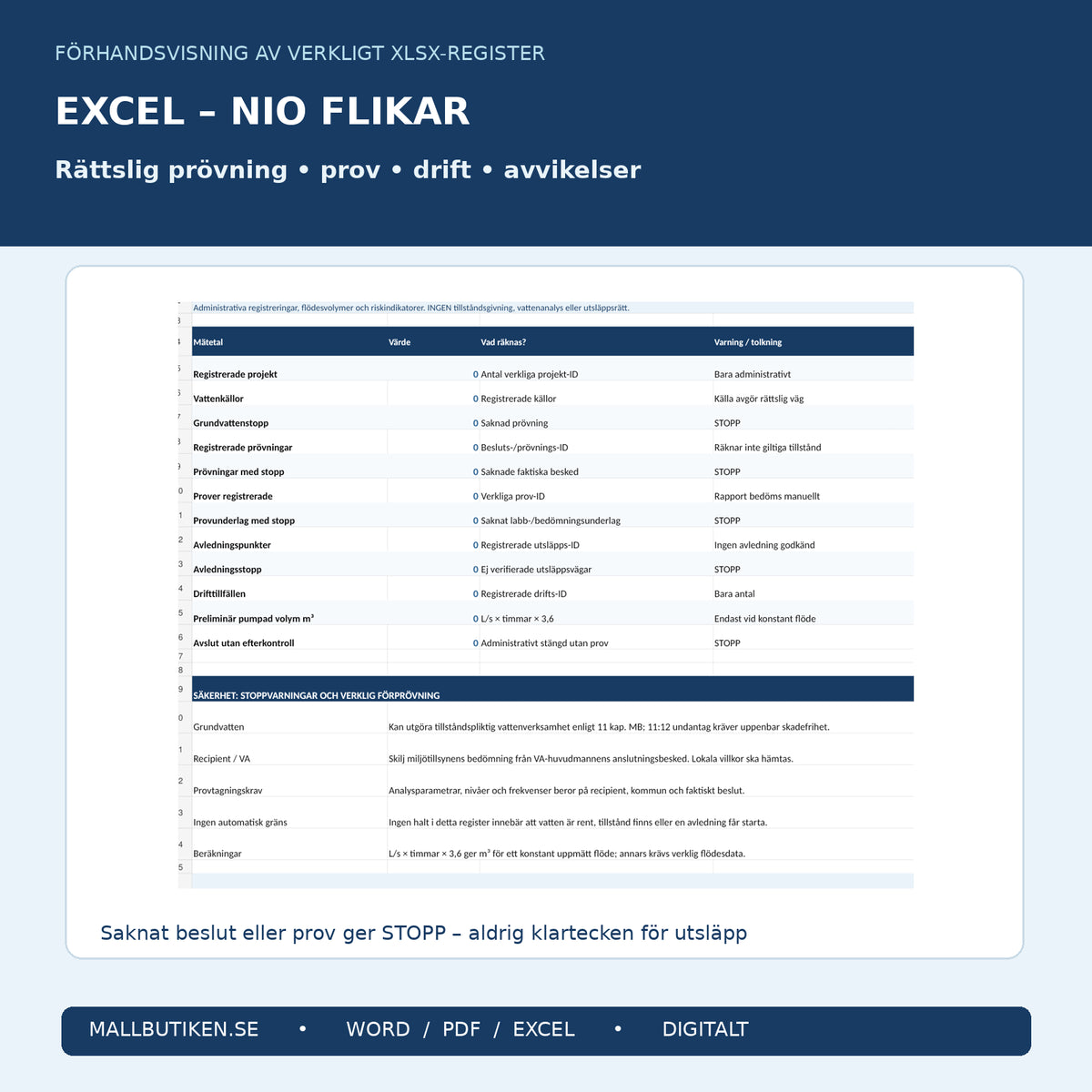
Digital delivery: Five Swedish working documents, one Swedish user guide, and one English User Guide. All seven are available as editable Word files (DOCX) and corresponding searchable, printable PDF files. In addition, a Swedish Excel register (XLSX) with nine tabs and 712 formulas is included. Total 7 DOCX + 7 PDF + 1 XLSX = 15 customer files in a ZIP. No physical shipping. The PDF versions are not interactively fillable. The file link to the digital delivery app is provided separately before future publication.
Package contents
01 Preliminary assessment – water source, groundwater, and legal track. 02 Sampling plan – sampling point, analysis order, and laboratory reference. 03 Discharge route – recipient, water and waste authority, contact, and actual decision. 04 Operation log – flow, treatment, water volume, and discharge. 05 Non-compliance protocol – stoppage, authority contact, and follow-up. 06 Swedish user guide. 07 English User Guide. All seven are available in both Word and PDF. 08 Excel register with nine tabs.
What the files contain
Fields for actual project ID, property, municipality, responsible contractor, water source, suspected contaminants, sampling points, and laboratories. You can record water volumes, the actual recipient, the water and waste authority's confirmation, diary number, and conditions from actual decisions. Excel provides STOP warnings when groundwater testing, an analysis report, a discharge decision, or follow-up is missing. Even when the documents are recorded, the register only shows manual assessment, never automatic discharge approval or proof of clean water.
For which types of construction work are the templates suitable?
Excavation for foundations: A construction site needs to divert rainwater and intruding water. The package helps document the actual water source, what needs to be investigated, and which water law track needs to be assessed before pumping.
Utility trenches with discharge to the municipal network: The water may contain sediment or other contaminants. Separate contact with the supervisory authority and water and waste authority may be required. In Stockholm, Stockholm Vatten och Avfall must be contacted before dewatering water is discharged into their utility network. This local arrangement should not be confused with a general nationwide fee or a national limit value.
Excavation in suspected contaminated soil: If the water may contain metals, oil, or other substances, the risk, sampling plan, and recipient must be assessed by an expert. If a contaminant is discovered on the property that could harm human health or the environment, special obligations apply under, among others, Chapter 10, Section 11 of the Swedish Environmental Code for the owner or user of the property.
Water from drilling or blasting: The process may affect water quality in ways other than a typical rain-filled excavation pit. Therefore, investigate sampling parameters and the recipient based on actual work steps.
Scope: The package is not an official municipal form, sampling standard, hydrogeological assessment, treatment technology design, water activity permit, water and waste agreement, or binding legal assessment. No nationally invented limit values for metals, oil indices, or other substances are included.
File list – document, function, and format
| File | Practical function | Language and format |
|---|---|---|
| 01 Preliminary assessment and groundwater | Identify the actual water source, contamination, permit track under Chapter 11, and authority contact. | Swedish · DOCX + searchable PDF |
| 02 Sampling plan | Select the correct sampling points, parameters, laboratory, and original reports for the relevant recipient with expert guidance. | Swedish · DOCX + PDF |
| 03 Discharge route and water and waste decision | Document infiltration, surface water, storm or wastewater, or an external recipient, as well as actual conditions. | Swedish · DOCX + PDF |
| 04 Operation log | Record actual flow, duration, measured water, sampling proof, operational failures, and the responsible party. | Swedish · DOCX + PDF |
| 05 Non-compliance and stoppage protocol | Document contamination, uncertain discharge route, supervisory contact, correction, and follow-up. | Swedish · DOCX + PDF |
| 06 Swedish user guide | Eight guidance sections, scenarios, workflow, and official legal sources. | Swedish · DOCX + PDF |
| 07 English User Guide | Instructions for using the Swedish administrative forms for excavation water. | English · DOCX + PDF |
| 08 Excel – discharge and control register | Nine tabs, filterable tables, status selections, control formulas, and twelve overview metrics. | Swedish · XLSX |
Excel – nine tabs and actual control signals
The workbook contains Project, Water Sources, Permits, Samples, Diversion, Operation, Non-compliance, Overview, and Read Me. The seven registers each have 100 pre-filled rows. You can follow up on all project IDs, sampling reports, discharge points, and recorded actions. No entry can be made into an official authority certificate simply because the user selects “Yes” in a status field.
Scenario 1 – groundwater: A source is recorded as Groundwater, but a review of Chapter 11 of the Swedish Environmental Code is missing. Excel displays “STOP – GROUNDWATER ASSESSMENT MISSING”.
Scenario 2 – recipient and sample: A sample entry is missing a laboratory report or expert assessment. Excel displays “STOP – ANALYSIS DATA MISSING”. Even when the report is present, a manual assessment of any site-specific conditions remains.
Scenario 3 – utility network: A storm or wastewater connection is missing an actual decision from the water and waste authority. Excel displays “STOP – WATER AND WASTE DECISION MISSING”.
Scenario 4 – pumped volume: A constantly measured flow of 2.0 liters per second for 1.5 hours yields 10.8 m³ according to the formula liters/second × hours × 3.6. This is a mathematical scenario, not proof of the right to pump or discharge the water; varying flow must be measured appropriately.
Scenario 5 – non-compliance: An action marked as completed without actual follow-up data generates “STOP – FOLLOW-UP MISSING”. All test entries are cleared from the delivered customer file.
Workflow: from excavation pit to archived discharge log
- Separate the water sources: investigate whether it is rain/surface water, construction process water, groundwater, or a mixture.
- Assess the groundwater issue separately: an expert assesses whether pumping constitutes a water activity and whether a permit, exemption, or other form of assessment applies.
- Inventory contaminants: base this on historical land use, excavation or blasting methods, and actual risk indicators.
- Determine the discharge route: infiltration, surface water recipient, storm water, wastewater, or external transport – with the correct contact channel for each option.
- Sample correctly: determine the sampling point, parameters, frequency, and analysis method together with an expert and the relevant supervisory authority.
- Obtain actual decisions: retain diary numbers, instructions, water and waste agreements, and conditions with validity dates.
- Log the operation: record actual water volume, sampling, treatment controls, and incidents.
- Stop and follow up on non-compliance: if quality, permits, or the discharge route are unclear, a separate assessment and potential stoppage are required.
Swedish law – what governs dewatering water?
The Swedish Environmental Code (1998:808), Chapters 2 and 9: The operator is responsible for knowledge and reasonable precautionary measures to prevent harm to people and the environment. Water diverted from construction and excavation work may need to be assessed against the rules for environmentally hazardous activities, wastewater, and the protection needs of the affected recipient. There is no single national limit value that can be copied for all municipalities, businesses, and recipients.
Chapter 11 of the Swedish Environmental Code – groundwater dewatering: According to the Swedish Geological Survey (SGU), dewatering groundwater from excavations is generally a water activity requiring a permit. The exemption in Chapter 11, Section 12 applies only when it is obvious that neither public nor private interests will be harmed. The operator must be able to substantiate any exemption assessment. Water activity permits and the right to discharge pumped water to a specific recipient are separate matters.
Chapter 10, Section 11 of the Swedish Environmental Code: If the owner or user of a property discovers relevant contamination that may cause harm or nuisance, the supervisory authority must be notified immediately under the provision. The actual situation needs to be assessed, and the document package must not be used to replace such a notification.
Primary source: The Swedish Environmental Code at the Swedish Parliament. Geological permit guidance: The Swedish Geological Survey (SGU).
Important: Stockholm and Sundbyberg are local examples
City of Stockholm: The Environmental Administration's guidance states that water discharged into the surrounding environment must be sampled before diversion and that the administration must be informed of analysis results and planned management. Before discharging into the utility network, Stockholm Vatten och Avfall must be contacted. City of Stockholm – Water Discharge.
Stockholm Vatten och Avfall: Prescribes its own guidelines, connection points, service requests, and, where applicable, special notifications. They can assess whether dewatering water may be accepted after treatment. SVOA – Dewatering Water.
City of Sundbyberg: Has separate, recipient-specific guidance for treatment equipment, sampling, and discharge parameters. These are local guidelines and must not be used as general Swedish limit values. Sundbyberg – Guidelines for Dewatering Water.
Other municipalities: Identify the actual recipient, the permit and notification track for the activity, and the current requirements of the water and waste authority. The year 2026 in this product refers to the document version; no new universal discharge limit for 2027 is claimed.
Frequently asked questions about dewatering water
Must water from an excavation pit be sampled before it is pumped away?
It depends on the water source, risk, planned recipient, and local requirements. The City of Stockholm specifies sampling before discharge into the surrounding environment, but the same routine cannot automatically be applied to all municipalities.
Can I pump excavation water directly into a storm drain?
Not without having assessed where the storm water system leads, any potential contamination, and the conditions of the relevant water and waste authority. A storm drain is not a general approval.
When is pumping from an excavation pit a water activity requiring a permit?
Dewatering groundwater may require a permit under Chapter 11 of the Swedish Environmental Code. The exemption under Chapter 11, Section 12 presupposes that the absence of harm is obvious. Contact an expert and, if necessary, the County Administrative Board or another competent authority.
Do I need both the municipality's decision and the water and waste authority's approval?
Different activities may require both. The environmental supervisory authority assesses the environmental effects of the discharge; the water and waste authority determines whether the network can accept the water according to the applicable connection conditions.
What substances should be analyzed in dewatering water?
The parameters are determined by an actual risk assessment, the water source, excavation or blasting work, potential soil contamination, and the receiving recipient. The package does not fill in a fictitious national standard panel.
Can I use Sundbyberg's guideline values for a project in Gothenburg?
No, not automatically. The values are linked to the municipality's assessments and recipients. Obtain the local conditions for the relevant project.
Can Excel calculate whether the water is legally allowed to be discharged?
No. Excel can summarize entries and preliminary volume, but it does not analyze water quality, the applicability of legislation, or any authority decision.
How does Excel calculate m³ from a pump's capacity?
The simple math is liters per second × hours × 3.6. For varying flow, actual measured values or an expert calculation model must be used.
What do we do if contaminated soil is discovered during excavation?
Limit the risk and investigate the need for immediate notification under Chapter 10, Section 11 of the Swedish Environmental Code. Follow the actual instructions of the responsible expert and the authority.
Can the company issue its own "approved discharge" certificate?
Not with the support of this template. It is an administrative working document. Actual decisions, sampling reports, and agreements must be issued by the respective competent authority.
Are the PDF files fillable, and is there an English version?
The PDF files are searchable and printable, not interactively fillable. Five working documents and Excel are in Swedish. An English User Guide is included.
Is the product legally or environmentally certified?
No. AI-assisted source checking and internal technical file QA have been performed, but no independent lawyer, hydrogeologist, water and waste technician, or authority has reviewed or approved the templates.
Related document template – a different area of work
For long-term operation and maintenance of the storm water system itself, Storm Water System – Operation Agreement, Supervisory Log, and Maintenance is also available. This new product instead applies to temporary water during land and excavation work, including groundwater testing, sampling, and discharge route.
Quality status and limitations
Version 1.0 – November 20, 2026. Official legal sources have been checked with AI assistance. All seven DOCX files, seven searchable PDFs with 14 A4 pages, nine Excel tabs with 712 formulas, stop signals, and ZIP integrity have been tested. No external independent legal, hydrogeological, laboratory, or authority review has been performed. The product does not provide individual legal advice or technical guarantee and has not been separately run in installed Microsoft Office. Always follow actual site conditions, local regulations, sampling reports, and decisions from competent authorities.