Svenska Dokumentmallar
MiCA Article 74 – wind-down plan, client assets and transfer certificates | Word/PDF/Excel
MiCA Article 74 – wind-down plan, client assets and transfer certificates | Word/PDF/Excel
- File format
- DOCX, PDF, XLSX
- Document language
- Five Swedish operational templates and a Swedish user guide as DOCX/PDF; separate English User Guide as DOCX/PDF; one Swedish Excel workbook with nine tabs. No complete English translation of the five work templates.
- Number of files
- 7
Digital download. No physical product is shipped.
Couldn't load pickup availability
About this template
Does your crypto company need to prepare an orderly wind-down or transfer of customer assets? An orderly wind-down plan under MiCA Article 74 must demonstrate that the affected crypto-asset service providers can cease their business in an orderly manner without causing undue financial harm to customers. This product package contains practical templates for customer balances, custodians, customer communications, recipient checks, and traceable transfer and closure confirmations.
Important legal distinction: Article 74 expressly applies to the service providers in Articles 75–79. This is a different scope from ESMA's and the Swedish Financial Supervisory Authority's supervisory message that companies without the required MiCA authorisation must cease unauthorised business after the end of the transitional period on 1 July 2026. The package addresses both situations without conflating them. Read ESMA's Article 74 and the Swedish Financial Supervisory Authority's notice of 1 July 2026.
Package contents
15 customer files: five editable Swedish templates, a Swedish user guide, and a separate English User Guide. All seven documents are available in DOCX and matching searchable PDF – a total of 7 Word + 7 PDF files. The package also includes a Swedish Excel workbook with nine tabs. The PDF files are printable and searchable, but not interactively fillable. The English guide is not a complete English translation of the five templates.
What the files contain
Documents for deciding which business areas and critical functions are affected; manually controlled balance reconciliation and discrepancy tracking; customer communications before withdrawal or migration; verification of the receiving provider or own wallet; checks of money laundering risks, sanctions, and customer instructions; evidence of actual customer receipt; residual and exception registers; and a formal decision on the completion of the wind-down. No API connections, private keys, seed phrases, or automated customer transactions are included.
Who needs a MiCA wind-down plan?
Crypto custodians: need to keep customer crypto-assets separate from the company's other assets. Crypto exchanges or trading platforms: must maintain sufficient functions to inform customers, manage open cases, and carry out permitted customer protection measures. CASPs with multiple group companies: must verify the individual legal entity's actual authorisation – not just the brand or the fact that another group company is authorised. Companies that did not receive authorisation: need to act in accordance with actual supervisory expectations and any individual regulatory decisions.
What is included file by file?
| Document | Work step | Format |
|---|---|---|
| Applicability and management decision | Assessment of actual MiCA service, relevant legal entity, and right to continue operations. | DOCX + searchable PDF |
| Customer assets and reconciliation | Customer balance, custodian balance, source data, discrepancies, and actual reconciliation check. | DOCX + searchable PDF |
| Customer notification and transfer information | Customer letter regarding service change, alternatives, secure communication channel, and dispatch confirmation. | DOCX + searchable PDF |
| Transfer and recipient verification | Verification of receiving CASP, AML/CFT, destination check, and final receipt confirmation. | DOCX + searchable PDF |
| Final wind-down and exceptions | Open customer requirements, remaining assets, critical functions, and management's final decision. | DOCX + searchable PDF |
| Swedish user guide | Eight steps, legal sources, scopes, and work process. | DOCX + searchable PDF |
| English User Guide | English instructions for the Swedish documents and Excel register. | DOCX + searchable PDF |
| Excel with nine tabs | Services, customers, assets, transfers, customer letters, exceptions, and sources. | XLSX |
What obligation does MiCA Article 74 impose?
Regulation (EU) 2023/1114, Article 74 requires providers of the services specified in Articles 75–79 to have a plan suitable for an orderly wind-down under applicable national law, including continuity or recovery for critical business. The plan must demonstrate that the wind-down can be carried out without causing undue financial harm to customers. Official Swedish legal text. It does not specify a universal number of days for all customer withdrawals or any standard form to be submitted by each company.
Separate supervisory situation 2026: The MiCA transitional period ended across the EU on 1 July 2026. ESMA expects companies without the required authorisation to cease unauthorised services and have a realistic, immediately implementable wind-down procedure, where customers are informed well in advance about, for example, transfer to an authorised CASP or their own wallet. ESMA's statement of 17 April 2026. Current Swedish law, any appeals, and individual decisions must always be checked separately.
Check 1: customer assets and balances
If the service includes custody under Article 75, customer positions and actual rights must be handled in accordance with the correct custody and registration requirements. The product provides a reconciliation basis with checks of the asset reference, the amount reported by the customer, the custodian balance, the common measurement date, the discrepancy, the investigation, and independent verification. Article 75 on custody.
A negative or positive discrepancy must not be hidden. Excel calculates the difference between two actually recorded balances when both are available. If one balance is missing, the discrepancy field remains empty. A balance of zero, however, is a numerical value and must not automatically be interpreted as a missing entry.
Check 2: secure recipient and actual customer receipt
A receiving crypto provider must be identified as the correct legal entity and have the applicable authorisation for the service in question. When moving to an own wallet, correct address and network checks, appropriate AML/CFT and sanctions measures, and secure customer communication are required. The templates must never request the customer's private key or seed phrase. A transaction that has been initiated or a transaction ID is not the same as a finally verified customer receipt.
Excel – nine tabs and verified control formulas
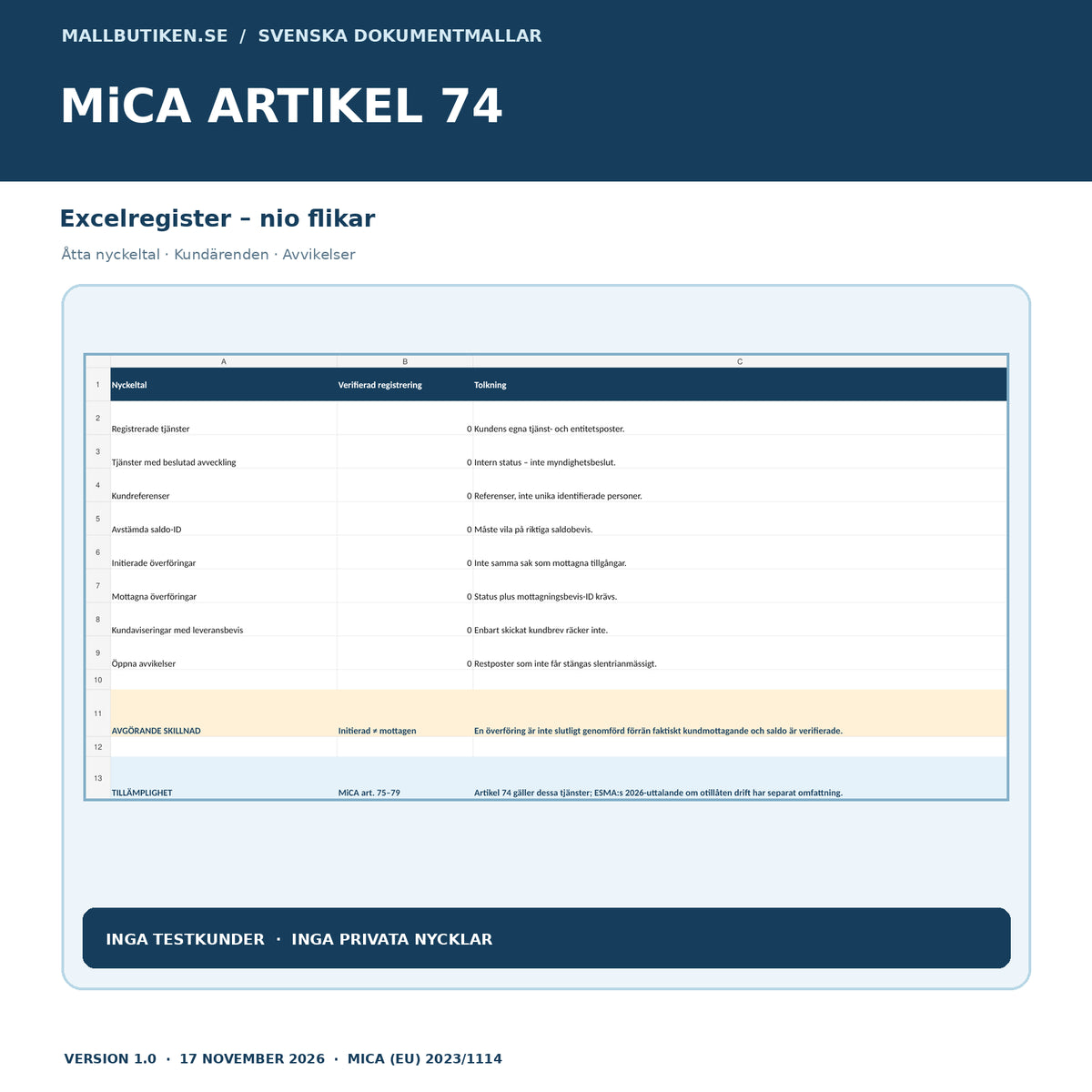
The workbook contains Read Me, Overview, Services, Customers, Assets, Transfers, Customer Letter, Exceptions, and Sources. The Overview tab summarises eight metrics: registered services, services with a decided wind-down, customer references, verified reconciled balances, initiated transfers, actual receipt with proof ID, customer notifications with delivery confirmation, and open exceptions. The formulas have been tested in a separate scenario copy. The customer version does not contain fictitious customers, amounts, or transfers.
Excel is an administrative register. It is not a crypto wallet system, an authorisation database, a secure customer portal, or a guarantee that the actual wind-down procedure complies with Swedish insolvency law, GDPR, money laundering regulations, or contract law.
How the company uses the package
- Map the correct legal entity. Identify the actual CASP status, authorisation, and which of the services in Articles 75–79 are being provided.
- Establish the legal basis for the wind-down. Distinguish the ordinary planning under Article 74 from special measures for an unauthorised company after the transitional period and from any individual decisions.
- Decide on protection and suspension. Document which services are to be suspended and which critical customer protection functions must be maintained.
- Reconcile actual customer positions. Link secure references to the account, custodian, fiat funds, crypto-assets, and unresolved transactions without storing secrets in Excel.
- Inform the customers. Send correct information through acceptable channels regarding the timeline, possible withdrawal routes, fees, risks, and support.
- Review the recipient. Check the current MiCA authorisation, legal entity, customer due diligence, sanctions, technical chain, and the customer's actual instruction.
- Verify the receipt. Separate the initiated transaction, technical receipt, actually received balance, and separate final confirmation.
- Close only after actual obstacles have been addressed. Retain residual items, customer requirements, supervisory evidence, and management decisions, and investigate applicable national law.
Frequently asked questions
Does MiCA Article 74 apply to all crypto companies?
No. The article expressly refers to services under Articles 75–79. At the same time, there is a separate requirement not to offer crypto services without the required MiCA authorisation after the transitional period. Assess the correct legal basis for the specific business activity.
Why is the wind-down plan needed even if the company is authorised?
Article 74 is a preventive requirement for relevant service providers. A plan should make it possible to carry out an orderly wind-down and manage critical functions if ever needed.
Can companies without authorisation continue to take on new customers during the wind-down?
As a general rule, no, not by calling continued unauthorised service provision a wind-down. However, check actual regulatory decisions and any appeal situations. Protective withdrawals/closures may have a different legal status than new business.
Can customer assets be transferred to any group company?
No. Check the authorisation of the specific receiving legal entity, the correct service, the customer's rights, and the necessary AML/CFT assessment. A common brand is not sufficient.
Is a transaction ID sufficient proof of a completed customer transfer?
Not on its own. Verify the relevant technical confirmation, actual recipient, and remaining customer balance. The package keeps these statuses separate.
Is it permitted to put customers' wallet keys in the Excel register?
No. The workbook is not designed to protect private keys, seed phrases, or other secrets. Use only internal references and permission-controlled storage.
Can Excel automatically report to the Swedish Financial Supervisory Authority or carry out withdrawals?
No. Excel does not send regulatory reports, make payments, automatically check current authorisations, or carry out crypto transactions.
Is the package approved by the Swedish Financial Supervisory Authority or an external lawyer?
No. The documents have internal AI-assisted legal source checking and technical tests. Independent legal review, checking against relevant insolvency law, and practical security/AML review must be carried out by the business before use.
Related templates
MiCA Article 71 – customer complaints and complaints register complements the wind-down plan when affected customers have complaints.
Legal sources and version
Version 1.0 – 17 November 2026. Sources: MiCA (EU) 2023/1114, Articles 74–75, ESMA's Article 74, ESMA's supervisory statement of 17 April 2026, and the Swedish Financial Supervisory Authority's notice of 1 July 2026. Wind-down under national insolvency, contract, tax, data protection, AML, and supervisory law must be assessed separately. No actual regulatory submission, customer communication, or crypto transaction is included.