Svenska Dokumentmallar
Environmental Claims & Greenwashing Compliance 2026/2027 – Swedish + English | EU 2024/825 Word/PDF/Excel
Environmental Claims & Greenwashing Compliance 2026/2027 – Swedish + English | EU 2024/825 Word/PDF/Excel
- File format
- DOCX, PDF, XLSX
- Document language
- Swedish
- Number of files
- 17
Digital download. No physical product is shipped.
Couldn't load pickup availability
About this template
Environmental Claims & Greenwashing Compliance 2026/2027 – complete SV/EN template package
This is a practical compliance package for companies that use, or plan to use, environmental, climate, sustainability, circularity, or reparability claims in their marketing. The package helps marketing, legal, compliance, sustainability, product, and e-commerce teams review a claim before publication, link the claim to verifiable evidence, check the scope and overall impression, and document approval.
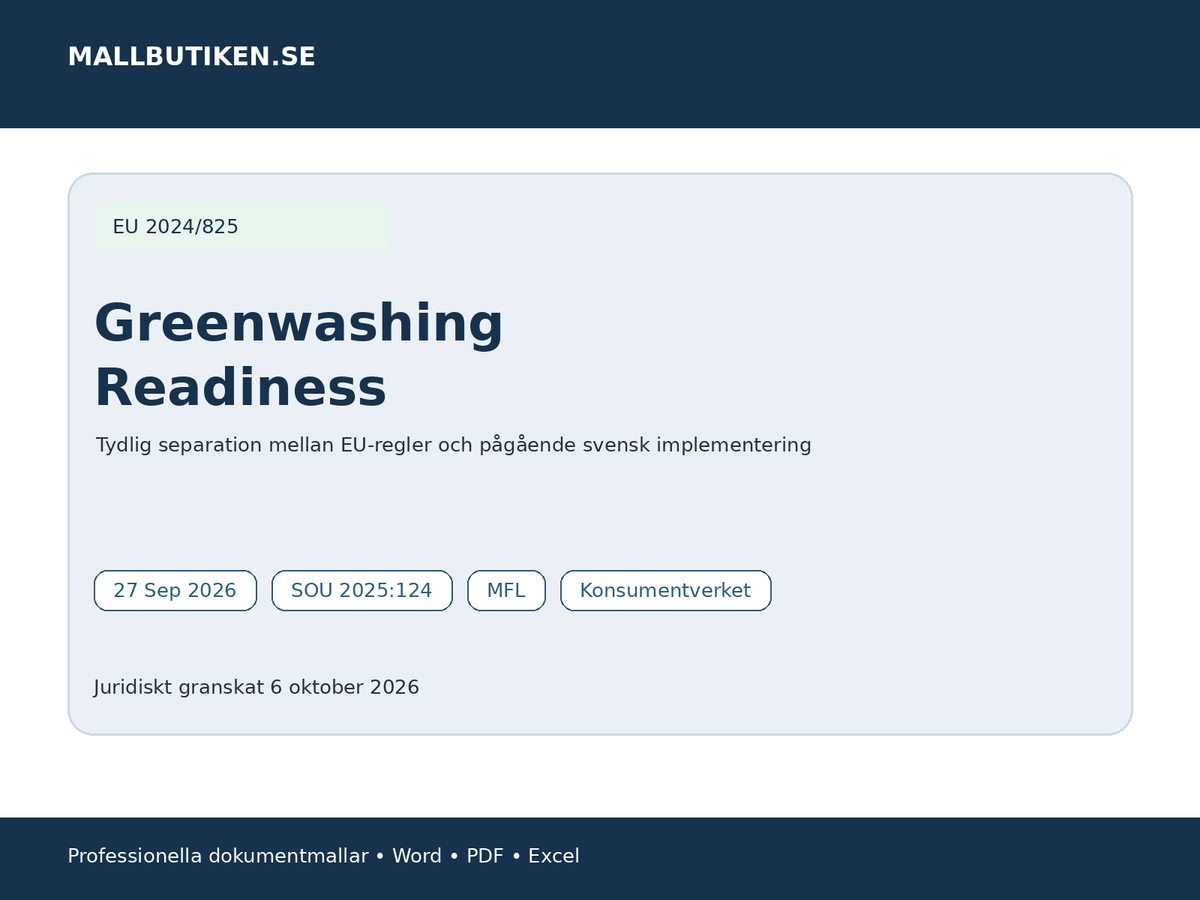
The Swedish Marketing Act is already in full effect. Directive (EU) 2024/825 specifies an EU application from September 27, 2026, while the Swedish implementation legislation is still ongoing. SOU 2025:124 is therefore treated in this package as a proposal/readiness – not as already enacted Swedish law.
Why is this package needed?
Environmental claims have long been subject to the requirements of the Marketing Act that advertising must be truthful, clear, and not misleading. Furthermore, the Swedish Consumer Agency emphasizes that environmental claims have a high burden of proof and that qualifications must be placed close to the claim itself. EU Directive 2024/825 further tightens the framework regarding, among other things, general environmental claims, sustainability labels, future environmental performance, comparisons, and certain climate claims.
The practical risk often lies not in a single word being incorrect, but in the overall impression becoming broader than the evidence. A formulation may, for example, be factually correct for a component, facility, or period but still be misleading if the marketing leads the consumer to believe that the claim applies to the entire product, the entire company, or the product's full life cycle.
What is included
The package contains 16 editable Word templates, 16 corresponding PDF files, and an advanced Excel register – a total of 33 delivery files.
- Compliance Plan – governance, claim gate, and legal status.
- Claim Review Form – pre-publication review for exact claim, channel, scope, and risk.
- Substantiation & Evidence File – method, data source, period, system boundary, verification, and limitations.
- Sustainability Label Review – control of labeling, certification systems, third-party monitoring, and scope.
- Future Environmental Performance Plan – for net-zero, reduction, and other future targets with measurable sub-targets, resources, and control.
- Climate & Carbon Claim Assessment – specific control for climate-neutral, net zero, climate-compensated, reduced climate impact, and similar messages.
- Comparative & Scope Review – comparisons, method, comparator, and whole-product/part-scope.
- User Guide – step-by-step from claim idea to approved and archived publication.
Excel – ongoing Green Claims Register
The Excel file is built for recurring use and contains:
- Dashboard with KPIs and open risks
- Claims Register
- Evidence Register
- Label Review
- Future Claims
- Climate Claims
- Comparative Claims
- Publication Log
- Actions / CAP
- Legal Status Tracker
- Sources
The register contains formulas, data validations, and status checks so that claims, evidence, reviews, and published versions can be tracked in a structured way.
Specifically regarding general environmental claims
Words and expressions such as green, environmentally friendly, climate-friendly, sustainable, organic, biodegradable, or similar can give a very far-reaching overall impression. EU Directive 2024/825 treats generic claims as a specific risk category. The package therefore includes a check for whether the claim needs to be specified or qualified and whether the evidence actually supports the entire message.
Specifically regarding climate neutrality and compensation
Product claims based on the compensation of greenhouse gas emissions are particularly sensitive. The directive explicitly points out claims such as climate-neutral, climate-compensated, and similar ones when the message gives the impression that the product's climate impact is neutral, reduced, or positive due to compensation outside the product's value chain. The package therefore helps the user separate actual emission reductions from external offset projects and to check if the marketing message exaggerates the result.
Future environmental targets and net-zero claims
Claims about future environmental performance require completely different documentation than a statement about the current situation. The template therefore contains fields for base year, system boundary, measurable final target, sub-targets, deadline, resources, responsible management, dependencies, and independent control. This makes it easier to distinguish an actual implementation program from a general ambition.
Sustainability labels and badges
The package contains a specific review of certifications and sustainability labels. It checks, among other things, who owns the system, if conditions are public, if monitoring is independent, what the certification actually covers, and if the marketing attributes qualities to the label that it does not prove.
Current legal status 2026/2027
- The Marketing Act (2008:486) – current Swedish basic rule for truthful, clear, and non-misleading marketing.
- Directive (EU) 2024/825 – according to the directive, member states were to apply implementation provisions from September 27, 2026.
- SOU 2025:124 – Swedish inquiry proposing changes to, among other things, the Marketing Act and proposing entry into force on January 1, 2027. The legislative process is still ongoing as of October 6, 2026.
- Swedish Consumer Agency's guidance on environmental claims – practically important for burden of proof, qualification, overall impression, and climate communication.
For whom?
The package is particularly suitable for e-retailers, brand owners, importers, manufacturers, agencies, marketing departments, ESG/sustainability functions, product teams, and small to medium-sized companies that want to implement a professional internal claim approval process.
Format and language
Svenska + English. The documents are delivered in Word (DOCX) and PDF. The operational register is delivered in Excel (XLSX). The Word templates are intended for editing and internal adaptation, while the PDF versions serve as reference and print-friendly worksheets.
Important
The templates provide structure and support but do not replace individual legal advice, technical verification, or life cycle analysis when required. For high-risk claims, complex LCA/PEF, multiple markets, or uncertain regulatory status, a specialist should be engaged.
Primary sources
Directive (EU) 2024/825, Marketing Act (2008:486), SOU 2025:124, and the Swedish Consumer Agency's guidance on environmental claims.
Related guides: Environmental claims and greenwashing 2026 – what are companies allowed to say? · EU compliance for businesses 2026/2027 – guide to new EU regulations.