Svenska Dokumentmallar
Emergency Water in Commercial Kitchens – Water Outages, Crisis Menus, and Distribution Logs | Word/PDF/Excel
Emergency Water in Commercial Kitchens – Water Outages, Crisis Menus, and Distribution Logs | Word/PDF/Excel
- File format
- DOCX, PDF, XLSX
- Document language
- Five Swedish working documents Swedish User Guide and English User Guide; Swedish Excel workbook
- Number of files
- 7
Digital download. No physical product is shipped.
Couldn't load pickup availability
About this template
How can a school kitchen or nursing home kitchen continue to serve safe meals when the water supply is cut off? This specialized document package helps municipal meal managers, public commercial kitchens, preschools, nursing homes, and LSS facilities plan an actual emergency water chain: local water needs, deliveries, container hygiene, crisis menus, information dissemination, and verified recovery after a water outage.
Legal basis: Regulation (EC) No 852/2004 on food hygiene, particularly Annex II, Chapters I–III and VII, requires food businesses to have access to drinking water of sufficient quality and quantity when needed to prevent contamination. In 2026, the Swedish Food Agency highlighted the preparedness of public meal services for water shortages and recommends dialogue with the water supplier, locally planned crisis menus, and coordination with the municipal emergency water plan. 2027 is a planning year – no new purported law or universal reporting requirement.
Safety limit: A delivery of a certain number of liters is not proof of drinking water quality. An estimated liter budget is not a guarantee that the kitchen can continue food handling. If safe water quality, handwashing, dishwashing, or other necessary hygiene cannot be ensured, the affected operation must be restricted or paused according to the documented assessment of the person in charge. Excel never issues a permit or an automatic “food-safe” verdict.
Digital delivery: Five Swedish working documents and a Swedish and English user guide; all seven are available as editable Word files (DOCX) and corresponding searchable/printable PDF files. In addition, a Swedish Excel register (XLSX) with nine tabs and 712 formulas. Total 7 DOCX + 7 PDF + 1 XLSX = 15 customer files in a ZIP. No physical shipping. PDFs are not interactively fillable.
Package contents
01. Emergency water – needs and risk plan. 02. Receipt and verification of actual emergency water delivery. 03. Crisis menu, hand hygiene, and decision on the scope of operations. 04. Water outage – alarm and communication log. 05. Return to normal operations and preparedness exercise. 06. Swedish user guide. 07. English User Guide. Each of the seven as DOCX and PDF. 08. Excel register with nine tabs.
What the files contain
Controllable fields for kitchen ID, water and sanitation supplier, the municipality's emergency contact, actual portions, locally estimated water consumption per meal, extra water for hand hygiene and dishwashing, water deliveries, and original receipts. You can document the source's quality statement, container, receipt hygiene, boiling recommendation, crisis menu, and special diet without entering individuals' health data in Excel. The register provides stop signals when the water or hygiene basis is insufficient. It does not make legal or medical decisions.
Five concrete situations where the package is needed
1. School kitchen during a water outage: the municipality announces that the mains water is shut off. The kitchen must assess alternative water supply, handwashing, dishwashing, ready-made food, delivery to the school, and whether a simplified crisis menu actually works.
2. Nursing home kitchen with special meal requirements: water shortage affects both food preparation and drinking. The document package coordinates water and sanitation statements, actual meal volumes, and the facility's existing routines for special diets, taking into account those who are extra dependent on functioning meals.
3. Preschool or after-school center with pre-packaged food: the facility may receive pre-prepared meals but still needs to control hand hygiene, serving, drinking water, and how contamination risk is avoided.
4. Commercial kitchen receiving tank water: document the actual supplier, source, quality confirmation, volume, cleaned/suitable container, and receipt receipt. Do not assume that a filled jug is hygienically approved.
5. Return after an outage: the municipality's water statement applies again, but the kitchen needs to check local hoses, faucets, containers, cleaning, any blocked raw materials, and the facility's own actual restart decision.
File list
| File | Practical function | Language | Format |
|---|---|---|---|
| 01 Emergency water – needs and risk plan | Size with actual portions and local assumptions; separate meal water from handwashing and dishwashing. | Swedish | DOCX + searchable PDF |
| 02 Water delivery and receipt | Water source, supplier, liters, hygiene control, water quality statement, and original receipt. | Swedish | DOCX + PDF |
| 03 Crisis menu and hygiene decision | Assess safe food preparation, serving, dishwashing, hand hygiene, and special dietary needs. | Swedish | DOCX + PDF |
| 04 Outage and communication | Water/sanitation/authority messages, actual timestamps, responsible parties, and information to receiving units. | Swedish | DOCX + PDF |
| 05 Return and preparedness exercise | Actual restoration of drinking water, equipment check, deviation, and follow-up action. | Swedish | DOCX + PDF |
| 06 Swedish user guide | Eight sections with rules, practical examples, and step-by-step handling. | Swedish | DOCX + PDF |
| 07 English User Guide | English explanation of the Swedish forms and regulatory limitations. | English | DOCX + PDF |
| 08 Excel – emergency water register | Nine tabs, 712 formulas, filterable tables, verification fields, and 12 overview metrics. | Swedish | XLSX |
The Excel register – water quantities and stop signals
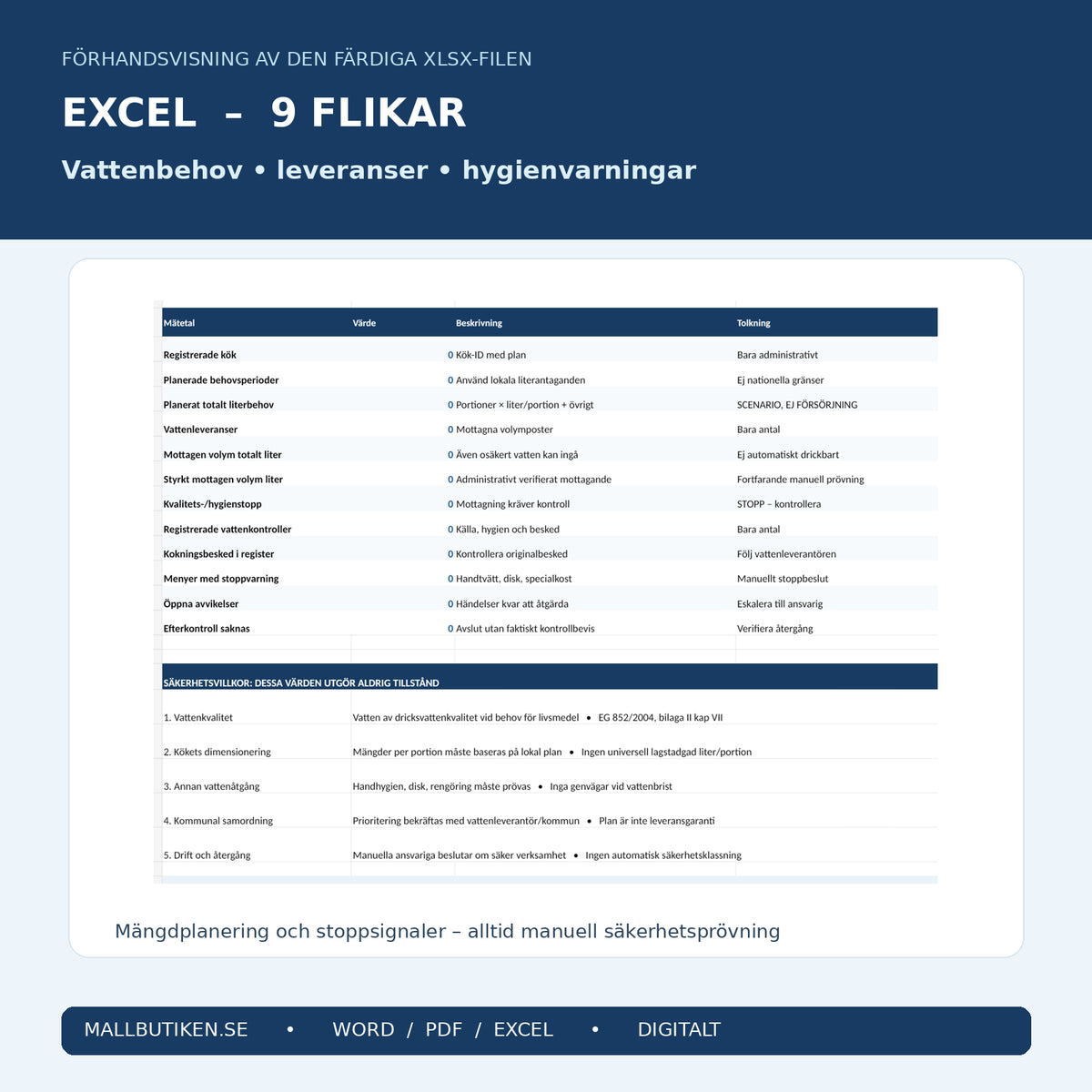
The workbook contains Kitchen, Needs, Deliveries, Water Control, Menus, Deviations, Actions, Overview, and Read Me. The register calculates planned liter needs and separates them from the actual delivered water volume and the part of the receipt documented with quality and hygiene basis. A water delivery is never automatically safe for consumption just because the numbers match.
Calculation example: A kitchen plans 300 portions and specifies its own scenario assumption of 2.2 liters per portion for a certain crisis menu. Excel calculates 660 liters for this need, before any extra amount for hand hygiene, dishwashing, and cleaning. If 400 liters are registered as received, the log shows the quantity data separately. 2.2 liters is not a statutory requirement or a national guideline. The home preparedness advice of 3–5 liters/person/day cannot simply be used as full dimensioning for an institutional kitchen.
Stop signals: Unclear water source or receipt hygiene gives “STOP – QUALITY / HYGIENE UNCLEAR”. Water control without basis gives “STOP – WATER BASIS MISSING”. A crisis menu without confirmed hand hygiene, cleaning, or safe water source gives “STOP – HYGIENE OPPORTUNITIES MISSING”. Completed action without follow-up check gives “FOLLOW-UP CHECK MISSING”. The tests were performed on fictional entries that were then cleared from the customer file.
Step by step – from planning to return
- Identify responsibility: specify kitchen, responsible manager, municipal emergency function, and current water supplier.
- Plan local quantities: specify which portions are to be served and a separate amount of water for other hygiene and operations.
- Test alternative crisis menu: assess actual water consumption, food safety, dishwashing, cleaning, and special diets.
- Verify the delivery chain: check actual water deliveries, source, container, tapping, hygiene, and receipts.
- Handle outage notice: separate the water supplier's message from the kitchen's own operational decision. Contact the right recipient and document timestamps.
- Restrict unsafe handling: if safe hygiene conditions are missing, the affected operation may need to be paused, changed, or moved.
- Verify return: save actual water/sanitation statements, check equipment/hygiene, close open actions, and document the responsible person's manual decision.
Official rules and 2026 preparedness guidance
Regulation (EC) No 852/2004: In Annex II, Chapter VII, point 1 a, requirements for sufficient supply with water of drinking water quality when needed to prevent contamination of food are stated. The requirements for food premises and hand hygiene in the same annex also apply in a disruption situation. EU's official legal text.
Swedish Food Agency's Control Wiki – Water Supply: The authority explains that the risk of contamination determines when drinking water quality is needed, that facilities with their own water supply may be covered by special drinking water regulations, and that faucets, jugs, and hoses need to be handled hygienically. The guidance is not binding in itself and excludes other ways to meet the legislation. Swedish Food Agency's guidance.
Water shortage in public meals – highlighted in 2026: The Swedish Food Agency recommends that municipalities have an emergency water plan and that public meal services dialogue with water suppliers and plan crisis menus. Facilities such as schools, preschools, and group homes can have different forms of their own preparedness based on the conditions. Swedish Food Agency: Does your meal service have preparedness for water shortage?.
Crisis menus for public kitchens: The Swedish Food Agency emphasizes that water, electricity, food, and staff can be knocked out at the same time. A planned menu must work with actual logistics and resources, and it may be important to coordinate prioritized kitchens with the municipality's emergency water plan. Swedish Food Agency – crisis menus and storage.
No new requirements for “2027 emergency water report”: The publication year is a planning label, not a purported new legal obligation. There is no universal amount of drinking water per portion that automatically determines whether a public kitchen can continue operations. The individual facility must be able to show that applicable hygiene legislation is met.
Frequently Asked Questions (FAQ)
Must municipal school kitchens have an emergency water plan?
The Swedish Food Agency recommends that municipalities have an emergency water plan and coordinate with prioritized facilities. This does not mean that this particular private template or a specific form is mandatory for every kitchen.
How many liters of water are needed per school meal?
It depends on the kitchen, menu, preparation, dishwashing, and hygiene. Excel uses the facility's own documented assumptions. No general authority decisions on liters per portion are calculated.
Can we use the home preparedness 3–5 liters per person per day?
Not as complete dimensioning for a public kitchen. The recommendation refers to basic personal needs and does not automatically cover production, handwashing, dishwashing, and cleaning.
Can the kitchen continue serving food during a total water outage?
It must be risk assessed. If drinking water, hand hygiene, or cleaning cannot be maintained in a safe way, the operation needs to be restricted or paused, alternatively operated with an actually safe backup solution.
Is all tank water automatically approved?
No. The water's source, actual water quality, transport, container, and tapping need to be sufficiently safe. A delivery receipt replaces no quality assessment.
Is it enough that the municipality has an emergency water plan?
No. The kitchen must confirm actual contact routes, delivery conditions, prioritization, local hygiene needs, and how meals should be handled during an outage.
What happens if a boiling recommendation applies?
Follow the actual water supplier's and authority's current statement. It must be assessed separately how the recommendation affects drinking, food, ice, dishwashing, and hand hygiene.
Can Excel certify that we can open the kitchen again?
No. It compiles administrative entries and can flag insufficient basis. Return must be decided by the responsible parties based on actual water statement, hygiene control, and current rules.
Do the files contain patient or allergy records?
No. Excel should only be used with kitchen, delivery, and action ID. Individuals' health, special diet, and allergens should be handled in the facility's own suitable and protected systems.
Are all files English and the PDF files fillable?
The five working documents, Swedish guide, and Excel are Swedish. English User Guide is included. The PDFs are searchable/printable, but not interactively fillable; edit in DOCX and XLSX.
Complementary documents – without SEO overlap
Do you instead need the drinking water supplier's consumer information on quality problems? The template store also has Drinking water deviation – boiling recommendation, consumer information, and return. This new product refers to the meal service's concrete water needs, receipt log, hygienic crisis menu decisions, and distribution.
Review, version, and limitations
Version 1.0 – November 20, 2026. EU regulations and Swedish authority guidance have undergone AI-assisted official source control. The seven DOCX files, seven searchable A4 PDFs, nine Excel tabs, 712 formulas, stop warnings, and ZIP integrity have been technically tested. No external independent lawyer, food inspector, water and sanitation expert, or authority has reviewed or approved the documents. No separate practical compatibility testing has been performed in an installed Microsoft Office environment. Always follow the latest authority statement, local risk assessment, and safe operational routines.