

Svenska Dokumentmallar
Framework Agreement Template Package 2026/2027 – Word/PDF + English | Swedish Law
Framework Agreement Template Package 2026/2027 – Word/PDF + English | Swedish Law
 Downloading the template is available immediately after purchase. Our document templates are always delivered in customizable formats.
 If you are unsure which template is appropriate or how you should complete it, please see the relevant information under the 'Legal Information' tab in our main menu.
 Our templates are designed in accordance with current legislation and practice in each area to ensure that the documents you create are legally correct.


Couldn't load pickup availability
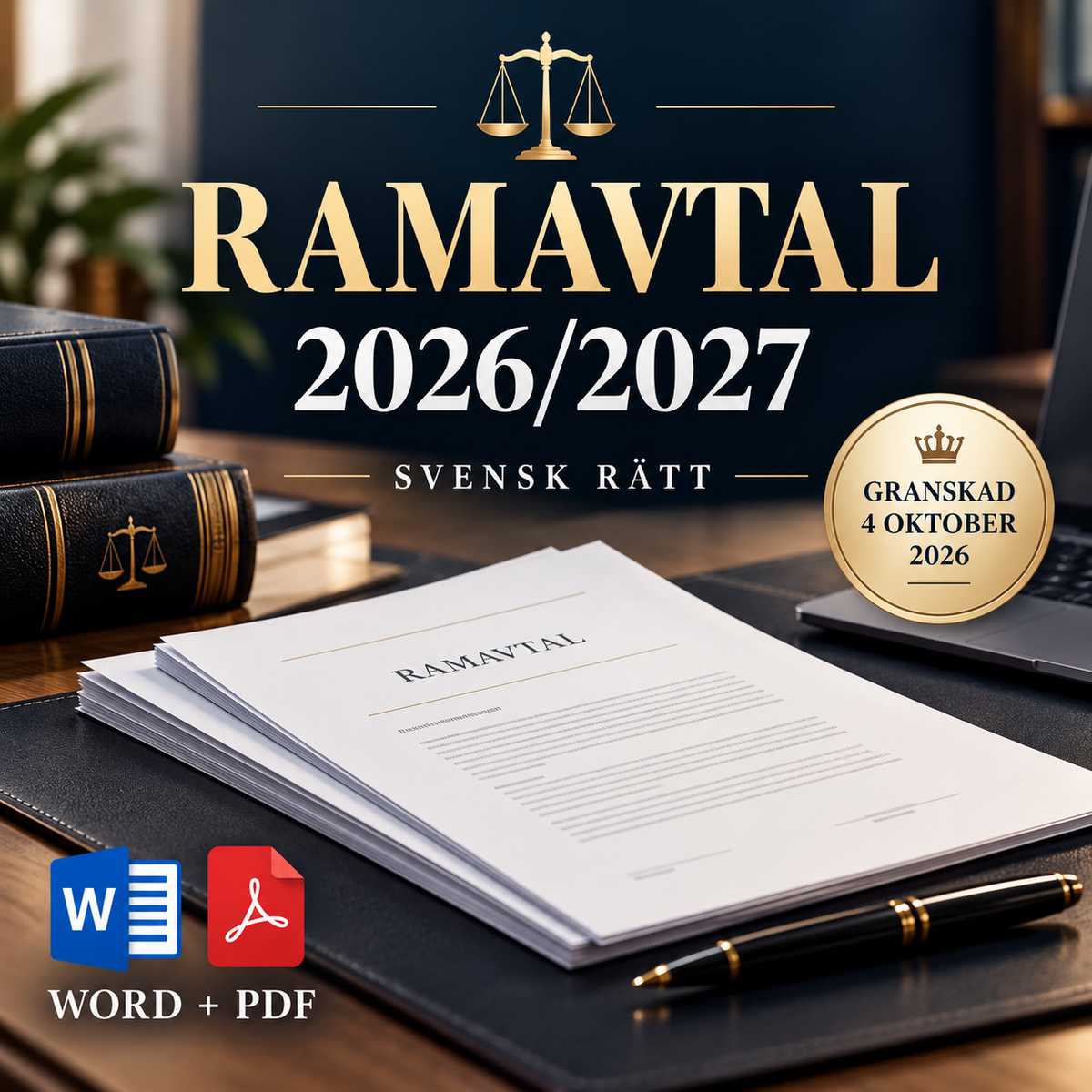
Framework Agreement Template Package 2026/2027 – complete B2B framework agreement in Word and PDF
This is a comprehensive and professional framework agreement for recurring purchases of goods and/or services between companies. The package is designed for businesses that wish to establish common legal and commercial terms for a long-term collaboration, while each actual order is made through a separate call-off.
The template package is reviewed against current Swedish law and official guidance as of October 4, 2026, and prepared for use during 2026/2027. It contains a Swedish version, a complete English-language Framework Agreement under Swedish law, and a separate detailed user guide.
Delivery: 3 documents in both Word (DOCX) and PDF – a total of 6 files, 53 A4 pages, and 12 appendices/schedules. Digital download. No physical product is sent.
This is included
- Framework Agreement 2026/2027 – Swedish version, 23 pages with 28 contract sections and 12 appendices.
- Framework Agreement 2026/2027 – English / Swedish law, 23 pages with a corresponding structure and 12 schedules.
- Detailed user guide, 7 pages with step-by-step instructions, legal checkpoints, and a pre-signing checklist.
When is a framework agreement suitable?
The template is suitable when two companies want to create a stable contractual framework for recurring orders without negotiating all basic terms for every purchase. It can be used, for example, for ongoing deliveries of components, consumables, services, support, consulting services, IT services, or combined goods and service deliveries.
The framework agreement regulates the basic terms. Each actual order is subsequently made through a Call-off specifying, for example, scope, quantity, price, delivery date, location, and specific acceptance criteria.
Important limitation – private B2B, not PPA/UPA
This product is a private law B2B framework agreement. It is not designed as a framework agreement under the Swedish Public Procurement Act (LOU), the Act on Procurement in the Utilities Sectors (LUF), or other procurement legislation.
Public framework agreements have specific rules regarding, for example, which organizations may place call-offs, how contracts may be awarded, and the permitted duration of the framework agreement. If the agreement is to be used in public procurement, separate adjustments under procurement law are therefore required.
28 contract sections
The main agreement covers, among other things:
- parties and the purpose of the agreement,
- contract documents and order of priority,
- definitions,
- scope of the framework agreement,
- call-offs, orders, and contract formation,
- forecasts, volumes, and capacity,
- prices, fees, and price adjustment,
- invoicing and payment,
- delivery of goods, risk, and title,
- services, personnel, and subcontractors,
- inspection, testing, and acceptance,
- defects, remedies, and warranties,
- SLA and service credits,
- change management,
- intellectual property rights,
- personal data and information security,
- confidentiality and trade secrets,
- compliance and ethical requirements,
- documentation, audit, and follow-up,
- liability and limitation of liability,
- insurance,
- force majeure,
- term and termination,
- consequences of termination,
- notices, assignment, and amendments,
- Swedish law and international sales,
- dispute resolution,
- other contract provisions.
12 professional appendices
- Scope of delivery – which goods and/or services may be called off.
- Volume, forecast, and minimum commitments – including any capacity or take-or-pay solutions.
- Call-off process, authorization, and contact channels – who is authorized to order and how a Call-off becomes binding.
- Price list and price adjustment – currency, discount, index, freight, travel, and notice period.
- Delivery terms and product warranties – place of delivery, transport, risk, Incoterms, and warranty.
- Services, staffing, and acceptance – deliverables, milestones, key personnel, and acceptance criteria.
- SLA and support – service levels, measurement, reporting, and service credits.
- Intellectual property rights and licenses – background material, standard products, specially developed results, and third-party licenses.
- Data protection and information security – GDPR, access control, incident reporting, and sub-processors.
- Compliance and sustainability requirements – e.g., anti-corruption, sanctions, export control, and product safety.
- Liability, indemnities, and insurance – liability caps, carve-outs, and insurance levels.
- Term, termination, CISG, and dispute resolution – start date, extension, force majeure, ongoing call-offs, international sales, and forum.
Call-offs and contract formation
One of the most common conflict points in long-term supplier relationships is ambiguity regarding when an individual order actually becomes binding and which terms apply to it. The template therefore contains an explicit call-off mechanism where authorized purchasers, ordering channels, and order confirmations can be defined.
There is also a clear order of priority between the main agreement, appendices, data processing agreements, call-offs, and subsequent amendment agreements so that conflicting standard terms or order texts do not inadvertently override the Framework Agreement.
Prices, indexing, and cost control
Appendix 4 makes it possible to document the price list, unit, currency, discounts, index or other price adjustment method, next adjustment, and special costs. The template avoids vague standard wording where the supplier can unilaterally refer to a future price list without an agreed-upon control mechanism.
Goods and the Sale of Goods Act
For the purchase of personal property, the Sale of Goods Act (1990:931) may become applicable. The Sale of Goods Act is largely non-mandatory, meaning that the Parties can agree on other solutions. The framework agreement therefore contains its own rules regarding, for example, delivery, inspection, defects, warranty, and liability that can supplement or replace the statutory standard rules.
However, the Sale of Goods Act does not apply when the service component is the predominant part of the Supplier's obligation. The template is therefore structured so that goods and service deliveries can be handled separately.
Services, acceptance, and SLA
For services and project deliveries, the Parties can define clear deliverables, milestones, key personnel, and acceptance criteria in Appendix 6. Appendix 7 is used for measurable service levels and support.
Service credits or price reductions are not automatically exclusive remedies. If the Parties want a certain remedy to be exclusive, this must be stated explicitly.
Change management
The template contains a formal Change Control process. No Party is required to implement a change that affects price, scope, security, schedule, or risk allocation before a Change Order has been approved by authorized representatives.
Intellectual property rights
Appendix 8 helps the Parties distinguish between the Supplier's background material, standard products, the Customer's material, third-party material, and results developed specifically within the collaboration. It is used to specify owners, the Customer's license or right of use, and any restrictions.
GDPR and information security
If the Supplier processes personal data on the Customer's behalf, a separate data processing agreement is normally required under Article 28 of the GDPR. The framework agreement therefore does not contain a simplified clause claiming that a few sentences replace a full-scale DPA.
Appendix 9 is used to document security requirements, incident reporting, access controls, logging, sub-processors, storage location, and deletion routines.
Liability and insurance
Appendix 11 makes it possible to specify liability caps, special carve-outs, any indemnities, and insurance levels. The base template distinguishes between direct and indirect loss but leaves the commercially sensitive levels open so that they can be adapted to the contract value and actual risk.
International sales and CISG
For international sales of goods, the Act (1987:822) on International Sales and the CISG may become applicable. Therefore, there is a specific selection point in Appendix 12 where the Parties can state whether the CISG is to apply or be explicitly excluded.
For purchases where both the seller and the buyer have their places of business in Denmark, Finland, Iceland, Norway, or Sweden, the special Nordic rule in Section 2 of the Act on International Sales applies.
English Framework Agreement under Swedish law
The English version contains the same structure, 28 contract sections, and 12 schedules. It is intended for situations where Swedish law is to be applied but where, for example, the supplier, customer, group, or advisors work in English.
It is therefore an English-language template under Swedish law – not a template under British or American law.
Detailed user guide
The user guide explains when a framework agreement is the correct form of contract, the difference from public procurement, how the call-off process is built, how all 12 appendices are used, and which legal issues should be checked before signing.
The guide also includes a complete final checklist for parties, scope of delivery, volume, call-offs, prices, delivery, SLA, IP, GDPR, liability, term, CISG, and dispute resolution.
Reviewed for 2026/2027
The legal review is dated October 4, 2026. The package has been checked against, among other things, the Contracts Act (1915:218), the Sale of Goods Act (1990:931), the Act (1987:822) on International Sales, the GDPR, and the Act (2018:218) with supplementary provisions to the EU Data Protection Regulation, as well as the Trade Secrets Act (2018:558).
Format and delivery
3 documents • 6 files • 53 pages • 12 appendices/schedules
- Word (DOCX) – fully editable with clear fill-in fields and tables.
- PDF – for reference, printing, and layout verification.
- Digital delivery – no physical product is sent.
Important
This is a professional general contract template and does not replace individual legal advice. Public procurement, large international agreements, regulated business, complex IT outsourcing, extensive processing of personal data, competition law issues regarding exclusivity, or very high liability amounts should be assessed separately by a qualified advisor.