Svenska Dokumentmallar
Co-located operations 2027 – municipal packaging collection, notification, responsibility and receipt | Word/PDF/Excel
Co-located operations 2027 – municipal packaging collection, notification, responsibility and receipt | Word/PDF/Excel
- File format
- DOCX, PDF, XLSX
- Document language
- Five Swedish work templates Swedish guide and English User Guide; Excel Swedish
- Number of files
- 7
Digital download. No physical product is shipped.
Couldn't load pickup availability
About this template
Do you run a hair salon, restaurant, shop or office in a residential building where the business shares packaging collection containers with households? From 1 January 2027, municipalities must provide property-based collection of paper, plastic, metal and glass from households and co-located businesses that have actively opted for municipal collection. The business must make an active choice by submitting a notification. It is not enough to already use the same waste room.
This document package focuses on the individual business's path to verified collection: checking whether the business is actually co-located, preparing the municipal notification, allocating work between the property owner and tenant, checking collection options and documenting actual proof of receipt and the start of collection. It is narrower than a general waste room package for property owners.
15 real customer files: five editable Swedish working documents, one Swedish user guide and a separate English User Guide, all available in both Word (7 DOCX) and searchable/print-friendly PDF (7 PDF). Also, one Swedish Excel register (1 XLSX) with nine tabs. The PDFs lack interactive form fields. The main templates and Excel are in Swedish; only the English User Guide is in English. Requires compatible word processing/spreadsheet software.
01 · Package contents
Seven document types: co-location assessment, notification basis, responsibility matrix, alternative collection, start and receipt protocol, Swedish guide and English User Guide. All are available in both editable DOCX and corresponding searchable PDF. Plus an Excel register for 2027 with nine Swedish tabs. 7 DOCX + 7 PDF + 1 XLSX = 15 customer files.
02 · What the files contain
Business ID, municipality and local address; actual shared waste containers and evidence; basis for active municipal notification and local notification deadlines; division of responsibility with the landlord; separate waste fractions and receipt routes; receipt, decision and observed first collection; as well as a deviation log. Excel manually records statuses and makes no regulatory decisions.
Who is co-located – and who is not?
Yes, potentially: a salon or restaurant in a multi-residential building that actually uses waste containers and other waste arrangements together with households. No, not merely at the same address: a business that has separate, its own waste containers despite there being residences in the same building. The definition is found in Chapter 1, Section 8 of the Packaging Ordinance (2022:1274) and explained in the Swedish Environmental Protection Agency's guidance.
According to Chapter 7, Sections 10–11, a co-located business that wants the municipality to collect its packaging waste must submit a notification. The municipality may prescribe the time for the notification. There is therefore no generally correct municipal form, notification day or promised start date in this product. Follow the municipality's actual e-service and waste regulations.
Document by document
| Working document | What you can document | Format |
|---|---|---|
| 01 Co-location assessment | Actually shared containers, household waste arrangement, address and basis | DOCX / PDF |
| 02 Municipal notification – basis | Active choice, municipal channel, local time regulations and actual receipt | DOCX / PDF |
| 03 Responsibility matrix property/business | Landlord, business, municipality and internal sorting tasks | DOCX / PDF |
| 04 Alternative collection | When the business does not qualify, check of receipt location/carrier | DOCX / PDF |
| 05 Start check, receipt and deviation | Actual first collection, fractions, missed collection and follow-up | DOCX / PDF |
| 06 Swedish user guide | Practical scenarios and check of national/municipal differences | DOCX / PDF |
| 07 English User Guide | Instructions in English for Swedish working documents | DOCX / PDF |
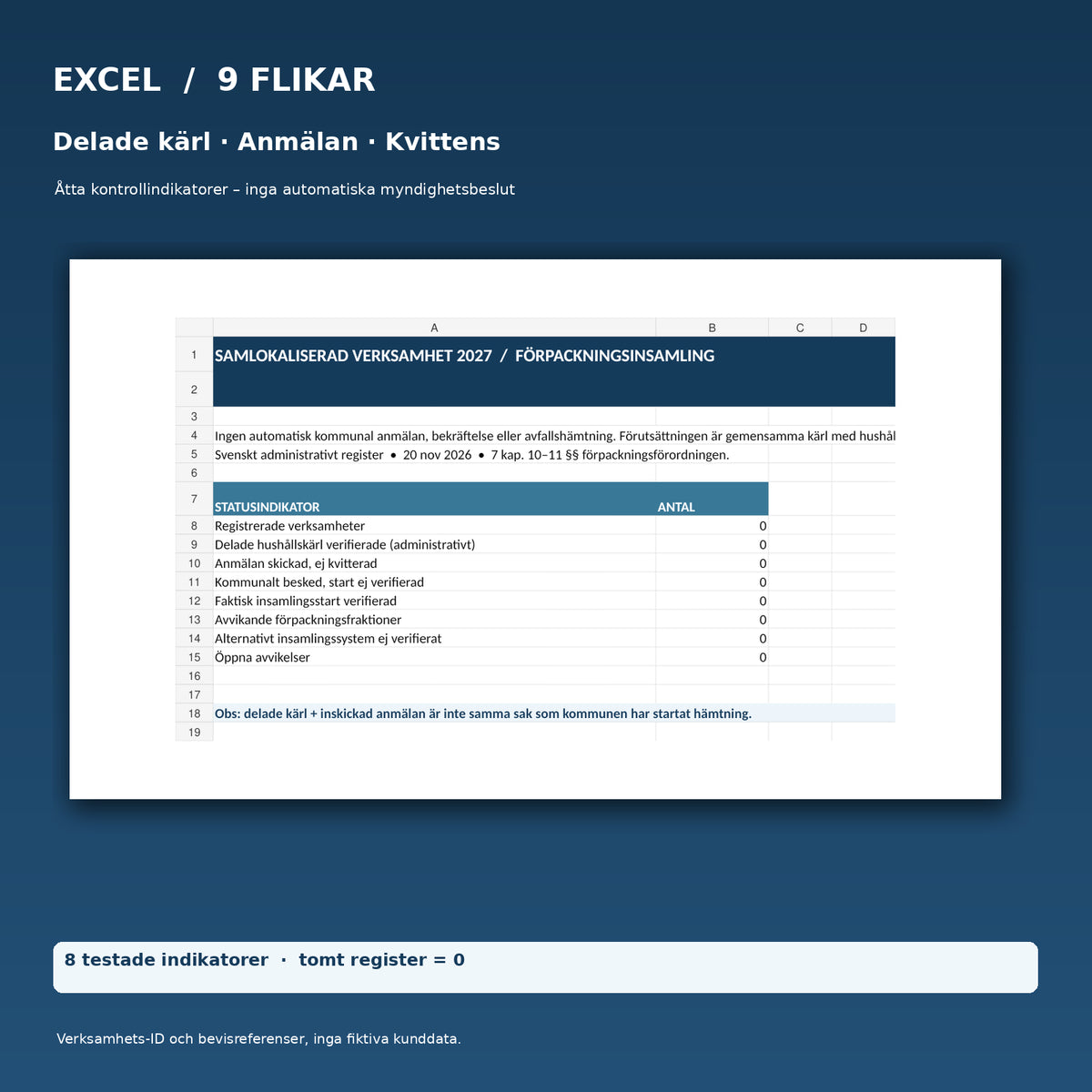
| 08 Excel – Collection register | Nine tabs and eight tested administrative control indicators | XLSX |
Three practical customer cases
Hairdresser with shared containers: the business can first check whether the definition is met, then submit an active choice in the municipality's actual channel. Shop with its own separately placed containers: the location's proximity to residences does not automatically make it co-located; another business collection system may be needed. Restaurant that has submitted the notification: the notification is not equal to confirmed municipal collection. The register allows the business to document both the municipality's actual receipt and actually observed collection start.
How you go from assumption to verified collection
- Identify the waste containers: check that the business really shares containers/arrangements with households on or at the property.
- Check the municipality's FNI system: which packaging fractions, collection points and local notification deadlines apply to the current address?
- Fill in the notification basis: make an active municipal choice according to the correct channel. The template is not an official notification and sends nothing automatically.
- Allocate the tasks: clarify responsibility for containers, access, source separation, contact routes and handling of bulky material.
- Document alternatives: if co-location is missing – use the relevant collection system for business packaging.
- Save actual receipt: distinguish between sent, received, confirmed and actually verified start.
- Follow up on deviations: document missed collection, wrong material, residual packaging and applicable receipt route until the action is verified.
What changes on 1 January 2027?
Chapter 6, Section 4 of the Packaging Ordinance requires that from this day municipalities provide property-based collection of paper, plastic, glass and metal packaging from households and co-located businesses that have chosen municipal collection. According to Chapter 6, Sections 6–7, bulky packaging and other materials have special receipt routes. It is therefore not the same as that all packaging should always be placed in the same container.
Municipal collection is not automatic for all businesses. Other businesses should handle their sorted packaging waste through correct business collection systems, including receipt locations organized by the producer responsibility organization or registered market-driven systems. The Swedish Environmental Protection Agency also describes the requirement for a permit for the carrier that professionally transports waste. Read Packaging waste from businesses and the Waste Ordinance (2020:614).
The Excel register – nine tabs and eight checks
Overview, Businesses, SharedContainers, Notifications, Fractions, Alternatives, Receipt, Deviations and Read me. The overview counts registered businesses, administratively verified shared household containers, submitted unacknowledged notifications, received notifications without verified start, registered actually verified start, fraction deviations, alternative collection lacking verification and open deviations.
All eight formula indicators were tested with fictitious status entries (all eight gave the expected 1). After resetting, all showed 0, and the test data is not in the customer file. Excel does not count legal obligations, waste quantities, municipal fees or automatic deadlines and is not connected to any municipality's system.
Frequently asked questions
Does my business have to register if we already share waste containers with households?
Yes, if the business wants to choose municipal collection, it must make an active choice according to Chapter 7, Section 10. That it uses the containers today is not in itself a notification.
Is it enough that the business is located in a multi-residential building?
No. The business actually needs to share waste containers and other waste arrangements with households to be counted as co-located.
Will municipal collection become mandatory for all businesses on 1 January 2027?
No. The municipality's obligation is limited to households and co-located businesses that have chosen municipal collection. For other businesses, there are special business collection systems.
Can a business leave packaging at a regular municipal recycling center?
Not automatically. The Swedish Environmental Protection Agency distinguishes between co-located businesses that have chosen municipal collection and other businesses. Check the applicable receipt system for the current material.
What applies to bulky cardboard?
Bulky paper and cardboard as well as plastic packaging have special easily accessible collection points for the users covered. Check the actual municipal arrangement.
Can I use the Mallbutiken Word document as the municipality's official notification?
No. The document is a preparatory basis. Always use the municipality's actual e-service or form and document the receipt afterwards.
Does a submitted notification immediately give the right to use the municipality's recycling center?
Not necessarily. The Swedish Environmental Protection Agency's assessment is that the special other municipal collection systems become available only when the business, after notification, has property-based collection via the municipality.
Is the Excel connection automatic to the municipality?
No. It records data that you enter yourself. Registered receipt or start must be supported by actual evidence.
Are the PDF files interactive and are all files in English?
The PDF files are searchable and printable without interactive fields. The main documents and Excel are Swedish; only the separate English User Guide is in English.
Related Mallbutiken products
For the property's waste room itself, information to residents and general sorting log – see Waste Room & Property-Based Collection 2027. For cleaning, cleaning and marking of containers – see Waste Containers & Container Care. For checking external waste handover – see Waste Handover and Receipt Proof. This package applies to the individual company's active municipal collection choice and chain of evidence.
Legal sources, version and actual review
Version 1.0 · 20 November 2026. AI-assisted internal check against Swedish Environmental Protection Agency on co-located businesses, Swedish Environmental Protection Agency on businesses' packaging waste, Packaging Ordinance and Waste Ordinance. No external legal review, municipal certification, actual notification, verified collection or approval of municipal matter. The product right must be checked against current municipal regulations and actual conditions.