Svenska Dokumentmallar
Damaged lithium battery return – transport restrictions, ADR assessment and proof of receipt | Word/PDF/Excel
Damaged lithium battery return – transport restrictions, ADR assessment and proof of receipt | Word/PDF/Excel
- File format
- DOCX, PDF, XLSX
- Document language
- 5 Swedish templates 1 Swedish user guide 1 English User Guide; Excel in Swedish
- Number of files
- 7
Digital download. No physical product is shipped.
Couldn't load pickup availability
About this template
Should you issue a return label if the lithium battery may be damaged? A standard return label may be inappropriate. Document suspected damage, stop the standard return, gather information for a qualified ADR assessment, communicate with the customer, and obtain proof of receipt – without conflating the customer's complaint with decisions regarding transport, fire, or waste.
This specialist package is designed for Swedish e-commerce businesses, returns departments, store warehouses, workshops, and service companies that receive items such as electric bicycle batteries, electric scooter batteries, or electronics with lithium batteries. The package provides documentation support; it is not an approval to pack or ship dangerous goods.
Package Contents
15 files: 5 Swedish work forms, a Swedish user guide and an English User Guide – each as an editable Word file and a searchable/printable PDF – plus 1 Swedish Excel register with nine tabs. The PDF files do not contain interactive form fields. Digital ZIP delivery.
What the Files Contain
RMA/battery ID, source of damage report, stop tracking, risk indicators, request for a qualified ADR assessment, customer text, separate waste assessment, authorized recipient, and receipt. The Excel register keeps track of evidence and statuses. It does not determine the ADR classification, transport authorization, correct waste code, or whether the return may be shipped.
One Concrete Problem – Three Different Decisions
1. Return/complaint: What has the customer reported, and what consumer law issues are involved? 2. Transport: Is the goods damaged or defective in the sense of ADR-S/RID-S, and what requirements apply to that specific transport? 3. Waste: Is this still a product that needs to be assessed, or is it actually waste, with any separate recording and reporting requirements? The decisions must be made separately by the appropriate person responsible.
File by File
| File | Use | Format / language |
|---|---|---|
| 01 Return notification and receipt block | Damage report, RMA ID, time-stamped stop of standard return | DOCX/PDF · Swedish |
| 02 Damage indication and chain of evidence | Customer report versus expert-assessed fact; original evidence | DOCX/PDF · Swedish |
| 03 ADR assessment and specialist request | Structured request to a qualified dangerous goods operator | DOCX/PDF · Swedish |
| 04 Customer notice of stopped return | Safe and objective customer communication without incorrect shipping instructions | DOCX/PDF · Swedish |
| 05 Waste assessment and proof of receipt | Product/waste, affected roles, actual receipt, and register evidence | DOCX/PDF · Swedish |
| 06 User guide | Workflow, five scenarios, common boundaries, and sources | DOCX/PDF · Swedish |
| 07 English User Guide | English instructions for using the Swedish work templates | DOCX/PDF · English |
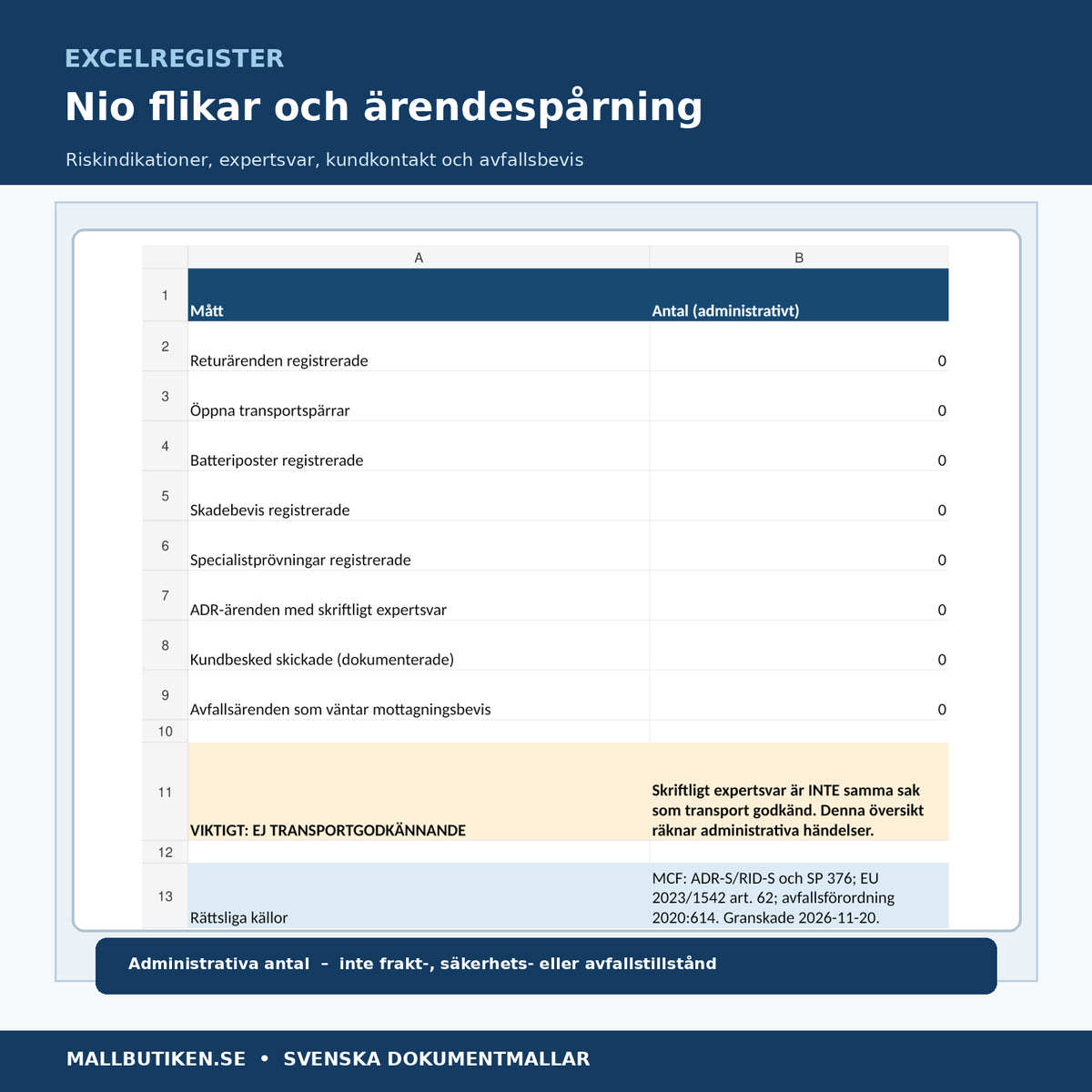
| 08 Excel – return register | Nine tabs for cases, evidence of damage, expert assessment, and closure | XLSX · Swedish |
The Nine Tabs of the Excel Register
Overview, Cases, Batteries, Evidence of Damage, ADR Assessment, Customer Contact, Waste, Evidence, and Read Me. Eight administrative indicators include, for example, open stops, registered evidence, expert opinions, and pending receipt confirmations. Dropdown fields do not prevent incorrect information from being entered; it is always the business's responsibility to verify it. The register contains no macros and does not retrieve external data.
How the Package Is Used
- Record the battery return and any damage indications without creating a hazardous intervention.
- Administratively stop the standard postal return when it is inappropriate and follow the emergency plan in case of acute danger.
- Save customer information and evidence, clearly separated from expert conclusions.
- Request a written transport assessment from a competent dangerous goods manager or carrier before any potential mode of transport.
- Provide the customer with an objective decision; a transport stop is not an automatic rejection of the complaint.
- Assess separately whether the item is waste and whether the requirements of the Waste Ordinance apply to the operator.
- Archive the actual proof of receipt and mark the case as closed only after verification.
Legal Basis and Safety Disclaimer
The Swedish Defence Research Agency (MCF) states that the transport of lithium and sodium-ion batteries may be covered by ADR-S/RID-S. Damaged and severely damaged batteries are treated separately under, among other things, special provision 376; applicable packaging instructions such as P908/LP904 and P911/LP906 must be determined by an expert in each case. The Swedish Work Environment Authority describes risks of fire and gas generation.
In the event of actual waste classification, the Waste Ordinance (2020:614) and the Swedish Environmental Protection Agency's waste register may become relevant. EU Battery Regulation 2023/1542, Article 62 contains rules on distributors' take-back obligations. However, take-back does not imply the right to use standard parcel shipping for a damaged battery.
Important limitation: The product is not a user manual for packaging, storage, emergency response, shipping, or disassembly, nor is it a completed ADR document or a safety certificate. In case of suspected acute danger, the business's safety procedures must be followed; call emergency services if necessary.
Frequently Asked Questions
Can I send the customer a standard return label?
Not without first assessing whether the shipment in question may be transported that way. Damaged or defective batteries may require special handling according to ADR-S/RID-S and a competent assessment.
Does the template determine whether P908 or P911 applies?
No. The template gathers information for a qualified assessment. It does not determine the damage category, correct packaging instructions, or transportability.
Is a damaged battery always hazardous waste?
No. Its status as goods or waste must be assessed on a case-by-case basis. If it is hazardous waste, additional responsibilities and reporting requirements may apply.
Is the customer's complaint rejected when the return is stopped?
No, the transport issue and the customer's legal complaint claim must be assessed separately.
Do the PDF files contain fillable fields?
No. The PDF files are searchable and printable. Use DOCX for editing and XLSX for case tracking.
Are the documents in English?
The five work templates and the Excel register are in Swedish. A separate English user guide is included, but not translated legal documents.
Version Information and Transparency
Version 1.0 · legal authority source review with AI assistance 2026-11-20 · no independent external legal, ADR safety advisor, or fire safety review. Digital ZIP delivery. Controlled original documentation is required before any actual transport decision.
Related: Battery take-back in e-commerce – Article 62 for standard take-back, unlike the damaged special return this product concerns.