Svenska Dokumentmallar
STIM reporting for live events 2026/2027 – invoice details, setlist & Excel | Word/PDF
STIM reporting for live events 2026/2027 – invoice details, setlist & Excel | Word/PDF
- File format
- DOCX, PDF, XLSX
- Document language
- 5 Swedish Work Templates Swedish Guide English User Guide; Swedish Excel
- Number of files
- 7
Digital download. No physical product is shipped.
Couldn't load pickup availability
About this template
STIM reporting for live events – collect attendance, ticket prices, artists, and performed music before the organizer and music creator report via the correct STIM service. The template package helps concert organizers, associations, restaurants, choirs, and bands keep the organizer's invoice documentation separate from the music report of performed works and retain genuine receipts. It is a standalone administrative work aid – not an official STIM form or music license.
Digital download as a ZIP. You get 7 editable Word documents (DOCX), 7 corresponding searchable and printable PDF files, and 1 Swedish Excel workbook (XLSX) with nine tabs: a total of 15 customer files. Five work documents and the Excel workbook are in Swedish. There is also a Swedish user guide and an English User Guide for the Swedish templates. The PDF files are not interactively fillable.
Package contents
- Organizer responsibility and applicability check – responsible organizer, licensing issues, and reporting roles.
- Invoice documentation for live events – actual attendance, price categories, entry prices, and supporting documentation.
- Repertoire list and setlist – actually performed songs/works and their creators.
- Reporting log and receipt – track organizer reporting and repertoire reporting separately with actual evidence.
- Deviation and supplement protocol – manage incorrect figures, changed setlists, and canceled performances.
- Swedish user guide – workflow, examples, boundaries, and checklist.
- English User Guide – guidance for the Swedish templates according to Swedish law.
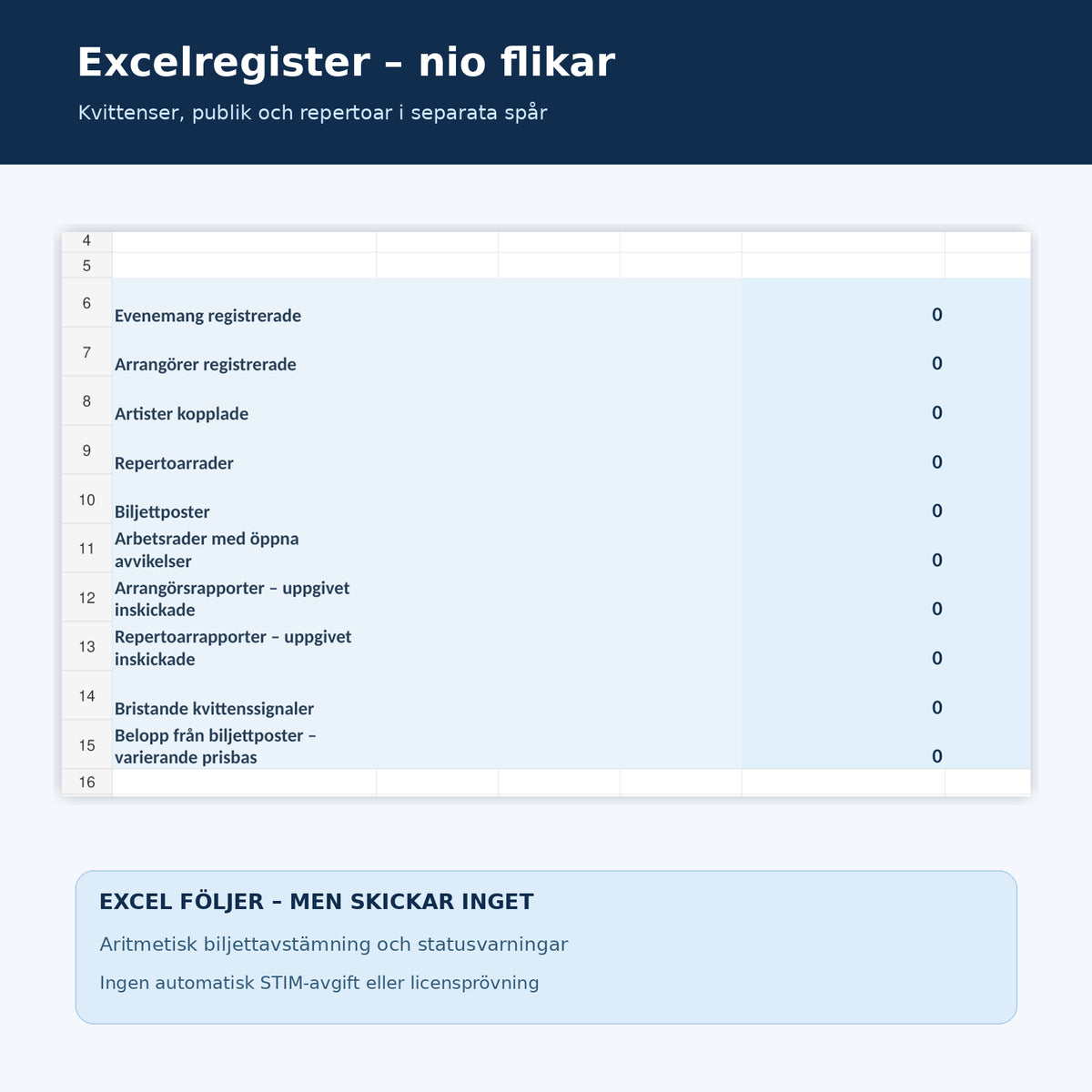
- Excel register with nine tabs – separate registers and warning signs.
What the files contain
Two separate reporting workflows: 1. the organizer's invoice documentation regarding date, location, artist, visitors, and tickets, 2. the music report regarding which works were actually played. Consistent event IDs, responsible persons, source documentation, actual submission receipts, and deviations make it easier to follow up on multiple concerts without mixing up internal notes with STIM's decisions.
Excel only calculates number of tickets × manually entered price in the price base the user has selected. It does not calculate any official STIM fee, license, VAT, or compensation. No data is sent automatically to STIM.
Who uses the document package?
Music organizers, cultural associations, choirs, orchestras, music cafes, restaurants, small festivals, bands, and artist companies with public live performances in Sweden. It is suitable for both one-off gigs and recurring events. An artist agreement regulates booking, payment, and technology; this package instead handles the documentation for music use, repertoire, and reporting follow-up. It is a separate administrative step.
Files and languages
| Document | Practical use | Language | Format |
|---|---|---|---|
| 01 Organizer responsibility | Roles, license check | SV | DOCX + PDF |
| 02 Invoice documentation | Audience, price, documentation | SV | DOCX + PDF |
| 03 Repertoire list | Works, setlist, creator | SV | DOCX + PDF |
| 04 Reporting log | Status and receipts | SV | DOCX + PDF |
| 05 Deviations | Corrections and supplements | SV | DOCX + PDF |
| 06 User guide | Steps and source control | SV | DOCX + PDF |
| 07 English User Guide | English explanations of Swedish files | EN | DOCX + PDF |
| 08 Reporting register | Nine work tabs | SV | XLSX |
Excel – nine tabs and tested logic
Start, Overview, Organizers, Events, Tickets, Artists, Repertoire, Reporting, and Deviations. The user enters their own event data and sources. The overview summarizes the number of registered entries. If a report is marked as submitted without verifiable receipt, the warning MISSING RECEIPT is displayed. If necessary data is missing, a control signal is displayed, not legal approval. An arithmetic ticket total is never an official STIM tariff.
How to use the templates
- Determine applicability and responsibility. Check the music use, relevant STIM license, and who is actually the organizer.
- Fill in actual audience data. Document the date, location, artist, paying and free visitors, and verified ticket prices.
- Distribute repertoire responsibility. For Swedish popular music, the artist often reports their setlist. For art music or foreign artists, STIM specifically designates organizer responsibility.
- Check performed works. Update the planned setlist to what was actually played, including original works and covers.
- Report in STIM's service. The organizer provides invoice-supporting data in My Pages; the authorized reporter submits the music report according to current instructions.
- Save actual receipts and follow up. Document supplements, checks, and any corrections separately.
Legal requirements and limitations
The Copyright Act (1960:729), Section 2, regulates rights in public performance, among other things. STIM explains when live music events require a license and reporting. Even events without an entry fee may be covered. Always check the actual type of event, which works are played, license terms, and exceptions.
STIM's public organizer guidance recommends reporting after each calendar month or within 14 days after STIM has requested reporting. This does not mean that all artists have a general statutory fourteen-day deadline for their setlist. Special cases such as art music, foreign artists, venue rentals, DJ headliners, and private events need to be assessed separately. The templates are not a license, a digital submission, or an approval from STIM or any authority.
Frequently asked questions
What is the difference between reporting and a music report?
Reporting concerns the organizer's event, audience, and entry prices. The music report or setlist concerns the works that were performed. STIM explains the difference here.
Who reports the setlist?
Often the artist for Swedish popular music. According to STIM's guidance, the organizer is responsible for the repertoire for art music and foreign artists, among others.
Does reporting apply when entry is free?
Yes, it may be required even for free events. Check STIM's current terms and exceptions for the actual event.
Can Excel submit the report or calculate the STIM fee?
No. Excel is an internal administrative register with simple totals and warnings. Actual submission and fee calculation occur via the correct STIM channel and current terms.
Are the PDF files fillable?
No. They are searchable and printable A4 PDFs. The seven DOCX files and the XLSX workbook are editable.
Are all work documents in English?
No. Five work templates and the Excel workbook are in Swedish. Two guides are included: a Swedish one and an English User Guide explaining the Swedish templates.
Is this an official STIM form?
No. These are Mallbutikens's own templates for collecting actual data before the customer uses STIM's official reporting channel.
Is an artist agreement also needed?
It may be needed separately for payment, time, and technology. This package instead handles the documentation for music use and reporting.
Version and sources
Version 1.0 · November 22, 2026. AI-assisted check of the Copyright Act and current STIM guidance. No external lawyer, STIM, or authority has approved the files. See STIM – responsible organizer, STIM – setlist, and STIM – event reporting.