Svenska Dokumentmallar
Board Rules of Procedure & CEO Instructions 2026/2027 – Reporting Instructions, Delegation Matrix & Guide Word/PDF
Board Rules of Procedure & CEO Instructions 2026/2027 – Reporting Instructions, Delegation Matrix & Guide Word/PDF
- File format
- DOCX, PDF
- Document language
- Swedish
- Number of files
- 6
Digital download. No physical product is shipped.
Couldn't load pickup availability
About this template
Board Rules of Procedure & CEO Instructions 2026/2027 – Reporting Instructions, Delegation Matrix & Guide
This is a complete corporate governance package for Swedish limited companies (aktiebolag) that wish to create a clear and documented division of responsibilities between the board of directors, the chair of the board, and the managing director (CEO). The package includes rules of procedure, CEO instructions, reporting instructions, a decision and delegation matrix, an annual board cycle, and a detailed user guide.
The template package was legally reviewed on October 5, 2026, against the current wording of the Swedish Companies Act (2005:551), amended up to and including SFS 2026:783, and takes particular account of the fact that rules differ between private and public limited companies.
Delivery: 6 separate documents in both Word (DOCX) and PDF – a total of 12 files and 15 A4 pages per format series.
Included in this package
- Board Rules of Procedure 2026/2027 – 3 pages.
- CEO Instructions 2026/2027 – 3 pages.
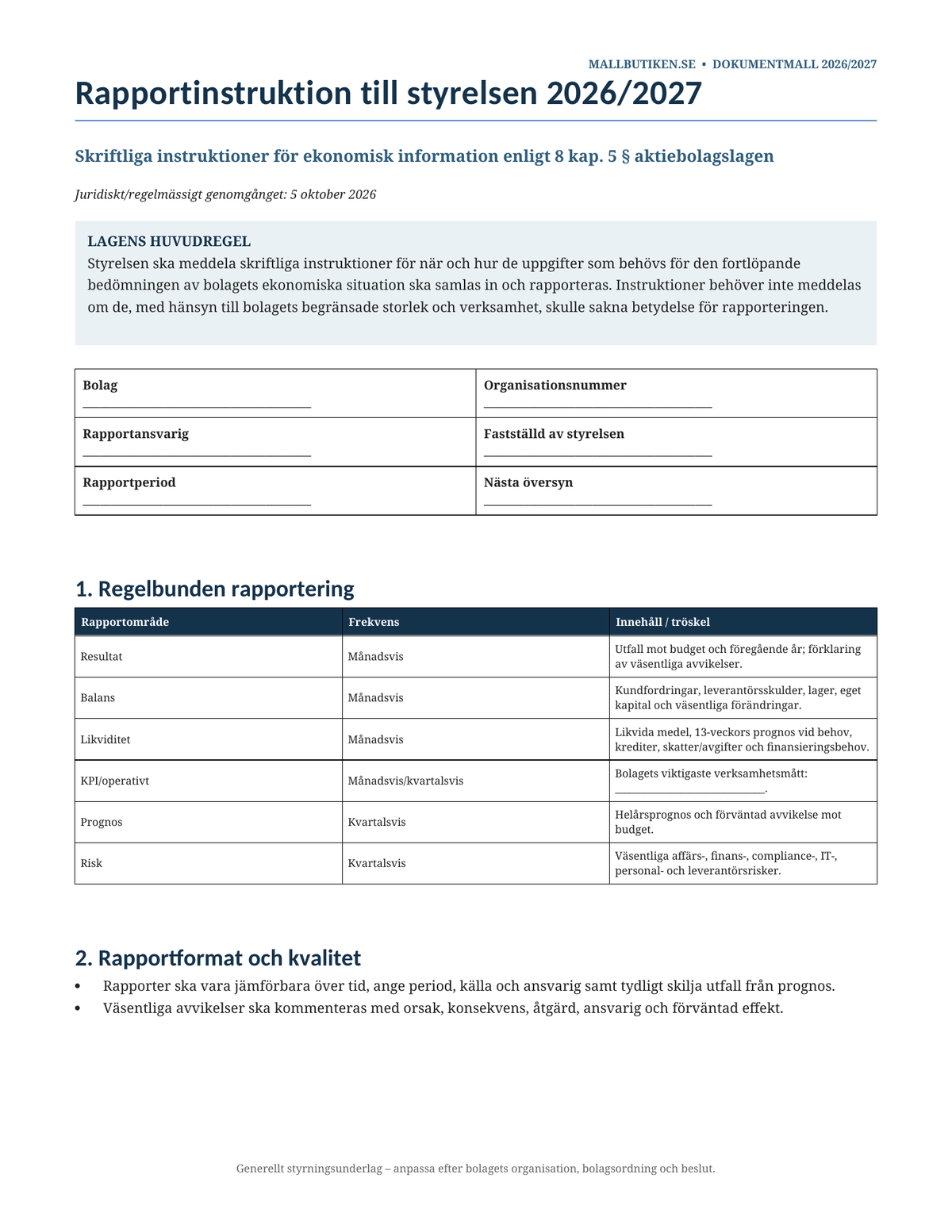
- Reporting instructions to the board – 2 pages.
- Decision & Delegation Matrix Board/CEO – 2 pages.
- Annual board cycle – 2 pages.
- Detailed user guide – 3 pages.
Important distinction: private vs. public limited company
This package is deliberately designed to avoid a common legal error found in older templates.
Private limited companies do not have a general legal requirement to establish a written set of rules of procedure or specific written CEO instructions annually. The previous general provisions in Chapter 8, Sections 6–7 of the Swedish Companies Act were repealed in 2014.
However, the board of a private limited company can voluntarily use rules of procedure and CEO instructions to clarify responsibilities, mandates, decision-making limits, and reporting. In practice, this is often valuable when the company has multiple board members, an external CEO, larger operations, or a more complex organization.
For public limited companies, special rules apply:
- The board must, in accordance with Chapter 8, Section 46 a of the Swedish Companies Act, annually adopt written rules of procedure.
- The board must, in accordance with Chapter 8, Section 46 b of the Swedish Companies Act, have written instructions regarding the division of labor between the board, the CEO, and other bodies established by the board.
- A public limited company must always have a managing director (CEO).
The board's responsibility cannot be delegated away
According to Chapter 8, Section 4 of the Swedish Companies Act, the board is responsible for the company's organization and the administration of the company's affairs. The board shall, among other things:
- continuously assess the company's financial situation,
- ensure adequate control of accounting and asset management,
- ensure that the company's other financial conditions are controlled in an appropriate manner,
- act with due care when delegating tasks,
- continuously monitor whether the delegation can be maintained.
A delegation matrix can therefore clarify who does what – but it does not remove the board's overall statutory responsibility.
Board Rules of Procedure
The rules of procedure provide a practical structure for the board's own work and include, among other things:
- company category and legal basis,
- the board's main tasks,
- the roles of the chair, members, deputy members, and the CEO,
- meeting frequency and notice procedures,
- requirements for decision documentation,
- quorum and conflicts of interest,
- minutes and documentation,
- matters normally reserved for the board,
- reporting and annual review.
What must a public limited company’s rules of procedure at least regulate?
For a public limited company, the rules of procedure must, according to Chapter 8, Section 46 a of the Swedish Companies Act, specify:
- how work shall be divided between the board members, where applicable,
- how often the board shall meet,
- to what extent deputy members shall participate in the board's work and be called to meetings.
The template covers these parts but also includes practical governance issues that many companies need to regulate beyond the legal minimum.
CEO instructions – the line between the board and daily management
According to Chapter 8, Section 29 of the Swedish Companies Act, the CEO shall manage the day-to-day administration in accordance with the board's guidelines and instructions. There is no universal monetary limit in the law defining day-to-day administration. The assessment depends on the company's operations, size, nature, and specific circumstances.
The CEO instructions help the board to concretize this limit and include, among other things:
- the CEO's operational responsibility,
- financial governance and internal control,
- agreements and commercial decisions,
- risk and compliance issues,
- matters to be referred to the board,
- monetary and risk thresholds,
- urgent measures,
- authorized signatories and powers of attorney,
- reporting to the board,
- conflicts of interest.
Urgent measures of an unusual nature or great importance
A CEO may normally not decide on measures that fall outside the day-to-day administration. The Swedish Companies Act does, however, have a specific exception for situations where a board decision cannot be awaited without material inconvenience to the company's business.
In such situations, the CEO may take the measure, but the board must be informed as soon as possible. The template has a specific section for this situation.
Reporting instructions – a separate legal requirement with an important exception
According to Chapter 8, Section 5 of the Swedish Companies Act, as a general rule, the board must provide written instructions for when and how information needed for the board's financial assessment is to be collected and reported.
Instructions do not need to be provided when, considering the company's limited size and operations, they would have no significance for the reporting to the board.
The separate reporting instructions include, among other things:
- monthly income statement,
- balance sheet,
- liquidity reporting,
- KPIs and operational key figures,
- forecasts and budget deviations,
- risk reporting,
- immediate reporting in case of extraordinary events.
Immediate reporting to the board
The package helps the company pre-determine which events should not wait until the next ordinary board meeting. Examples:
- acute liquidity or financing risk,
- risk of capital shortage or significant loss,
- major customer or supplier loss,
- material dispute or regulatory matter,
- suspected irregularity or fraud,
- serious IT, cyber, or personal data incident,
- other events of an unusual nature or great importance.
Decision and delegation matrix
The separate matrix translates the legal division of responsibility into practical mandates. Here, the company can specify who decides on, among other things:
- day-to-day purchases,
- investments within and outside the budget,
- loans, credits, and collateral,
- customer and supplier agreements,
- strategic or long-term agreements,
- hiring of personnel,
- appointment and dismissal of the CEO,
- disputes and settlements,
- related-party transactions.
Monetary limits are deliberately left open. An appropriate mandate must be adapted to the individual company's size, liquidity, risk profile, and business model.
Internal authority is not the same as authorized signature
A central part of the guide explains the difference between internal decision-making power and who can legally represent the company externally.
The CEO instructions and delegation matrix primarily regulate internal mandates. Registered signatory powers and specific powers of attorney must be checked separately. A company should therefore not assume that an internal monetary limit automatically governs legal effects toward third parties.
Annual board cycle
The package contains a two-page annual cycle with a practical structure for:
- annual accounts and the previous year,
- annual report and annual general meeting,
- strategy and half-year follow-up,
- liquidity, control, and preparedness,
- budget and business plan,
- annual review of governance documents,
- meeting calendar and recurring board agenda items.
Quorum and board documentation
The template also highlights Chapter 8, Section 21 of the Swedish Companies Act: the board is normally quorate when more than half of the total number of board members are present, unless the articles of association require more. Decisions may not be taken unless all members, as far as possible, have had the opportunity to participate and have received satisfactory documentation.
Minutes
Minutes must be taken at board meetings. Decisions must be recorded, the minutes must be adjusted in the manner required by law, and any member or the CEO has the right to have a dissenting opinion recorded.
Board minutes must be kept in numerical order and stored securely.
Conflicts of interest
The package contains clear checkpoints for conflicts of interest. Instructions or delegation may not be used to bypass the conflict-of-interest rules in the Swedish Companies Act. In the event of related-party transactions or other conflicts of interest, the matter must be assessed before the involved person participates in the handling or decision.
For which companies is this package suitable?
The package can be adapted for, among others:
- private limited companies with an external CEO,
- owner-led companies that are growing and need clearer corporate governance,
- companies with multiple board members,
- group companies,
- public limited companies,
- companies preparing for investment, financing, or changes in ownership.
Financial companies and other regulated businesses may be subject to additional special rules that must be checked separately.
Recommended workflow
- Check whether the company is private or public and read the articles of association.
- Adapt the rules of procedure to the board's actual organization.
- Define what the CEO may handle within the day-to-day administration.
- Fill in concrete monetary and qualitative thresholds in the delegation matrix.
- Determine what information the board should receive and how often.
- Decide which events must be reported immediately.
- Check registered signatory powers and powers of attorney separately.
- Establish the annual cycle and meeting calendar.
- Decide on the governance documents at a board meeting and include a reference to the minutes.
- Review the documents regularly and always after major organizational changes.
Legally reviewed for 2026/2027
The package was reviewed on October 5, 2026, against the Swedish Companies Act (2005:551), current version up to SFS 2026:783, particularly:
- Chapter 8, Section 4 – main tasks of the board and delegation.
- Chapter 8, Section 5 – written instructions regarding reporting to the board.
- Chapter 8, Sections 17–24 – chair, meetings, quorum, conflicts of interest, and minutes.
- Chapter 8, Sections 27–29 – CEO and day-to-day administration.
- Chapter 8, Sections 34–42 – conflicts of interest, representation, signatory powers, and exceeding authority.
- Chapter 8, Sections 46 a–50 – special rules for public limited companies.
Format and delivery
- 6 documents.
- 12 files in total.
- Word (DOCX) + PDF.
- 15 A4 pages per format series.
- Digital product – no physical goods are shipped.
Frequently asked questions
Must a private limited company have board rules of procedure?
No, not as a general requirement under the Swedish Companies Act. However, the company can voluntarily use rules of procedure for clearer governance.
Must a public limited company have rules of procedure?
Yes. The board must annually adopt written rules of procedure according to Chapter 8, Section 46 a of the Swedish Companies Act.
Must a private limited company have a CEO?
No. A private limited company may have a CEO but is not required to. Public limited companies, however, must have a CEO.
Are reporting instructions mandatory?
Chapter 8, Section 5 of the Swedish Companies Act sets a general requirement for written reporting instructions. Exemptions exist if the instructions would lack significance given the company's limited size and operations.
Do the CEO instructions determine who can sign for the company?
Not alone. Registered signatory powers and specific powers of attorney must be checked separately.
Can the same template be used by a private and a public limited company?
Yes, but the documents are marked so that legal requirements and voluntary governance choices can be distinguished and must be adapted to the company's category.
Important
These are general corporate governance templates. Regulated operations, larger groups, listed companies, complex signatory powers, related-party transactions, or special shareholder agreements may require additional rules or individual legal advice.