Svenska Dokumentmallar
Will with Children from Previous Relationships 2026/2027 – Spouses, Cohabitants, Statutory Share & Guide Word/PDF
Will with Children from Previous Relationships 2026/2027 – Spouses, Cohabitants, Statutory Share & Guide Word/PDF
- File format
- DOCX, PDF
- Document language
- Swedish
- Number of files
- 6
Digital download. No physical product is shipped.
Couldn't load pickup availability
About this template
Will with Children from Previous Relationships 2026/2027 – Spouses, Cohabitants, Statutory Share & Guide
This is a complete will package for families with children from previous relationships, joint children, or children from prior unions. The package contains separate will templates for spouses and cohabitants, a specific will for an individual married person with children from a previous relationship, an appendix for children/inheritance branches and legacies, a formal requirement and witness checklist, and a detailed user guide.
The template package is legally reviewed as of October 5, 2026, against the current wording of the Swedish Inheritance Code (1958:637), including rules on forced heirs, a spouse's right of inheritance, children from previous relationships, secondary inheritance, statutory share, testamentary capacity, formal requirements, and service of documents.
Delivery: 6 separate documents in both Word (DOCX) and PDF – a total of 12 files and 16 A4 pages per format series.
Included in this package
- Mutual will – spouses with children from previous relationships – 3 pages.
- Will – married person with children from previous relationships – 2 pages.
- Mutual will – cohabitants with children – 3 pages.
- Appendix – children, inheritance branches, legacies & special requests – 3 pages.
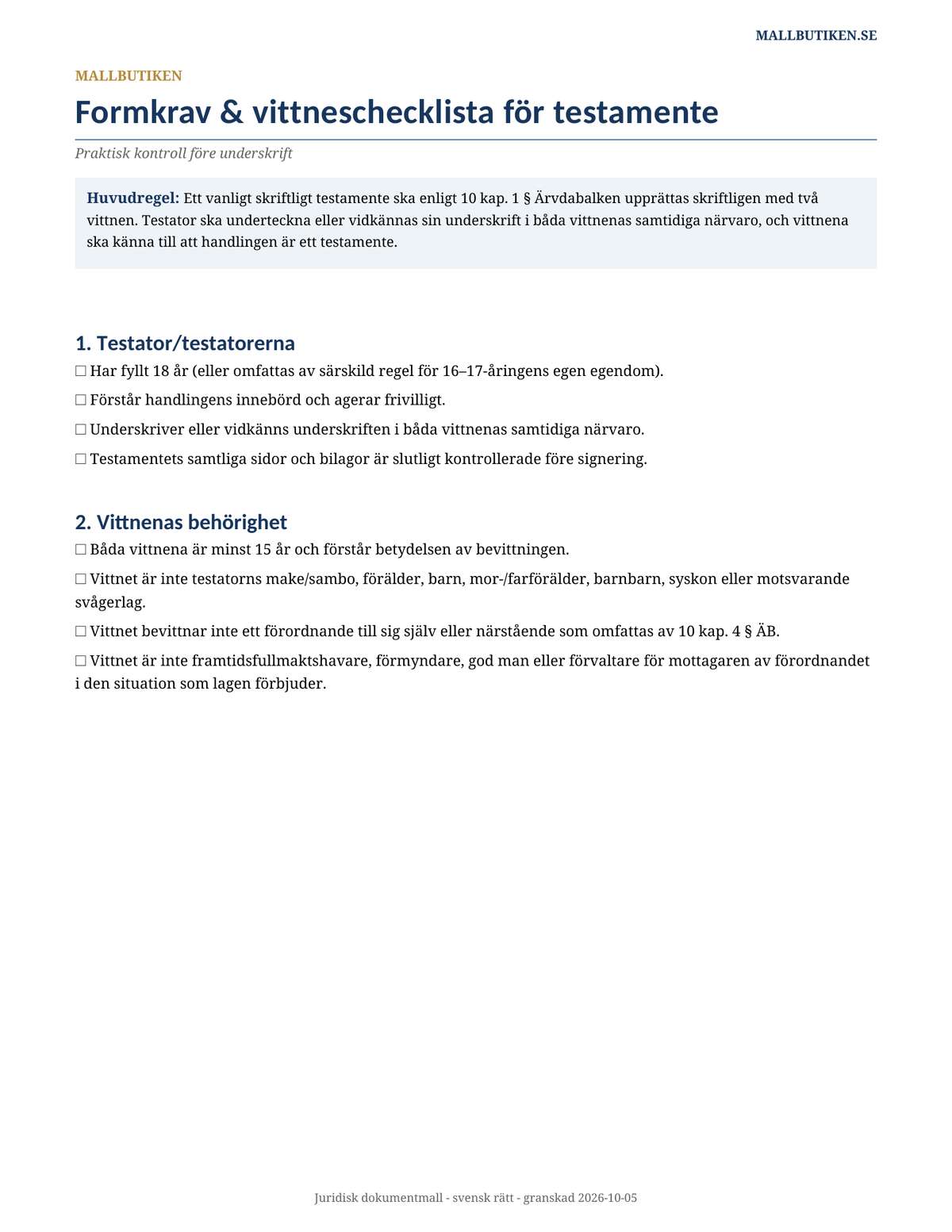
- Formal requirements & witness checklist for wills – 2 pages.
- Detailed user guide – will with children from previous relationships – 3 pages.
What is a child from a previous relationship ("särkullbarn")?
In a marriage, this term generally refers to a child of the deceased who is not also the child of the surviving spouse. Such a child has a different legal position regarding inheritance than the couple's joint children.
When a married person passes away, the main rule is that the surviving spouse inherits before the joint children. Joint children generally have to wait for their inheritance until the surviving spouse passes away.
However, children from previous relationships normally have the right to receive their inheritance from their parent immediately. The child can voluntarily waive their right in favor of the surviving spouse, in which case they gain a right to secondary inheritance according to law. Such a waiver cannot be forced through a will.
Why write a will when there are children from previous relationships?
A will can be used to strengthen the surviving spouse's financial protection within the framework of mandatory regulations. For example, the disposable part of the estate can be bequeathed to the surviving spouse with a right of limited disposition.
The will can also:
- specify how the disposable part is to be distributed,
- provide the surviving spouse with stronger financial protection,
- regulate the final distribution and secondary inheritance,
- designate the children's inheritance as separate property,
- specify legacies or specific assets,
- express wishes regarding housing, household items, and practical distribution.
However, a will cannot override a child's right to their statutory share if the child chooses to enforce it.
Inheritance share and statutory share – what is the difference?
The inheritance share is the portion that a forced heir would receive according to the legal order of succession. The statutory share is half of the inheritance share.
If a will limits a forced heir's statutory share, the heir must themselves call for an adjustment to receive it. According to the Inheritance Code, a six-month deadline applies from the date the forced heir received notice of the will.
The packages are therefore designed so that the statutory share is handled explicitly and not hidden behind simplified phrasing.
The will does not force the child to wait
A common misconception is that a will can automatically postpone a child's inheritance until the surviving spouse's death. That is not how Swedish law works.
The child normally has the right to their inheritance immediately. The child can, however, choose to waive their right in favor of the surviving spouse according to Chapter 3, Section 9 of the Inheritance Code. If such a waiver is made, the child instead receives a right to secondary inheritance in the same way as other secondary heirs according to the law.
The templates are explicitly written so as not to give the impression that such a waiver can be forced.
Surviving spouse's minimum protection
Furthermore, the surviving spouse has special minimum protection under Chapter 3, Section 1, paragraph 2 of the Inheritance Code. To the extent the estate allows, the surviving spouse must, together with property from the division of marital estate and their own separate property, have property equivalent to four price base amounts.
A will cannot set aside this statutory protection. The package's templates and guide therefore draw attention to both the statutory share and the surviving spouse's minimum protection.
Mutual will for spouses with children from previous relationships
The most comprehensive main template is intended for spouses where one or both have children from previous relationships.
It contains, among other things:
- identification of children from previous relationships and joint children,
- revocation of previous wills,
- bequest to the surviving spouse within the disposable part,
- explicit handling of the right to the statutory share,
- information on voluntary inheritance waiver according to Ch. 3, Sec. 9 of the Inheritance Code,
- secondary inheritance and final distribution,
- conditions regarding separate property,
- possibility of specific legacies,
- explanation of the right of limited disposition,
- signatures and a complete witness certificate.
Separate will for a married person with children from previous relationships
The package also contains a standalone template for when only one spouse needs to draw up a will or when the spouses for other reasons wish to use separate wills.
It is particularly useful when family circumstances differ between the spouses or when only one of them has children from a previous relationship.
Cohabitants with children – a completely different starting point
Cohabitants do not inherit from each other according to the legal order of succession. If a cohabitant passes away without a will and has children, the inheritance goes primarily to the deceased's forced heirs.
Therefore, a separate template for cohabitants with children is included. It is not labeled as a template for "children from previous relationships," as the concept carries a different meaning when the parties are not married.
The template helps cohabitants to:
- bequeath the disposable part to the surviving cohabitant,
- respect the children's right to their statutory share,
- direct final distribution,
- designate children's inheritance as separate property,
- specify practical wishes regarding housing and household items,
- regulate what is to happen if the cohabitation ends.
Right of limited disposition or full ownership?
The guide explains the difference between two important concepts.
Right of limited disposition essentially means the recipient may use, sell, and consume the property during their lifetime, but cannot decide through their own will how that portion should pass to secondary heirs.
Full ownership in principle provides a stronger right and can include the possibility of also bequeathing the property further.
Which alternative is suitable depends on the family situation and the final distribution one wishes to achieve. The package therefore highlights options that must be selected and adapted, rather than automatically applying the same solution to every family.
Separate property for children
All will templates include the possibility of stipulating that property received by children or other forced heirs shall be the recipient's separate property.
There is also support for addressing:
- substitute property,
- returns/yields,
- special conditions and legacies.
Appendix for children, inheritance branches, and legacies
Blended families can have complicated family structures. Therefore, a separate work and distribution sheet is included with space for:
- names and personal identification numbers,
- relationship,
- joint child or child from a previous relationship,
- inheritance branch and planned share,
- special legacies,
- contingent beneficiaries,
- separate property conditions,
- practical requests.
If the appendix is to be a legally binding part of the will, the main document must refer to it clearly, and the appendix must be handled with the same care regarding signatures and witnessing.
Formal requirements are crucial
An ordinary will must, according to Chapter 10, Section 1 of the Inheritance Code:
- be in writing,
- be witnessed by two witnesses,
- be signed or acknowledged by the testator in the simultaneous presence of both witnesses,
- be confirmed by the witnesses with their names,
- be witnessed by persons who know that the document is a will.
The witnesses do not, however, need to know the contents of the will.
Who cannot be a will witness?
Chapter 10, Section 4 of the Inheritance Code contains special eligibility and disqualification rules. Among other things, the testator's spouse or cohabitant, certain close relatives, and several persons with close ties to the beneficiary may not witness in ways prohibited by law.
Therefore, a separate two-page Formal requirements & Witness checklist is included to be used before signing.
Six months – two different legal questions
The guide clearly distinguishes between:
- adjustment for statutory share according to Chapter 7 of the Inheritance Code, and
- challenging the validity of a will according to Chapter 14.
Both can be subject to six-month deadlines from notification, but they are based on different legal grounds and should not be confused.
When should individual legal advice be used?
A standardized template does not fit all situations. The guide recommends seeking specific advice in cases such as:
- large or very unevenly distributed assets,
- companies, shares, or complicated ownership structures,
- agricultural or forest property,
- international connections or property abroad,
- conflict-ridden blended families,
- previous wills that are difficult to interpret,
- wishes for far-reaching rights of use or special administration,
- questions regarding the testator's decision-making capacity.
Recommended workflow
- Map out the family – spouses/cohabitants, children from previous relationships, joint children, and inheritance branches of deceased children.
- Choose the right will template in the package.
- Fill in personal details and identify all relevant forced heirs.
- Decide how the disposable part is to be distributed.
- Decide on the right of limited disposition/full ownership where the template offers options.
- Decide if the children's inheritance should be separate property.
- Add any legacies or special requests.
- Use the formal requirements and witness checklist.
- Print the final version and conduct the witnessing correctly.
- Store the original securely and perform a new review if family circumstances change.
Legally reviewed 2026/2027
The package has been reviewed as of October 5, 2026, based on the current Inheritance Code (1958:637), as amended through SFS 2026:251, primarily:
- Chapter 2 – forced heirs and legal order of succession.
- Chapter 3, Sections 1 and 9 – spouse's right of inheritance, children from previous relationships, and inheritance waiver in favor of the surviving spouse.
- Chapter 7, Sections 1–3 – statutory share and adjustment of wills.
- Chapter 9 – right to make and receive a will.
- Chapter 10, Sections 1–7 – formal requirements, witnesses, revocation, and mutual wills.
- Chapter 14 – notification and challenging.
Format and delivery
- 6 documents.
- 12 files total.
- Word (DOCX) + PDF.
- 16 A4 pages per format series.
- Digital product – no physical item is sent.
Common questions
Can a will ensure that children from previous relationships do not receive an inheritance immediately?
Not unilaterally. The child normally has the right to receive their inheritance immediately. The will can affect the distribution within the disposable part, and the child can voluntarily waive it in favor of the surviving spouse.
Can children from previous relationships be made entirely disinherited?
The forced heir's statutory share is protected. If the will encroaches upon the statutory share, the child must call for an adjustment within the statutory deadline to receive it.
How large is the statutory share?
The statutory share is half of the inheritance share that would have accrued to the forced heir by law.
Do cohabitants inherit from each other?
No, not according to the legal order of succession. Therefore, a special cohabitant template is included.
Must the witnesses read the will?
No. They must be aware that the document is a will but do not need to know the contents.
Must the witnesses be present at the same time?
Yes, for the standard written will, both must be present simultaneously when the testator signs or acknowledges their signature.
Does it include both spouses and cohabitants?
Yes. The package contains two spouse versions and one separate cohabitant version.
Important
This is a general document package according to Swedish law. Wills can have major financial consequences and should always be adapted to the actual family situation. In case of uncertainty or complex circumstances, individual legal advice is recommended before signing.
Guides: statutory share, children from previous relationships, and waiver
Before drafting, we recommend our guide on wills with children from previous relationships. It explains the statutory share and the difference between adjustment for a statutory share and challenging a will. If a child from a previous relationship later wishes to let the surviving spouse inherit first, there is also the guidance on inheritance waiver and renunciation.
The will must meet its own formal requirements. An inheritance waiver is a separate decision that does not occur automatically through a clause in the will.