Svenska Dokumentmallar
Termination of Tenancy Agreement 2026/2027 – Residential, Private Rental & Commercial Premises Word/PDF
Termination of Tenancy Agreement 2026/2027 – Residential, Private Rental & Commercial Premises Word/PDF
- File format
- DOCX, PDF
- Document language
- Swedish
- Number of files
- 4
Digital download. No physical product is shipped.
Couldn't load pickup availability
About this template
Termination of Tenancy Agreement 2026/2027 – Residential, Private Rental & Commercial Premises
This is a complete template package for a tenant’s termination of a tenancy agreement under Swedish law. The package contains three separate termination forms for different rental situations: standard residential tenancy under Chapter 12 of the Swedish Land Code, private rental under the new Private Rental Act (2026:772), and commercial premises where the tenant wishes to terminate the agreement for vacating the premises.
The template package was legally reviewed on October 4, 2026, and developed for use during 2026/2027. The separation is important because the rules regarding notice periods, how notice may be given, and which regulatory framework applies differ between standard residential tenancy, private rental, and commercial premises.
Digital delivery: a ZIP file. The product's previous table of contents specifies 4 document types in Word/PDF (8 internal format files, 5 pages). The internal files have not been inventoried separately.
Included in this package
Verified digital delivery: a ZIP archive, Uppsagning_Hyresavtal_2026_2027_Mallpaket.zip.
The original product list specifies three termination forms for tenants (standard residence, private rental, and commercial premises for vacating) as well as a user guide, according to the list in Word and PDF. It specifies 4 document types, 8 internal Word/PDF format files, and 5 A4 pages. The internal files of the ZIP archive have not been independently inventoried.
A ZIP download is verified, not 8 individual download links.
What the files contain
Residential termination: termination date and vacating in accordance with applicable rental rules. Private rental: separate form according to the Private Rental Act (2026:772) when applicable. Commercial premises: tenant's termination for vacating, not for modification of terms. Guide: formal requirements, recipients, deadlines, and evidence regarding service or receipt.
Notice periods, formal requirements, and any transitional provisions must be checked for the actual agreement. Agreements for commercial premises may have specific rules and contractual terms.
Documents according to the table of contents
- Termination of Tenancy Agreement – Residential 2026/2027, 1 A4 page.
- Termination – Private Rental 2026/2027, 1 A4 page.
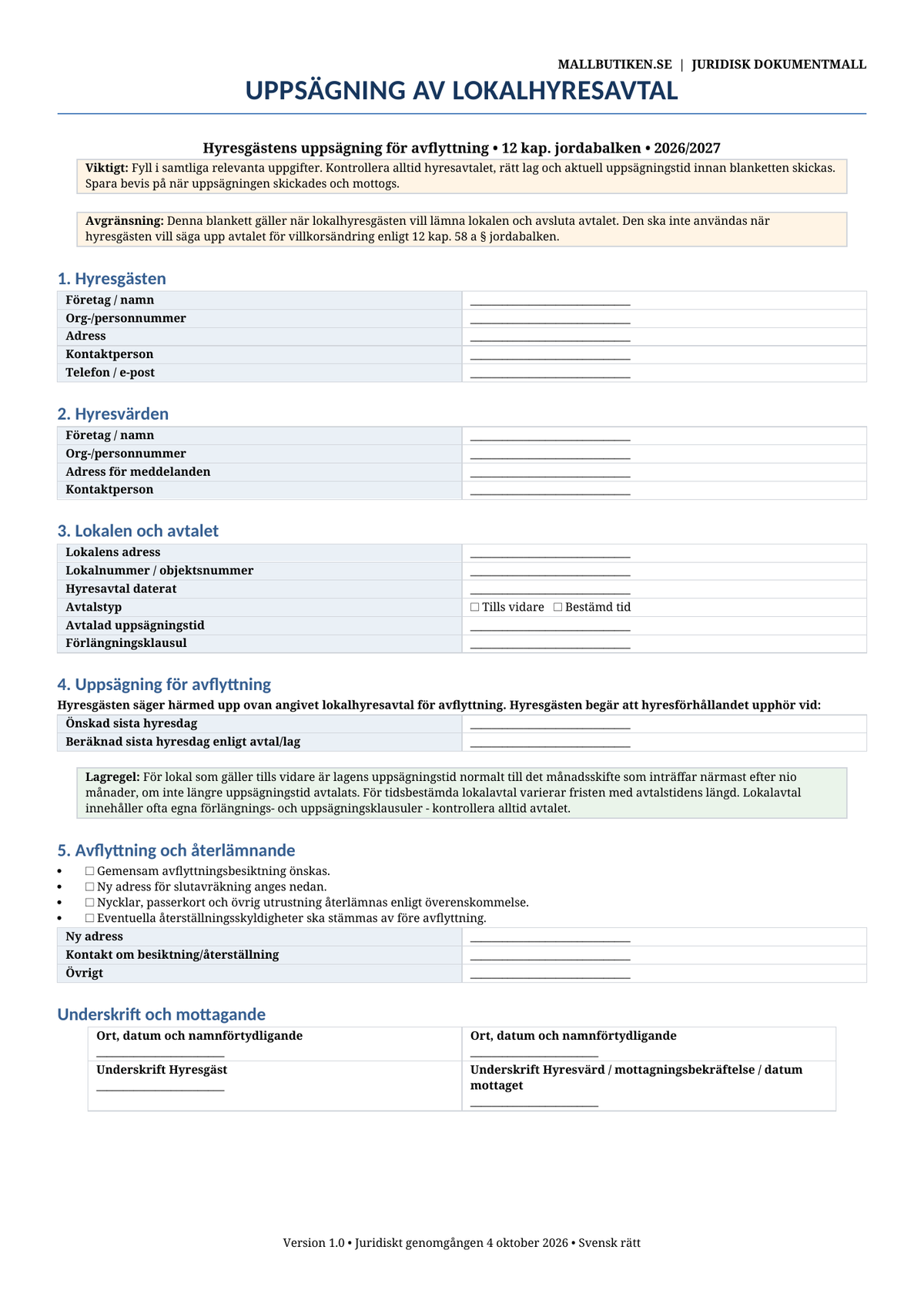
- Termination of Commercial Tenancy Agreement – Tenant 2026/2027, 1 A4 page.
- Detailed User Guide, 2 A4 pages.
- All documents in both Word and PDF.
Three different forms – choose the right regulatory framework
One of the greatest risks when terminating a tenancy agreement is using a general form without first checking which law applies. For this reason, this package contains three clearly delimited templates.
1. Standard residential tenancy according to Chapter 12 of the Land Code
The first form is intended for a tenant's termination of a residence covered by the rental rules in Chapter 12 of the Land Code.
According to Chapter 12, Section 5 of the Land Code, a residential tenant may always terminate the agreement so that it ends at the turn of the month occurring earliest three months after the termination. In certain situations, the tenancy agreement may grant the tenant more favorable rights, and the agreement should therefore always be checked.
The form contains fields for:
- tenant and landlord,
- rental object and apartment number,
- date of the tenancy agreement,
- indefinite or fixed-term agreement,
- agreed notice period,
- desired and calculated last day of tenancy,
- new address, inspection, and practical details,
- signature and acknowledgment of receipt.
Written termination and evidence
If the tenancy has lasted longer than three months, the termination must normally be in writing according to Chapter 12, Section 8 of the Land Code. A tenant's oral termination may in some cases be accepted if the landlord provides a written acknowledgment, but written termination is normally safest from an evidentiary point of view.
For standard rentals, a registered letter may be used under the conditions of the law, which is also covered in the user guide.
2. Private rental according to the Private Rental Act (2026:772)
The second form is specifically designed for agreements covered by the Private Rental Act (2026:772), which entered into force on July 1, 2026, replacing the Act (2012:978) on the rental of private dwellings.
The new law applies, among other things, when a natural person or an estate of a deceased person rents out a house or part of a house for residential purposes, but it contains important exceptions. For example, not all sublettings of a rental apartment are covered.
Three months' notice period under the new law
According to Chapter 6, Sections 1–2 of the Private Rental Act, the tenant may terminate both fixed-term and indefinite agreements so that they end at the turn of the month occurring earliest three months from the termination.
The form contains specific fields for:
- identity of the tenant and landlord,
- the privately rented dwelling,
- type and date of the agreement,
- date the termination is sent or delivered,
- desired and calculated last day of tenancy,
- landlord's specified electronic address,
- vacating details and acknowledgment of receipt.
Electronic address and registered letter for private rentals
The Private Rental Act contains its own rules on when a termination is considered to have taken place. If the recipient has specified an electronic address for messages regarding the tenancy agreement, the termination may, according to the law, be considered to have taken place when sent to that address. Registered mail may also be used in accordance with the law's rules.
This makes the separate private rental form particularly relevant following the 2026 legislative amendment.
Transitional rules – older private rental agreements
The new Private Rental Act entered into force on July 1, 2026. The previous act (2012:978) still applies to agreements entered into under the older act before the entry into force. Therefore, the user guide reminds you to check the date of the agreement and which regulatory framework the agreement falls under.
3. Commercial premises – tenant's termination for vacating
The third form is for the commercial tenant who actually wants to end the tenancy and leave the premises.
For a commercial tenancy agreement valid for an indefinite period, the legal notice period according to Chapter 12, Section 4 of the Land Code is normally the turn of the month occurring closest after nine months from the termination, unless a longer notice period has been agreed upon.
For fixed-term commercial agreements, the minimum legal notice period depends on the length of the rental period. Commercial agreements also often contain their own termination and extension clauses, making it particularly important to check the agreement.
Vacating is not the same as changing terms
The form for commercial premises should not be used when the tenant wishes to stay in the premises but change the rent or other rental terms.
For termination regarding the change of terms, Chapter 12, Section 58 a of the Land Code applies. In such cases, the termination must, among other things, specify which change is requested, and if the parties do not reach an agreement, the dispute may need to be referred to the Rent Tribunal within two months.
The commercial template contains
- tenant and landlord,
- address of the premises and object number,
- date of the tenancy agreement,
- indefinite or fixed-term agreement,
- agreed notice period,
- extension clause,
- desired and calculated last day of tenancy,
- inspection, keys, and restoration,
- signature and acknowledgment of receipt.
Detailed user guide included
The separate user guide helps the user select the correct form and goes through the following step by step:
- the difference between standard residential tenancy, private rental, and commercial premises,
- the main rules regarding notice periods,
- how to verify the last day of tenancy,
- written form and evidence,
- how the termination can be sent,
- what happens after residential termination,
- the new Private Rental Act from July 1, 2026,
- the difference between vacating commercial premises and changing terms,
- when the templates should not be used,
- final checklist before sending.
When the package should not be used
The package is deliberately limited to the tenant's ordinary termination. It should not be used for:
- landlord's termination of a residence,
- landlord's termination of commercial premises,
- termination due to forfeiture or other immediate breach of contract,
- commercial tenant's termination for change of terms according to Section 58 a,
- disputes where the last day of tenancy or applicable regulatory framework is already contested.
This is important because landlord terminations and commercial tenancy agreements involving changes of terms have their own mandatory formal requirements and procedural rules.
Legally reviewed for 2026/2027
The documents were reviewed on October 4, 2026, based on, among others:
- Chapter 12, Sections 3–8 of the Land Code – rental period, notice period, and the manner of termination.
- Chapter 12, Section 58 a of the Land Code – commercial tenant's termination for change of terms.
- Private Rental Act (2026:772), especially Chapter 1 and Chapter 6.
- the transitional provisions to the Private Rental Act.
Format and digital delivery
Verified: a ZIP download. The older product list specifies 8 internal format files (not independently inventoried).
- Word (DOCX) – fully editable forms and guide.
- PDF – print-ready A4 versions.
- 4 documents / 8 files / 5 A4 pages.
- Digital product – no physical goods are sent.
Guides and further reading
Read the guide on notice periods and formal requirements, the guide on the Private Rental Act 2026, the guide on commercial tenancy and termination, and the guide on residential tenancy agreements.
Frequently Asked Questions
Are the landlord's termination forms also included?
No. The product list specifies forms for the tenant's termination of a residence, private rental, and commercial premises, as well as a guide. A ZIP file is attached for delivery; internal format files have not been inventoried separately.
Which form should I use for a standard rental apartment?
Normally the residential form according to Chapter 12 of the Land Code.
Can I use the same form when I rent a privately owned co-op or villa?
Not without first checking if the agreement is covered by the Private Rental Act (2026:772). The package therefore contains a separate private rental form.
How long is a residential tenant's notice period?
According to Chapter 12, Section 5 of the Land Code, the tenant may always terminate the residential agreement to the turn of the month occurring earliest three months from the termination.
How long is the notice period for private rentals after July 1, 2026?
According to the new Private Rental Act, the tenant may terminate the agreement to the turn of the month occurring earliest three months from the termination.
How long is the notice period for commercial premises?
For indefinite agreements, normally nine months to the turn of the month, unless a longer period has been agreed upon. Fixed-term agreements must be checked against both the agreement and Chapter 12, Section 4 of the Land Code.
Can the commercial template be used to negotiate lower rent?
No. If the purpose is to stay but change the terms, the rules on the change of terms in Chapter 12, Section 58 a should be followed.
Important
The template package is professional general documentation material. Always check the current tenancy agreement, applicable law, and exact notice deadline before sending the termination. In the event of a dispute or uncertainty regarding the regulatory framework, individual legal advice should be obtained.