

Svenska Dokumentmallar
Violence & Threats in the Work Environment 2026/2027 – Risk Assessment, Alarm Plan & Safety Procedures Word/PDF
Violence & Threats in the Work Environment 2026/2027 – Risk Assessment, Alarm Plan & Safety Procedures Word/PDF
 Downloading the template is available immediately after purchase. Our document templates are always delivered in customizable formats.
 If you are unsure which template is appropriate or how you should complete it, please see the relevant information under the 'Legal Information' tab in our main menu.
 Our templates are designed in accordance with current legislation and practice in each area to ensure that the documents you create are legally correct.


Couldn't load pickup availability
Violence & Threats in the Work Environment 2026/2027 – Risk Assessment, Alarm Plan & Safety Procedures
This is a complete work environment package for employers who need to prevent, assess, and manage violence or threats of violence at work. The package is designed for operations where employees encounter customers, patients, users, students, clients, the public, or other individuals in situations where conflict, threats, harassment, or violence may arise.
The template package was legally reviewed on October 4, 2026, primarily against AFS 2023:2 Chapter 5 on violence and threats of violence, AFS 2023:12 on the design of workplaces, AFS 2023:1 on systematic work environment management, and the Work Environment Act.
Delivery: 6 separate documents in both Word (DOCX) and PDF – a total of 12 files and 11 A4 pages per format series.
Included in this package
- Risk Assessment – Violence & Threats 2026/2027 – 2 pages.
- Safety Procedure – Violence & Threats – 2 pages.
- Alarm & Escalation Plan – 2 pages.
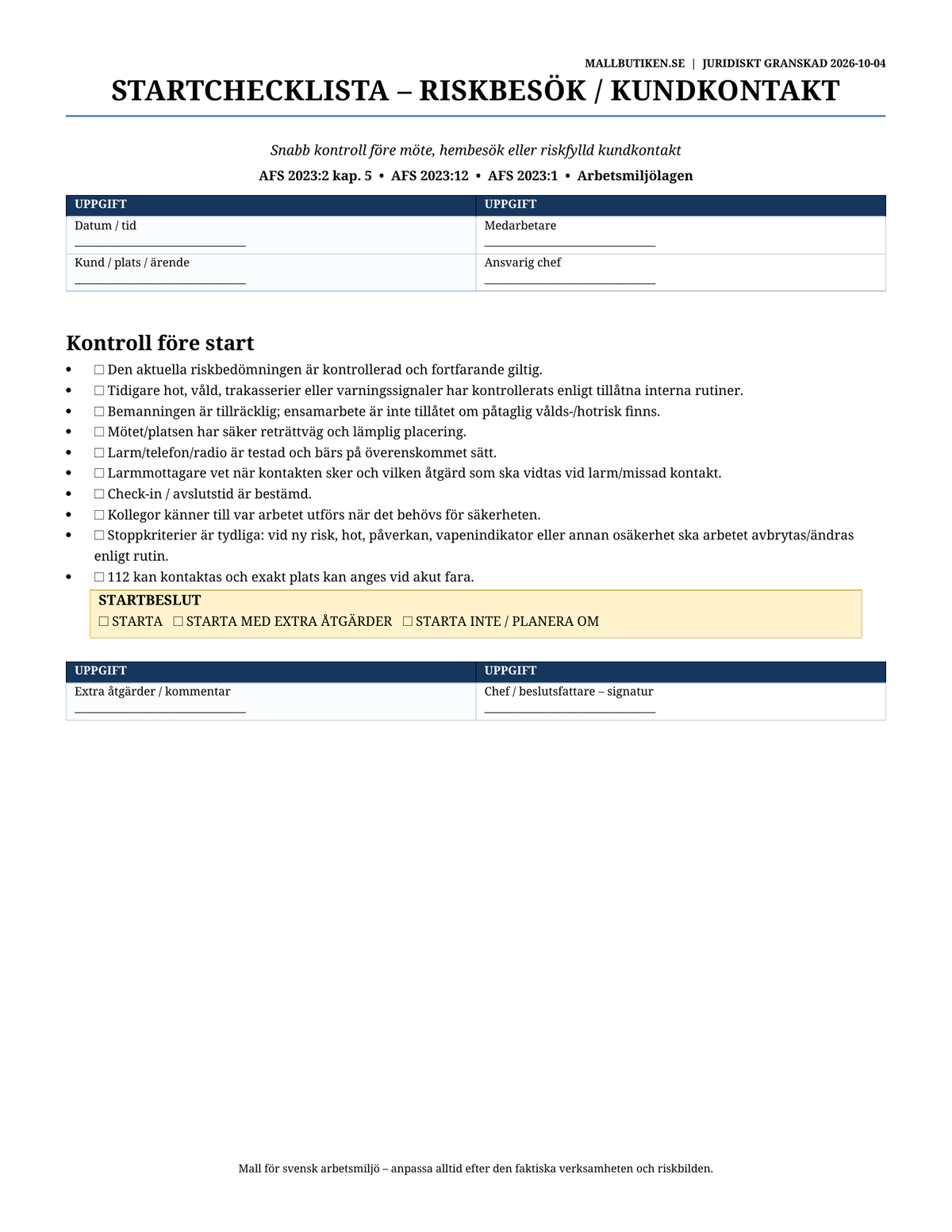
- Start Checklist – Risk Visits / Customer Contact – 1 page.
- Crisis Support & Post-Incident Plan – 2 pages.
- Detailed User Guide – 2 pages.
AFS 2023:2 applies to all operations where risks may exist
The regulations regarding violence and threats of violence apply to operations where there may be a risk of violence or threats, regardless of how the threat is communicated. This means that the employer must assess more than just physical encounters. Threats via telephone, email, the internet, and social media may also be covered.
The employer must prevent the risk
AFS 2023:2 requires the employer to organize work in a way that prevents the risk of violence and threats as far as possible. The employer must also have specific safety procedures for work where such risks exist and follow up on these procedures to ensure they are up to date.
The package is therefore structured as a complete workflow – not just a risk form.
Risk assessment of the actual work situation
The risk assessment helps the organization map out, among other things:
- previous threats, violence, harassment, and near-misses,
- work involving money, medication, demands, rejections, or the exercise of public authority,
- contact with customers, patients, users, or clients,
- work during late hours, at night, or in isolated locations,
- home visits and work on other people's property,
- digital threats and harassment,
- lone working,
- physical environment and retreat routes,
- ability to obtain assistance quickly,
- the employee's training, experience, and competence.
Significant risk – lone working is prohibited
If a work task involves a significant risk of violence or threats of violence, the employer may not, according to AFS 2023:2, allow the employee to perform the task as lone working.
The risk assessment template therefore includes a clear "stop rule." A personal alarm or mobile phone does not automatically make such lone working permissible.
How is it determined if the risk is significant?
The assessment must be made based on the concrete situation. Relevant factors may include, for example:
- explicit or implied threats,
- previous incidents or experience from similar situations,
- time and place,
- the nature of the work task,
- physical conditions at the workplace,
- the employee's knowledge and competence.
Safety procedures that staff are actually aware of
The separate safety procedure gives the employer a structure for what applies before, during, and after a threatening situation. It covers, among other things:
- staffing and lone working,
- communication of known risks,
- retreat routes and the possibility of reaching safety,
- when alarms should be used,
- how the employee should act if the situation escalates,
- support and supervision,
- reporting and follow-up after the incident.
Special support and supervision
In work where there is a risk of recurring violence or threats of violence, the employer must ensure that the employee receives special support and supervision.
Depending on the operation, this may involve, for example, regular managerial support, supervision, training in conduct, occupational health services, or other support measures.
Alarms – more than just a button
If an alarm is necessary for safety, a functioning chain must be in place according to AFS 2023:2. The employer must, among other things, ensure that:
- alarms are available where needed,
- it is determined who receives the alarm,
- the recipient knows what action to take,
- safety procedures and measures in the event of an alarm are practiced regularly,
- alarm equipment is checked and maintained.
Separate Alarm & Escalation Plan
The package's alarm plan documents:
- fixed alarms, personal alarms, panic alarms, telephone, app, or radio,
- primary and backup recipients,
- maximum response time,
- escalation steps if no contact is made or the risk persists,
- when to contact 112,
- location information for police/emergency services,
- code words and discreet signals where the operation uses such,
- drilling and checking the alarm chain.
Start checklist for risk visits and customer contact
The risk landscape can change rapidly. Therefore, a compact one-page checklist is included for, for example:
- home visits,
- meetings with known or possible threat profiles,
- authority and client contacts,
- customer visits,
- work in isolated locations.
The checklist covers, among other things, risk assessment, staffing, retreat routes, alarms, check-in, stop criteria, and the ability to provide an exact location to 112.
Physical design of the workplace
AFS 2023:12 requires that workplaces be designed so that the risk of violence and threats is prevented as far as possible.
This may mean, among other things, that the operation needs to assess:
- possibility of retreat or a safe zone,
- visibility of the premises,
- entrances and access,
- ability to see the area outside before a door is opened,
- concealed spaces and unnecessary congestion risks,
- placement of staff and visitors.
When violence or threats have occurred
According to AFS 2023:2, the employer must investigate and document near-misses and incidents where violence or threats of violence have occurred.
The follow-up should, among other things, clarify:
- what led to the incident,
- what the sequence of events was,
- whether the procedures worked,
- whether the alarm worked,
- what physical or psychological consequences arose,
- what measures are needed to prevent recurrence.
Crisis Support & Post-Incident Plan
The package contains a separate document that helps the manager and the organization plan for:
- emergency care and first aid,
- early crisis support,
- occupational health services,
- adjustment of work or scheduling,
- practical support during contact with authorities,
- follow-up meetings,
- return to regular work,
- continued safety measures.
Serious incidents and notification to authorities
Severe personal injuries, fatalities, injuries affecting multiple employees simultaneously, or near-misses that posed a serious danger to life or health may fall under the obligation to notify the Swedish Work Environment Authority (Arbetsmiljöverket) without delay.
The post-incident plan therefore contains a control point for this assessment, but does not replace official reporting to authorities.
Complements the Mallbutiken Incident Report
This product focuses primarily on preventive work regarding violence and threats. For a full incident investigation following an accident or a serious near-miss, it can be combined with Mallbutiken's separate product Incident Report / Workplace Accident 2026/2027.
First aid and crisis support
AFS 2023:2 also contains regulations on first aid and crisis support. Preparedness must be adapted to the nature, scale, and specific risks of the operation.
In operations with a risk of violence and threats, the employer should therefore plan in advance how affected employees can quickly receive help and support.
Which operations is this package suitable for?
The templates can be adapted for many types of operations, for example:
- care and social services,
- social services and exercise of public authority,
- schools and education,
- retail and trade,
- reception, hotels, and service,
- security and guarding,
- transport and public transit,
- real estate and on-call services,
- customer service and call centers,
- fieldwork and home visits.
Recommended workflow
- Map out risk situations together with affected employees and safety representatives.
- Document the risk assessment and decide on preventive measures.
- Establish safety procedures and define when lone working is not permitted.
- Establish an alarm and escalation plan where alarms are needed.
- Train and inform affected employees.
- Practice alarms and safety procedures regularly.
- Use the start checklist for particularly high-risk visits or contacts.
- After an incident: secure support, document, investigate, and update the risk assessment.
- Follow up to ensure that the measures are actually working.
Legally reviewed for 2026/2027
The documents were reviewed on October 4, 2026, based on, among others:
- The Work Environment Act (1977:1160), primarily Chapter 3, Sections 2 and 2a.
- AFS 2023:2 Chapter 5 – violence and threats of violence.
- AFS 2023:2 Chapter 4 – first aid and crisis support.
- AFS 2023:2 Chapter 6 – lone working.
- AFS 2023:12 Chapter 6 – workplace design and protection against violence/threats.
- AFS 2023:1 – systematic work environment management and written risk assessment.
Format and delivery
- 6 documents.
- 12 files in total.
- Word (DOCX) + PDF.
- 11 A4 pages per format series.
- Digital product – no physical item is sent.
Common questions
Must the employer have a specific procedure for violence and threats?
Yes, when work may involve such risks, the employer must have specific safety procedures and keep them up to date.
May an employee work alone if there is a personal alarm?
Not if the work task involves a significant risk of violence or threats of violence. In that case, the task may not be performed as lone working.
Must alarms be practiced?
Yes. Where alarms are needed, employees must regularly practice safety procedures and actions in the event of an alarm.
Do the regulations also apply to threats via telephone or the internet?
Yes. AFS 2023:2 covers threats regardless of how they are communicated.
Must incidents be documented?
The employer must investigate and document near-misses and incidents where violence or threats of violence have occurred.
Are risk assessment and alarm plan included?
Yes. Both are included along with a safety procedure, start checklist, post-incident plan, and user guide.
Important
The templates are general work environment documents. They must be adapted to the actual threat profile, the organization's staffing, physical environment, alarm organization, and the conditions of the affected employees. When the organization lacks sufficient in-house expertise, occupational health services or other expert assistance should be engaged.