
Cyber Resilience Act 2026/2027 – reporting, SBOM and cybersecurity requirements

Short answer: The Cyber Resilience Act (CRA), Regulation (EU) 2024/2847, introduces horizontal cybersecurity requirements for products with digital elements. Reporting obligations under Article 14 apply as of 11 September 2026, while the main part of the regulation begins to apply on 11 December 2027.
Which products are covered?
Broadly speaking, the CRA covers products with digital elements that are made available on the EU market. This can include both hardware and software, as well as components. Exact exemptions and classifications must be verified for the specific product in question.
Important dates
| Date | Requirement |
|---|---|
| 11 June 2026 | Provisions regarding the notification of conformity assessment bodies began to apply. |
| 11 September 2026 | Reporting obligations for actively exploited vulnerabilities and significant incidents began to apply. |
| 11 December 2027 | The main part of the CRA begins to apply. |
Reporting from September 2026
The Commission's guidance specifies that a manufacturer must submit an early warning within 24 hours of becoming aware, and a full notification within 72 hours for situations that fall under the scope. Subsequently, a final report may be required in accordance with the CRA deadlines.
What do companies need to establish?
- cybersecurity risk assessment for the product,
- vulnerability management and coordinated vulnerability disclosure,
- inventory of software components and SBOM where needed,
- process for security updates and support period,
- technical documentation and evidence of conformity,
- incident and vulnerability reporting with clear roles and escalation.
CRA compared to NIS2
The CRA is primarily product-oriented and directs requirements at economic operators regarding products with digital elements. NIS2 is operational and organization-oriented, and applies to certain types of essential or important services. Therefore, a company may need to handle both regulatory frameworks simultaneously.
Frequently asked questions
Does the CRA already apply in 2026?
Yes, certain parts already apply. Reporting under Article 14 began to apply on 11 September 2026.
Do all other product requirements apply already?
No. The main rule is that the regulation applies in full from 11 December 2027.
Is SBOM explicitly a single universal format?
No. The company needs to document components and vulnerabilities in a manner that satisfies applicable requirements and supports risk and vulnerability management.
See CRA Compliance 2026/2027.
Related guides
More working documents: See more templates for EU compliance and product regulations.
Related product-specific rules: The specific RED cybersecurity requirements have applied to relevant radio equipment since 1 August 2025, and Delegated Regulation (EU) 2022/30 is repealed from 11 December 2027. For a practical distinction between radio functions, data protection, EN 18031 and the transition to CRA, read our guide to RED, radio toys and the transition to CRA.
Cloud-backend scope: Connected products may need a separate assessment of cloud dependencies alongside their other CRA requirements. Read the guide on when a cloud backend qualifies as RDPS rather than standalone SaaS.
Sources
The guide provides general information and does not constitute legal or technical advice for a specific product.
Templates in this article
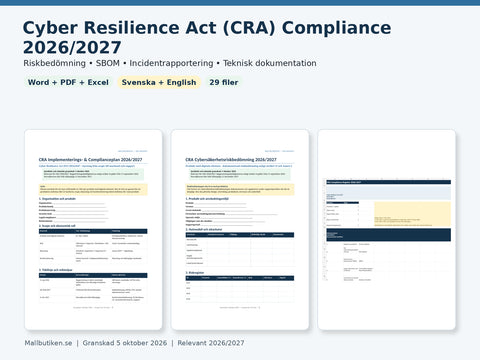
Cyber Resilience Act (CRA) Compliance 2026/2027 – Swedish + English | Risk Assessment, SBOM & Incident Reporting Word/PDF/Excel
Word (DOCX) + PDF + Excel (XLSX)
79 SEK
View template: Cyber Resilience Act (CRA) Compliance 2026/2027 – Swedish + English | Risk Assessment, SBOM & Incident Reporting Word/PDF/Excel
Explore the topic
 Business guides – contracts, HR, AI & compliance
CRA SBOM and risk assessment 2026/2027 – step-by-step guide
Practical CRA guide: how to build an SBOM, document cybersecurity risks, and link components to vulnerability management ahead of 2027. Reviewed ag...
 Business guides – contracts, HR, AI & compliance
Which companies are covered by NIS2 and the Cybersecurity Act?
How Swedish organizations determine if they are covered by the Cybersecurity Act: sector, establishment, size, special cases, essential/important e...
 Business guides – contracts, HR, AI & compliance
NIS2 and supplier agreements – which cybersecurity requirements should be agreed upon?
How NIS2-affected organizations can agree on supplier security: incidents, subcontractors, access, vulnerabilities, continuity, monitoring, and exit.


