
Liquidity Budget 2026/2027 – how to create a monthly cash flow forecast
Plan your cash flow with the correct payment dates. The guide provides a calculation example, a stress scenario, and shows how accounts receivable and credit policy relate to the forecast.

A cash flow budget shows whether a company has enough money for upcoming payments. Create the forecast based on when money is expected to be received and paid out. Calculate the closing cash balance as opening cash plus receipts minus disbursements. Carry the balance over to the next period.
Here you will find a workflow, a calculation example, and a checklist for your company’s cash flow forecast. Start month by month and supplement with more frequent periods if cash flow is tight or payments vary significantly.

The most important points in brief
- Profit is not the same as money in the bank.
- Customer and supplier invoices should be placed according to expected payment, not automatically by invoice date.
- VAT, taxes, investments, and loan amortizations affect cash flow.
- Create an alternative scenario and track which assumptions have changed.
Operating budget or cash flow budget?
| Question | Operating Budget | Cash Flow Budget |
|---|---|---|
| What is tracked? | Revenue and expenses | Receipts and disbursements |
| Customer pays next month | Revenue is assessed according to accounting principles | The money is placed in the expected payment period |
| Amortization | Is usually not an expense | Is a disbursement |
| Investment | The cost can be spread through depreciation | The disbursement is recorded when it is to be made |
Read the guide on operating budgets and earnings forecasts for tracking profitability. Verksamt.se recommends creating the cash flow budget in parallel to show why a good annual result does not guarantee that there is enough money every month.
Which payments should be included?
Start with the actual balance of available liquid assets. Keep personal funds separate from any credit that may need to be utilized; display financing separately so that dependency on credit becomes visible.
| Category | Example | Check |
|---|---|---|
| Receipts | Customer payments, loans, capital contributions, and repayments | What is the date and how certain is the amount? |
| Suppliers | Open invoices, planned purchases, and credits | Are partial payments and credits included? |
| Personnel | Salaries and related payments | Are disbursements and taxes in the correct period? |
| Tax and VAT | Payments to or from the tax account | Check the company's actual dates and accounting periods. |
| Financing and investments | Interest, amortization, equipment, and financing payouts | Avoid double counting and unfounded assumptions about new loans. |
How to create the forecast step by step
- Select start date and periods. Document when the balance was retrieved. If the forecast is monthly, the opening balance should refer to the start of the first month.
- Gather open customer items. Assess when each major customer payment is actually expected. Note uncertainty instead of assuming everything will be paid on time.
- Gather supplier invoices. Retrieve open amounts from the accounts payable ledger and add expected purchases that have not yet been invoiced.
- Enter other payments. Include personnel, tax, VAT, rent, financing, and investments at the correct time.
- Calculate the balance. Use opening liquidity plus receipts minus disbursements. Carry the closing balance over to the next period.
- Determine action level. An internal minimum level makes it easier to act before the balance becomes negative. The level should be adapted to risks and payment patterns.
- Create a stress scenario. Test for delayed customer payments, lower sales, or an unexpected disbursement.
- Compare with actuals. Update the forecast and explain major differences. Save previous versions so that changed assumptions can be tracked.
Example: a positive monthly flow can still cause problems
| Item | October | November |
|---|---|---|
| Opening liquidity | 30,000 | 45,000 |
| Receipts | 120,000 | 110,000 |
| Disbursements | 105,000 | 125,000 |
| Closing liquidity | 45,000 | 30,000 |
If 40,000 SEK of the October receipts arrive in November instead, the October closing balance will be 5,000 SEK. November will then start with 5,000 and receive 150,000 in receipts; its closing balance is still 30,000. The two-month total remains unchanged, but the October buffer is much smaller.
Also check payments within the month
Even a positive balance at the end of the month can hide a deficit before a large customer payment. If salaries and suppliers must be paid earlier, supplement with weeks or a list of actual dates.
How to connect the ledger and credit policy to cash flow?
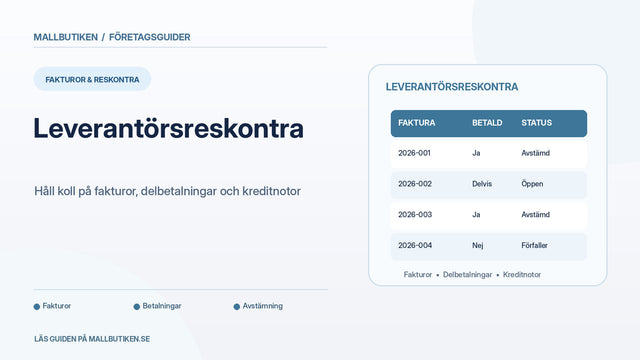
The accounts payable ledger provides a concrete list of upcoming disbursements. Read how to reconcile partial payments and credit notes before entering the amounts into the forecast. Otherwise, the same invoice could be counted both as the original amount and as remaining debt.
Customers' payment terms and payment ability affect receipts. Follow up on late items and use a B2B credit policy when credit decisions need to be consistent. The forecast needs to reflect real assumptions even when the contract specifies an earlier date.
Checklist before an investment or purchase decision
- The forecast is updated with actual open items.
- Major customer payments have been assessed individually.
- VAT, taxes, and personnel payments are included.
- The investment's payment plan and financing are clear.
- The stress scenario shows when the buffer becomes too small.
- Someone is responsible for decisions and follow-up.
Common mistakes
- Using the invoice date as the payment date for all items.
- Forgetting amortizations because they are not operating expenses.
- Entering a possible loan as if the financing were already decided.
- Double-counting VAT by mixing amounts with and without VAT.
- Only looking at month-end when intra-month payments are critical.
- Creating a forecast without following up on the actual results.
Frequently asked questions about cash flow budgets
Should VAT be included?
Yes, the forecast must reflect actual payments. Customer and supplier payments and flows to or from the tax account must be handled consistently, without double counting.
How long of a forecast is needed?
Twelve months can provide a useful planning horizon. In cases of uncertainty or weak cash flow, it often needs to be supplemented with more frequent follow-up for the near term.
What does a negative balance mean?
It shows a calculated financing need in the scenario. Check the assumptions and plan measures before payments fall due. A negative forecast balance is not, in itself, a complete legal assessment of insolvency or capital deficiency.
Is cash flow shortage the same as capital deficiency?
No. Liquidity is about solvency and payment timing. Equity is a different assessment. In cases of suspected capital deficiency, the board also needs to check the rules regarding balance sheets for liquidation purposes.
Work in a ready-made cash flow model
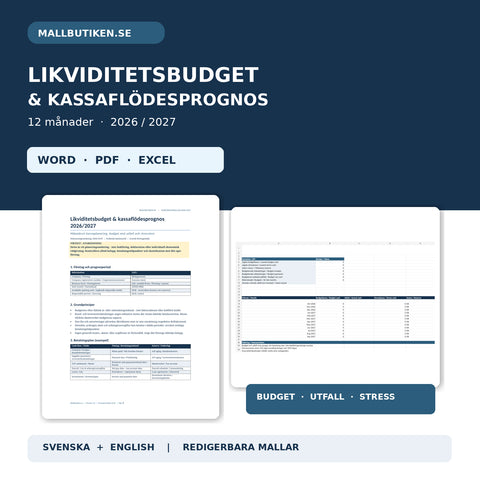
Cash Flow Budget & Forecast provides a basis for payment planning and follow-up. Supplement if necessary with Accounts Payable & Payment Monitoring for open invoices.
Rolling 13-week cash-flow forecast – spot shortages before payments fall due
A monthly budget can show positive month-end cash while hiding a shortage before payroll or a tax payment. Where needed, add a rolling view of the coming 13 weeks. Each week's closing cash becomes the next week's opening balance. Move the forecast forward by a week as actual payments are recorded.
Example in SEK: Week 1 opens with SEK 40,000, receives SEK 10,000 and pays SEK 35,000, closing at SEK 15,000. Week 2 expects SEK 25,000 in and SEK 35,000 out, leaving SEK 5,000. If the SEK 25,000 receipt is delayed to week 3, week 2 instead closes at minus SEK 20,000. That shortage matters even if later receipts restore the month-end position.
Use verified bank balances, customer and supplier ledgers, VAT, taxes, wages, debt repayments and committed investments. Classify expected receipts as confirmed, likely or uncertain. Show credit facilities separately from cash on hand and stress-test late customer payments. See Verksamt's cash budget.
If recorded cash accounts differ from the bank, reconcile the discrepancy before using the balance to start the forecast. Read the guide to bank reconciliation and account 1930. Thirteen weeks is a practical planning horizon, not a legal deadline. Review the forecast as often as risks and payment patterns require.
Related guides
- Financial management – hub for budget and follow-up
- Operating budget and full-year forecast
- When is a balance sheet for liquidation purposes required?
- Finance and accounting templates
Sources
Last updated: . General financial information. The examples are simplified and do not replace individual accounting, tax, or financial advice.
Templates in this article

Explore the topic
 Business guides – contracts, HR, AI & compliance
Operating budget 2026/2027 – how to track budget, actuals, and earnings forecasts
How to create an income budget and follow up against actuals and full-year forecasts. A guide to revenue, expenses, margins, accruals, and common b...
 Business guides – contracts, HR, AI & compliance
Accounts payable – reconciliation, partial payments and credit notes
Here is how you track supplier invoices, link partial payments and credit notes, and reconcile outstanding liabilities against your bookkeeping.
 Business guides – contracts, HR, AI & compliance
Business credit policy – credit checks, credit limits and B2B invoices
How to establish a credit policy for B2B customers. A guide to credit checks, credit limits, payment terms, GDPR and customer credit registers.


