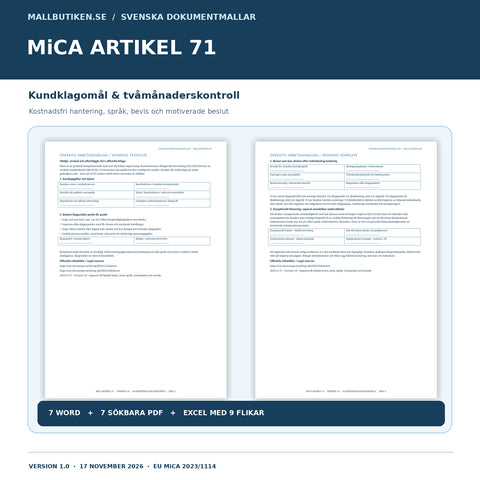
MiCA Article 71 – client complaints, two-month deadline and register
MiCA Article 71 requires free, fair and documented complaints handling for relevant crypto-asset service providers. Practical steps, a decision matrix and the two-month limit under EU 2025/294.

How should a crypto business handle client complaints under MiCA? A crypto-asset service provider (CASP) within scope must operate transparent, free-of-charge and documented complaint procedures. MiCA Article 71 requires information for clients, an available template and fair responses. Commission Delegated Regulation (EU) 2025/294 specifies receipt acknowledgments, languages, records and decisions.
Who is covered? Primarily providers of crypto-asset services within MiCA's scope. This is not the specific procedure for issuers of asset-referenced tokens in MiCA Article 31, a DSA content-moderation appeal process or advice on an individual's damages claim. Check the legal entity, services and regulatory status.
MiCA Article 71 and the two-month limit
Article 71 of Regulation (EU) 2023/1114 requires effective, transparent, prompt, fair and consistent handling. Complaints must be free of charge; a standard form must be offered; received complaints and actions must be recorded. Under Article 6 of Regulation (EU) 2025/294, a reasoned decision must be communicated without undue delay, within the provider's published timeframe and in any event within two months of receipt. In truly exceptional circumstances a delay requires prompt reasons and an expected decision date. Two months is not permission to delay every case.
What must be documented? Decision matrix
| Stage | Check | Evidence to retain |
|---|---|---|
| Publish procedure | Are description, annex template, contact route, accepted languages and timeframe available? | Approved policy version, URL and review date |
| Receive | Can clients complain free of charge electronically and on paper? | Complaint, date, channel and case ID |
| Acknowledge | Were contact details, receipt date and indicative timeframe communicated without undue delay? | Acknowledgment and any reasoned inadmissibility decision |
| Investigate | Is the case clear and complete, without demanding information the firm already has? | Investigation notes, necessary follow-up and evidence |
| Decide | Are all points addressed consistently and in time? | Reasoned decision, delivery proof, available remedies |
| Improve | Are complaints, actions, delays and categories analysed? | Secure register, management report, corrective action |
Practical six-step process
- Determine scope: identify the legal entity, covered crypto-asset services and relevant clients.
- Publish understandable information: display the procedure and the harmonised form in the annex to EU 2025/294 on the website and client-facing devices, in the languages required by Articles 1 and 3.
- Provide permissible channels: accept electronic and paper complaints. Use of the EU form must not be an admissibility condition.
- Record actual receipt: assign a case ID; store receipt date, investigation, responsible person and actions in a secure electronic register. Do not confuse the receipt date with a later request for clarification.
- Acknowledge and investigate promptly: state the contact person, receipt date and expected timeframe; request only necessary further information and keep the client informed.
- Decide and review: address each complaint point, explain the result and available remedies if a claim is refused in whole or part. Review recurring complaint types and processing times.
Two practical situations
The client did not use the EU form
A customer emails a detailed complaint about a fee without using the standard form. That omission alone cannot justify rejection. Record the complaint and request only genuinely necessary additional facts.
The investigation takes longer
A customer challenges a crypto transfer. The provider needs technical logs and requests clarification. This does not automatically restart the two-month period from the original receipt. A truly exceptional delay requires reasons and a new expected decision date.
Frequently asked questions
Is the EU complaint form mandatory for clients?
No. The provider must make the annex form available, but cannot require that specific form as a condition for admitting a complaint.
Is the response deadline exactly 60 days?
No. The rule is two months after receipt, not a universal 60-day count. Prompt handling and any shorter published timeframe also apply.
May clients complain only online?
No. Electronic and paper submissions must be possible, with applicable language requirements.
Is saving the final reply sufficient?
No. The provider must keep records of complaints and measures, and continually analyse duration, themes and outcomes.
Sources and limits
Source review: 17 November 2026. General EU-law and documentation guidance only, not individual legal advice. Authorisation, litigation, individual client rights and cross-border supervision require separate review.
Related MiCA Article 71 document package
Complaint template, policy, decision letter and register in Word, PDF and Excel. Practical documentation support, not a substitute for the official EU form or legal assessment.