
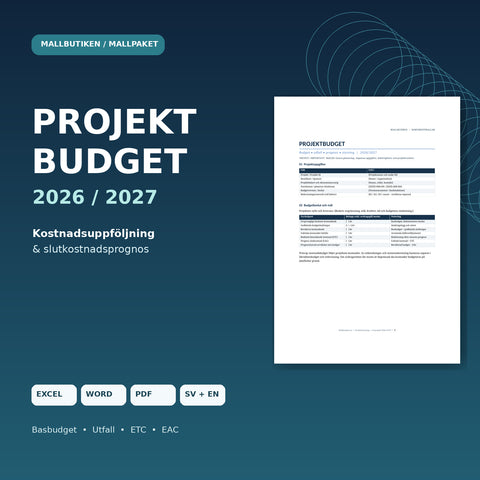
Project Budget 2026/2027 – how to track budget, actuals, and final cost forecast

Short answer: A good project budget should not only show the original budget. It should also track actuals, remaining costs, approved changes, and a forecast for the final cost. This makes it possible to detect deviations early instead of when the project is already finished.
What should a project budget include?
| Field | Why it is needed |
|---|---|
| Original budget | The baseline upon which the project was approved. |
| Approved changes | Keeps decided scope and cost changes separate from simple overruns. |
| Actuals | Costs actually booked or verified to date. |
| ETC | Estimate to Complete – estimated cost for remaining work. |
| EAC | Estimate at Completion – forecast for total final cost. |
| Variance | The difference between the current budget and the forecast/actuals. |
| Decision log | Shows who approved major changes and when. |
A budget is not the same as actuals
The budget is a financial plan. Actuals show what has actually happened. The forecast shows what you estimate will happen moving forward. Verksamt.se similarly emphasizes that a budget is a plan based on assumptions and should be used actively for management, rather than treated as a static reflection of reality.
Worked example: project budget, actual costs and forecast in Excel
Illustrative numbers: A project started with an approved budget of SEK 1,000,000 and an approved scope change of SEK 100,000. At review, verified actual cost (AC) is SEK 620,000 and the estimated cost of remaining work (ETC) is SEK 540,000. Keep the same cost basis and consistent VAT treatment in each figure.
| Item | Amount | Calculation or purpose |
|---|---|---|
| Original budget | SEK 1,000,000 | Locked baseline, never overwrite its history. |
| Approved changes | +SEK 100,000 | Track approval, date and accountable decision maker. |
| Current approved budget (BAC) | SEK 1,100,000 | 1,000,000 + 100,000. |
| Actual cost (AC) | SEK 620,000 | Recorded or otherwise verified costs incurred to date. |
| Estimate to complete (ETC) | SEK 540,000 | Updated cost of all remaining work, including commitments not already counted in AC. |
| Estimate at completion (EAC) | SEK 1,160,000 | AC + ETC = 620,000 + 540,000. |
| Forecast variance at completion (VAC) | −SEK 60,000 | Approved budget − EAC = 1,100,000 − 1,160,000. Negative means a forecast SEK 60,000 overrun. |
In Excel, separate columns for original budget, approved changes, current approved budget, AC, ETC, EAC and variance. Never double-count a purchase in both actual costs and the ETC estimate. Review work performed but not yet invoiced. This is a straightforward bottom-up forecast, not a complete earned value management calculation using CPI or SPI.
Project Management Institute (PMI) – AC, ETC, EAC och VAC / cost forecasting. This is forecasting guidance, not a general legal requirement to use a named template.
How to perform monthly cost tracking
- Lock the original project budget and document the baseline.
- Import or register actuals per cost item.
- Reconcile orders, invoices, and known but not yet booked costs.
- Update the ETC for remaining work.
- Calculate EAC and compare with the current approved budget.
- Explain major variances in writing and link them to decisions or risks.
- Update the change and decision log before the next steering group meeting.
Common mistakes
- Overwriting the original budget when the project changes.
- Only comparing the budget with booked actuals and ignoring future commitments.
- Mixing approved changes with cost overruns.
- Lacking a designated person responsible for forecasting per cost item.
- Reporting percentage spent without linking it to the actual degree of completion.
Frequently asked questions
What is the difference between ETC and EAC?
ETC is the estimated cost for what remains. EAC is the expected total final cost, i.e., actuals to date plus the remaining forecast.
How often should the project budget be updated?
For many projects, monthly tracking is a reasonable baseline. Projects with a high burn rate or significant risk may require more frequent tracking.
Should changes be included in the same budget?
Yes, but separate traceability is important. Maintain the original budget and show approved changes as a separate bridge to the current budget.
How do I build an Excel project budget template without losing the baseline?
Keep a locked original-budget column. Store approved changes separately with amount, approval date and owner. Calculate approved budget = original budget + approved changes, EAC = actual cost (AC) + estimate to complete (ETC), and variance = approved budget − EAC. Include the forecast update date and reason for changes.
Why can a project be under budget today but forecast to overrun?
Large work packages and supplier commitments may still be outstanding. Do not compare only incurred costs with the total approved budget. Recheck purchase orders, unbilled work, risks and the remaining ETC forecast, then escalate the variance and a corrective plan before changing an authorized budget.
See Project Budget & Cost Tracking 2026/2027.
Related content
- Income budget – budget, actuals, and income forecast
- Annual accounts in limited companies – step by step 2026
- Collaboration agreements between companies – 12 issues to regulate
- Templates for project management and project control
Sources
This guide provides general information on project management and does not replace accounting or project-specific advice.
Templates in this article
Explore the topic
 Business guides – contracts, HR, AI & compliance
Operating budget 2026/2027 – how to track budget, actuals, and earnings forecasts
How to create an income budget and follow up against actuals and full-year forecasts. A guide to revenue, expenses, margins, accruals, and common b...
 Annual reports – guides, rules & templates
Year-end closing for limited companies – step by step 2026
Year-end closing for limited companies step by step 2026: reconciliation, accruals, valuation, tax, K2/K3, capital deficiency, and the path forward...
 Business guides – contracts, HR, AI & compliance
Business collaboration agreement – 12 questions to regulate
A collaboration agreement should clarify responsibilities, deliverables, finances, decision-making, intellectual property, confidentiality, and exi...


