
Co-located businesses in Sweden 2027 – opting in to municipal packaging collection
Does your shop, salon or restaurant share waste bins with households in an apartment building? The business may opt for municipal collection of packaging waste, but the choice must be notified to the municipality. From 1 January 2027, municipalities must offer property-near collection to qualifying co-located businesses that opt in. Businesses are not enrolled automatically.

Does your shop, salon or restaurant share waste bins with households in an apartment building? The business may opt for municipal collection of packaging waste, but the choice must be notified to the municipality. From 1 January 2027, municipalities must offer property-near collection to qualifying co-located businesses that opt in. Businesses are not enrolled automatically.
Who is covered?
Co-location is about genuinely sharing waste containers or other waste facilities with households on or adjacent to a property. Simply operating at the same street address is not necessarily enough. Check the actual arrangement with your landlord and municipality.
Decision guide
| Who is covered? | Decision guide |
|---|---|
| Shared waste room and bins with residents | Assess co-location and notify the municipality if opting in. |
| Separate bins for the business | Do not assume the same rules apply; check the business waste system. |
| Bulky cardboard or packaging | Check the municipality's accessible collection points and instructions. |
What changes on 1 January 2027?
Chapter 6, section 4 of Swedish Ordinance (2022:1274) covers property-near collection of paper, plastic, glass and metal packaging from qualifying opted-in businesses. Bulky packaging is addressed separately in Chapter 6, section 6. Chapter 7, section 10 requires notification when the co-located business wants municipal collection; section 11 allows the municipality to set a local notification time.
A five-step process
- Record the property, shared bins and actual waste arrangements.
- Request the municipality's current notification form and check local timing.
- Agree responsibilities for access, bins and communication with the property owner.
- Keep copies of the notification, municipal confirmation and actual start date.
- Follow up missed collections and bulky packaging arrangements.
Two practical examples
A salon in an apartment building shares residents' bins and may apply to join municipal collection. A standalone workshop with its own bins cannot assume the same route is available and should review business waste collection options.
Common mistakes
Do not equate sharing an address with sharing waste management. The 2027 start date is not necessarily an individual deadline for every business to file a notification. Do not assume all bulky packaging is collected at the building. These rules are distinct from the EU Packaging and Packaging Waste Regulation (PPWR).
Questions and answers
Must every business in an apartment building register?
No. This notification concerns qualifying co-located businesses choosing municipal collection, depending on the actual waste arrangements.
Will bulky cardboard be collected from the building?
Not necessarily. From 2027, bulky packaging is covered by separate rules on accessible collection points. Check local instructions.
Legal sources and limitations
Reviewed 20 November 2026: Swedish Ordinance (2022:1274), Chapter 6 sections 4 and 6, Chapter 7 sections 10–11, and guidance from the Swedish Environmental Protection Agency. This is general information about Swedish law, not a collection contract or a guarantee of service.
Textile collection is not the same as packaging collection
A second-hand shop sharing household packaging bins must assess packaging collection separately from clothing accepted for reuse or classified as textile waste. Co-location rules do not authorise mixing these streams. See our guide to textile donations, waste classification, sorting and handover in second-hand shops. The appropriate waste collector depends on the actual waste stream and local rules.
Explore the topic
 Business guides – contracts, HR, AI & compliance
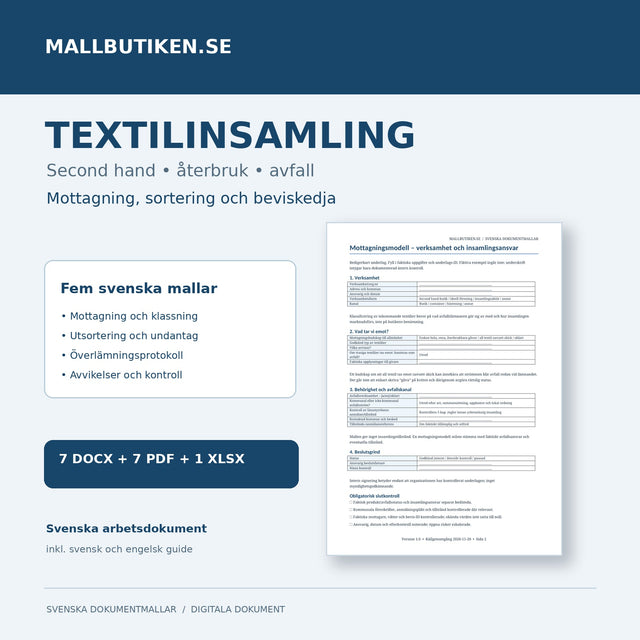
Textile donations or waste? Swedish second-hand collection rules in 2026
Practical guide for Swedish second-hand shops: reusable textile donations, waste classification, separate collection, local responsibility and 2028...


