
Damaged lithium battery return – when must standard shipping stop?

Do not automatically issue a standard return label if a lithium battery may be damaged. Record the customer’s report, administratively hold ordinary shipping until the proposed movement has been assessed, and ask a competent dangerous-goods specialist to determine the transport requirements. The customer’s claim, transport safety and possible waste status are three distinct decisions.
This guide is for Swedish online retailers, shops, workshops and returns departments handling loose lithium batteries, batteries in electronics or e-bike batteries. It is not an instruction for dismantling, charging, packing or shipping damaged batteries. If smoke, abnormal heat, strong odour or another immediate danger occurs, follow emergency procedures and contact emergency services when needed.
Three different decisions: customer claim, transport and waste
| Issue | Question | Record and responsibility |
|---|---|---|
| Return or complaint | What did the customer report, and what consumer-law remedy might apply? | Order/RMA reference, report, date, communication and independent customer-service decision. A shipping hold is not an automatic rejection of a complaint. |
| Dangerous goods | Is the battery damaged/defective or severely damaged under ADR-S, and may a specific movement be arranged? | Technical information for a qualified specialist; professional determination of classification, provisions, mode and transport conditions. |
| Waste | Is it still a product for inspection, or waste? Does hazardous-waste regulation apply? | Separate waste assessment, business role, relevant records, reporting where legally required, and actual receipt. |
Damaged versus severely damaged under ADR-S
The Swedish Civil Defence Agency (MCF) explains special provision 376 for damaged/defective lithium and sodium-ion batteries. Relevant indications may include leakage, a safety-related defect, lasting physical damage or inability to assess before transport. A customer’s description is evidence to review, not a final dangerous-goods classification. Cosmetic marks do not automatically establish a particular category.
| Specialist’s assessment | MCF guidance | Important limit |
|---|---|---|
| Damaged or defective battery | SP 376; packing instruction P908 or LP904 | A qualified actor must determine the actual transport classification and remaining obligations. |
| Severely damaged or defective, capable of dangerous reaction, fire, heat or gas release | SP 376; P911 or LP906, with some alternative arrangements subject to authority approval | A standard parcel label or improvised packing must not be presumed lawful. |
| Battery contained in equipment or a damaged battery-powered vehicle | Other classifications and provisions can apply, including SP 667 for vehicles | Rules for loose cells do not necessarily cover the entire vehicle or equipment. |
These are signposts to legal categories, not packing instructions. Road, rail, sea and air shipments can be governed by different rules. Consult MCF’s battery transport guidance.
Six steps for handling the case without an unsafe return
- Register the report: order/RMA ID, model, available serial/battery identification, customer narrative, photos and time. Separate what a customer says from professional findings.
- Hold the ordinary process: where damage is suspected, stop an automated standard label or collection pending a competent assessment. Keep the consumer claim open.
- Escalate immediate risk: treat smoke, abnormal heat and leakage as warning signs. Do not instruct the customer to open, test, discharge or personally pack a damaged battery; use emergency procedures when needed.
- Request expert review: identify the dangerous-goods specialist or carrier contacted; obtain a written assessment of battery type, damage severity, responsibilities and whether any transport may be arranged.
- Assess waste status separately: determine whether the item is a product to inspect or waste. If hazardous waste arises, recording and national register reporting may apply according to the business’s role.
- Close only on evidence: communicate a safe next step, preserve decisions and actual receiving evidence. Do not mark a physical receipt complete before confirmation.
Suggested return and decision log
This is a practical record structure, not a substitute for mandatory transport paperwork or waste-register reporting. Collect only necessary personal data.
| Field | Suggested record |
|---|---|
| Case and customer report | RMA ID, date, exact source of the described damage |
| Battery and evidence | Model, available ID, images and source of observations |
| Hold and safety | Time of label stop, responsible person and any emergency escalation |
| Expert review | Specialist identity, decision date, reference to written assessment and any continued hold |
| Waste/receipt | Separate classification, responsible operator, statutory records and actual receipt |
| Customer claim | Customer message, separate complaint decision and follow-up date |
Two realistic examples
Swollen removable e-bike battery
The customer reports that the housing is bulging. The shop records this as a report, suspends the automatic label and requests qualified transport advice. It continues handling the complaint without telling the customer to mail or pack the battery themselves.
Tablet with a suspected internal battery fault
The customer reports unusual heat and failure. The handler records the report without claiming an established ADR classification. Because the battery is contained in equipment, the movement requires its own assessment; the consumer complaint and any later waste assessment remain separate.
Common errors
- Issuing ordinary parcel labels simply because the customer asks to return the product.
- Treating suspected damage as a professionally confirmed ADR classification.
- Using the same packing assumptions for ordinary, damaged and severely damaged batteries.
- Assuming that a take-back duty under EU battery law automatically authorises normal shipping.
- Confusing the complaint, transport and waste decisions or claiming receipt before delivery.
- Calling every defective product hazardous waste without first assessing whether it is waste.
Frequently asked questions
Can I email a normal return label for a damaged lithium battery?
Not without an assessment of the particular transport. Damaged batteries may be subject to specific ADR-S/RID-S provisions. Consult a competent dangerous-goods actor.
Are P908 and P911 interchangeable?
No. MCF refers to P908/LP904 for damaged batteries and P911/LP906 for severely damaged batteries. This does not instruct customers to choose packaging themselves.
Can a damaged e-bike be shipped like a loose battery?
Not necessarily. Transporting an entire battery-powered vehicle as cargo can trigger other ADR-S provisions such as SP 667.
Does stopping transport reject the customer’s complaint?
No. The transport decision and consumer-law complaint must be handled independently, with a safe proposed next step.
Is a damaged battery always hazardous waste?
Determine first whether the item is waste and which rules and operator duties apply. Businesses dealing professionally with hazardous waste can face recording and reporting duties.
Does a template authorise the shipment?
No. It can document facts and decisions but does not determine classification, packing, waste codes, transport permissions or approvals.
For a separate overview of retailers' take-back duties, read our guide to battery take-back for e-commerce under Article 62. Take-back obligations do not automatically permit standard parcel transport of a damaged battery.
Sources and safety limits
MCF: transport of lithium batteries, SP 376; Swedish Work Environment Authority: battery fires; Swedish Waste Ordinance (2020:614), Chapter 6; Swedish Environmental Protection Agency: waste register; EU Battery Regulation 2023/1542, Article 62. Editorial source review: 20 November 2026. General information only; not professional transport, fire or legal advice or authority approval.
Explore the topic
 Business guides – contracts, HR, AI & compliance
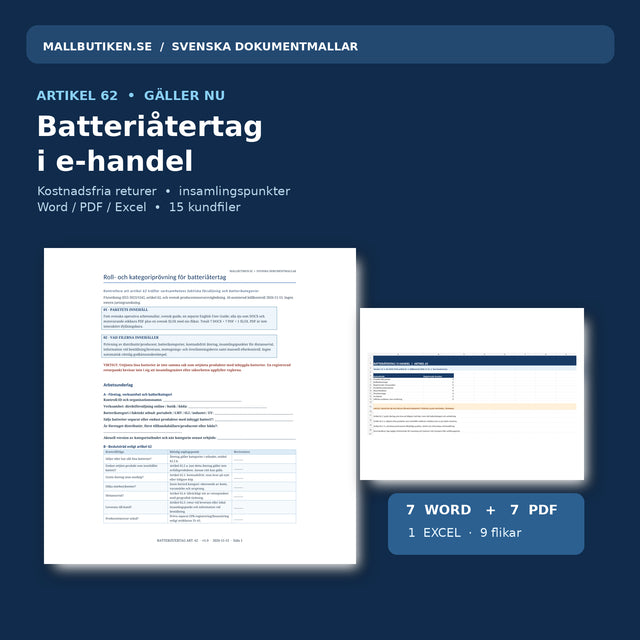
Battery take-back in online retail – free returns, collection points and Article 62
How online battery retailers must organise free take-back, accessible collection points and pre-order information under Article 62 of the EU Batter...


