
TBT in boat hull paint – XRF, sampling, removal and hazardous waste
Suspect TBT in older paint layers on your boat? Start with the hull's history and reliable testing. XRF measures tin in paint layers; chemical laboratory analysis can identify specific organotin compounds. If these substances are found, boat use, remediation and environmental precautions must be assessed under Swedish rules. A filled-in form is not proof that the hull is TBT-free.

Suspect TBT in older paint layers on your boat? Start with the hull's history and reliable testing. XRF measures tin in paint layers; chemical laboratory analysis can identify specific organotin compounds. If these substances are found, boat use, remediation and environmental precautions must be assessed under Swedish rules. A filled-in form is not proof that the hull is TBT-free.
Who is this for?
For boat owners, clubs and hull-remediation contractors in Sweden. This guide concerns existing paint layers, not the choice of new antifouling paint, general harbour waste reception or an overall marine survey.
The ban and historical paint layers
Organotin antifouling paint has been prohibited for Swedish recreational boats since 1989, but historical underlying coatings may remain. The Swedish Transport Agency supervises EU Regulation (EC) 782/2003 and says boats on which organotin is detected may not be used. Its discussion of travel to a remediation site should not be misunderstood as a general permission for normal boating.
XRF is not a direct chemical TBT analysis
The Swedish Transport Agency recommends XRF, a non-destructive way to measure tin, and paint scrapings with chemical laboratory analysis to identify individual organotin compounds. Its guidance treats organotin as present where XRF tin exceeds 100 µg/cm². A low or uncertain XRF reading is not an automatic TBT-free certificate. Ask for the instrument, locations, method, findings, uncertainty and professional interpretation.
Decision guide: what evidence is missing?
| Situation | Next action |
|---|---|
| No paint history or test | Gather records and arrange professional assessment; do not certify the hull yourself. |
| XRF report available | Interpret measured tin against official guidance; XRF alone does not identify the TBT molecule. |
| Need precise compound identification | Seek suitable scrape sampling and chemical laboratory analysis. |
| Organotin detected / removal required | Plan controlled remediation and waste records; do not treat the boat as cleared for normal use. |
Protect soil and water during paint removal
Plan paint removal using the Swedish Environmental Code's precautionary principles and local site conditions. The Environmental Protection Agency stresses containing dust and flakes and protecting soil and water. Ask the contractor for methods, containment and completion evidence. This guide does not provide hands-on hazardous blasting instructions.
Who is responsible for paint waste?
Collected paint dust, flakes and contaminated coverings should generally be treated as hazardous waste unless properly classified otherwise. Private owners normally do not file hazardous-waste register reports for their own household waste. A boat club does not automatically become the waste producer for each member's paint; professional collection, handling or transport may nevertheless trigger duties. Identify who actually produced, carried and received each waste stream.
What should be recorded?
- Boat ID, owner, past coatings and local club requirements.
- XRF measurements, locations, date, method and signed interpretation.
- Any laboratory sample, chain of reference and chemical results.
- Selected remediation, responsible contractor and containment.
- Waste classification, weights, carrier, receiving facility and receipts.
- Any applicable professional records, transport documents and reporting receipts.
- Post-work inspection and actual decisions from the club or competent authority.
Three practical examples
Old boat without paint records
A sale receipt is not a coating analysis. Record what is known and obtain measurement before claiming a TBT-free hull.
Elevated tin reading
Keep the complete XRF report, seek expert evaluation and do not equate tin with a specific chemical compound.
Commercial yard removes paint
Separate the owner's private records from the yard's business waste duties and obtain actual disposal evidence.
Frequently asked questions
Does XRF directly measure TBT?
No. It measures tin; a suitable chemical analysis can identify organotin compounds.
Can I keep using a boat with detected organotin?
The Swedish Transport Agency warns against use. Discuss safe remediation and any exceptional travel to the remediation site with the relevant experts.
Must every private boat owner report to the waste register?
No. Household waste is generally exempt; professional activities require separate assessment.
Is a Word checklist proof that a hull is TBT-free?
No. It helps organise real records but cannot replace a measurement report or official decision.
Related guide: waste received in harbours
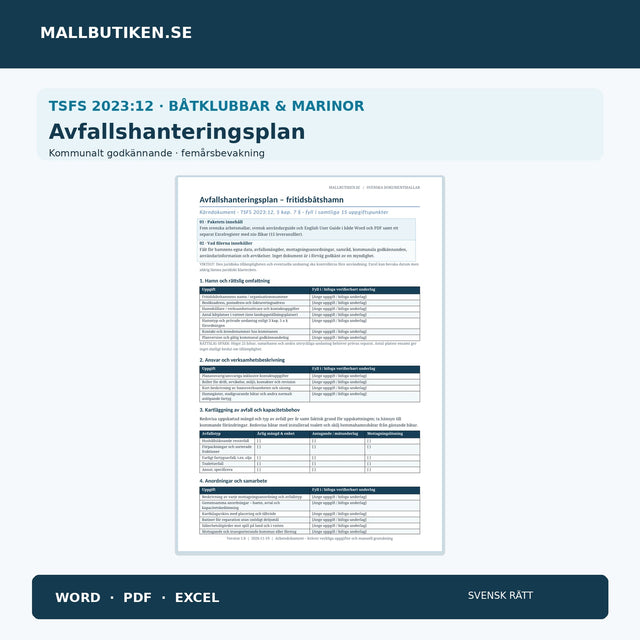
For receiving waste from visiting boats rather than stripping hull paint, see our separate guide to harbour waste-management plans under TSFS 2023:12. harbour waste-management plan.
Swedish official sources and limitations
- Transportstyrelsen – XRF och kemisk analys av TOF
- Naturvårdsverket – tillsynsvägledning skrovsanering
- Sveriges riksdag – avfallsförordning (2020:614)
- EUR-Lex – förordning (EG) nr 782/2003
Editorial source check: 20 November 2026. There is no new universal TBT-removal deadline asserted for 2027. Local conditions may apply; the associated product's checkout and digital download have not been tested here.
Explore the topic
 Business guides – contracts, HR, AI & compliance
Waste management plan for a Swedish leisure boat harbour – TSFS 2023:12 and municipal approval
A Swedish sailing club, leisure boat marina or guest harbour may need both suitable reception arrangements for waste from visiting boats and a wast...


