Svenska Dokumentmallar
AI Exam Proctoring – High-Risk Assessment, GDPR, and Human Review | Word/PDF/Excel
AI Exam Proctoring – High-Risk Assessment, GDPR, and Human Review | Word/PDF/Excel
- File format
- DOCX, PDF, XLSX
- Document language
- Five Swedish work templates and a Swedish user guide an English User Guide; Swedish Excel register
- Number of files
- 7
Digital download. No physical product is shipped.
Couldn't load pickup availability
About this template
Is your school or educational provider considering AI-based exam monitoring, automatic exam alerts, or the detection of suspected unauthorized behavior? This Swedish document package helps you conduct a controlled preliminary assessment of the use of the AI system, data protection, and its limitations, prepare the correct information, and document human review of individual alerts. An AI alert is not proven cheating. Filling out the templates in the package does not make the monitoring legal, permitted, or approved.
Quick facts – what do you get?
Document type: preliminary assessment, information, investigation basis, and pilot decision. For: Swedish school boards, educational providers, exam administrators, and data protection officers. Legal framework: Swedish operations, GDPR, and applicable EU regulations. 15 files: 7 editable Word documents (DOCX), 7 corresponding searchable and printable PDFs, and 1 Excel workbook (XLSX). Five working documents and a Swedish guide are in Swedish; a separate English User Guide is included. The PDFs are not interactive fillable forms. Digital ZIP delivery. Word/Excel or compatible software is required for editing.
01. Package contents
Five independent Swedish working documents: system/high-risk preliminary assessment, GDPR/biometric screening, information for exam participants, alert/human review, and pilot decision/follow-up. Also included are a Swedish user guide and an English User Guide. All seven documents are available in DOCX and corresponding PDF (14 files). A separate Swedish Excel workbook contains nine tabs (1 XLSX). Total of 15 customer files and seven independent documents.
02. What the files contain
Review of the monitoring function and legal basis, reference to Annex III point 3(d) of the AI Act, specific review of prohibited emotion recognition and biometric processing, preparation of information for students, alert ID and evidence, independent human assessment, alternative stop/supplementary decisions, and documented follow-up. Registration, automatic output, manual review, and a possible disciplinary decision are different things.
Who is the package suitable for – and when is it not?
Situation 1: an educational institution is considering camera/AI-assisted exam monitoring and must first assess whether the use is even legal, proportionate, and feasible. Situation 2: an educational provider receives an AI indication of suspected cheating and needs to document objective observation, the student's opportunity to provide information, and human review before any formal decision is considered.
Not suitable for: grading and assessment of student answers, complete disciplinary committee decisions, automatic evidence evaluation, monitoring software, identity verification systems, or a completed Data Protection Impact Assessment (DPIA). A legal decision is required to determine whether a legal basis, biometric processing, camera surveillance, or disciplinary sanctions require individual assessment.
File by file – documents, use, and format
| Document | Specific function | Language | Format |
|---|---|---|---|
| System and high-risk preliminary assessment | Check intended function, AI Act Annex III 3(d), roles, and the need for special assessment | Swedish | DOCX + searchable PDF |
| GDPR and biometric screening | Map personal data, possible biometric identification, legal basis, and DPIA needs | Swedish | DOCX + searchable PDF |
| Information for exam participants | Customize clear information about actual processing, human review, and contact channels | Swedish | DOCX + searchable PDF |
| AI alert and human review | Record indications without equating them with evidence, supplement with factual observations | Swedish | DOCX + searchable PDF |
| Pilot decision, stop, and follow-up | Distinguish clearly defined prerequisites, conditions, stops, actual deployment, and post-control | Swedish | DOCX + searchable PDF |
| Swedish User Guide | Practical step-by-step completion checklist and legal boundaries | Swedish | DOCX + searchable PDF |
| English User Guide | Instructions for the Swedish forms; not an English legal template | English | DOCX + searchable PDF |
| Excel – monitoring register | Nine tabs: alerts, review, GDPR, provider, actions, and decisions | Swedish | XLSX |
DOCX files are editable. PDF files are searchable and printable but not fillable with interactive form fields. Excel is editable. The main templates have not been translated into English; the English User Guide describes how the Swedish templates are used.
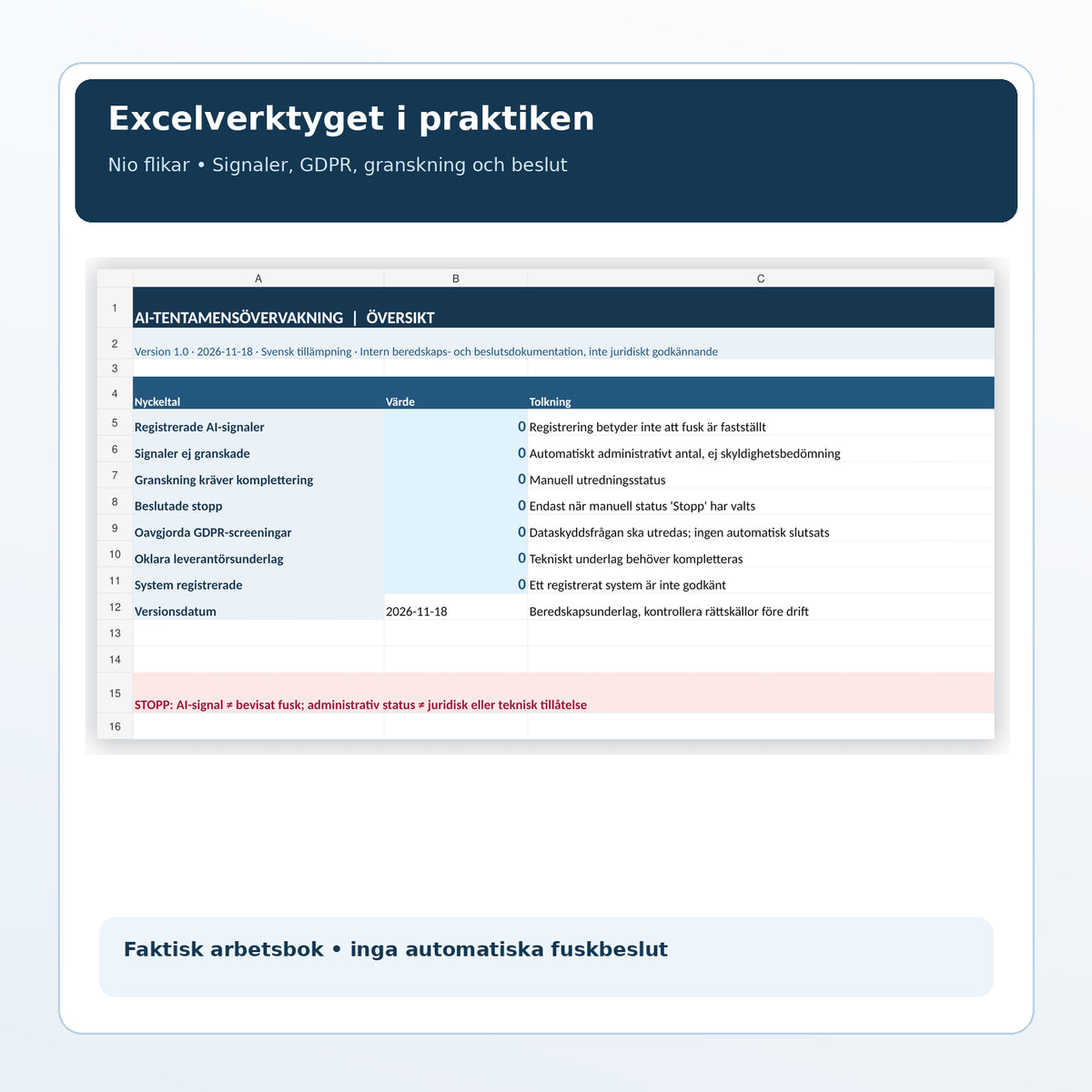
The Excel workbook in practice
The nine tabs are Overview, System, Alerts, Review, GDPR DPIA, Provider, Actions, Decisions, and Read Me. Input fields, drop-down lists, and formulas separate automatically calculated administrative statuses from human conclusions. The Overview counts registered AI alerts, alerts not yet reviewed, requested supplements, decided stops, undecided data protection issues, open provider documents, and registered systems.
Test example: a fictitious registered alert gives the administrative status Manual review required, not Cheating confirmed. A manually marked review leads only to Administratively reviewed. The formulas and a reopened workbook are tested; fictitious data has been removed from the delivery file. Excel is not an automatic legal risk classifier or disciplinary authority.
How you complete the material
- Describe the actual AI system, the provider, the monitored situations, and all planned data categories.
- First check any AI bans, system classification under the AI Act, and actual legal basis under GDPR. Document uncertainties.
- Assess necessity, proportionality, data processing agreements, the need for a DPIA, and possible special biometric processing.
- Prepare and legally review information for exam participants before any processing begins.
- If the system can be used legally: document AI alerts, human review, alternative explanations, conflicting evidence, and requested supplements.
- Let the competent function decide according to applicable educational, administrative, and disciplinary rules. Record decisions, deployment, actual follow-up, and archiving separately.
Legal prerequisites and limitations
AI Act – exam monitoring: AI systems intended to monitor and detect prohibited behavior in students during exams at educational institutions are found in AI Act (EU) 2024/1689, Annex III point 3(d). Individual classification, roles, and possible exemption requirements must be assessed. According to amending regulation EU 2026/1744, the special Annex III high-risk rules will generally apply from December 2, 2027; this does not mean a general exemption from other rules before that date.
Prohibited AI functions: Article 5.1(f) restricts the use of AI to infer emotions within educational institutions, with narrow exceptions for medical or security purposes. This is a separate check from high-risk classification and not something a template can approve. Official AI Act, Article 5.
GDPR already applies: personal data, camera images, legal basis, information, data minimization, and security must be assessed based on actual circumstances. Biometric identification functions may trigger GDPR Article 9, but not all images are automatically biometric data within the meaning of Article 9. In cases of likely high risk, a consequence assessment may be required before processing under Article 35. GDPR original text; IMY's guidance on consequence assessment; IMY on AI and legal basis. An AI flag never automatically provides a legal basis for a cheating allegation.
Related templates – the right document for the right task
For AI-assisted student assessment and grading, there is another package; it applies to result assessment rather than monitoring alerts. For special review of AI emotion recognition, there is a separate product track. For general AI governance, use the AI Governance Package. These do not replace the actual legality assessment of exam monitoring.
Frequently asked questions
Is AI monitoring during exams automatically permitted?
No. You must assess the purpose, applicable educational law, AI regulations, data protection, necessity, and proportionality before any processing or operation.
Are all AI exam monitoring systems high-risk?
Not without checking the actual intended function. AI Act Annex III 3(d) includes an explicit category, but classification and the prerequisites of Article 6 must be assessed in the individual case.
Can the school use AI for emotion recognition?
There is an explicit prohibition under the AI Act for such uses in educational institutions, with very limited medical or security exceptions. Do not assume that an exemption applies.
Is an AI alert evidence of cheating?
No. The alert is an indication that must be reviewed independently and may not automatically be equated with a confirmed event or a disciplinary decision.
Do we need to conduct a DPIA?
It may be required under GDPR Article 35 if the processing is likely to result in a high risk to the rights and freedoms of individuals. The assessment must be done for the planned actual processing and before start when a DPIA is required.
Can the Excel program approve the exam monitoring?
No. Excel helps with case and evidence follow-up. It does not decide on legal basis, disciplinary responsibility, AI Act compliance, or technical permissibility.
Are English legal forms included?
No. Five working templates and Excel are in Swedish; a separate English user guide is included to understand their workflow.
Sources, version, and review
Product version: 1.0 · AI-assisted legal source review: November 18, 2026 · External legal review: not performed. Sources: official AI Act, amending regulation 2026/1744, GDPR, and IMY's DPIA guidance. The documents are support for internal review and not an authority form, an expert opinion, or a guarantee that a certain AI monitoring is permitted.