Svenska Dokumentmallar
The Recycling Industry 2026/2027 – Chemical Risk Sources, Exposure Control, Inspection Checklist & Action Plan | Word/PDF/Excel
The Recycling Industry 2026/2027 – Chemical Risk Sources, Exposure Control, Inspection Checklist & Action Plan | Word/PDF/Excel
- File format
- DOCX, PDF, XLSX
- Document language
- Five Swedish work templates Swedish guide English guide and Swedish Excel register
- Number of files
- 7
Digital download. No physical product is shipped.
Couldn't load pickup availability
About this template
Prepare workplace documentation of chemical hazards during sorting, dismantling, and material processing. This template package is intended for employers in the recycling industry and links inventory, risk assessment, measurement data, control measures, and inspection records.
Package Contents
15 customer files: 7 editable Word documents, 7 corresponding searchable PDF files, and an Excel register with 6 tabs. Five Swedish work templates, Swedish and English guides. Digital download as a ZIP file, version 1.0.
What the Files Contain
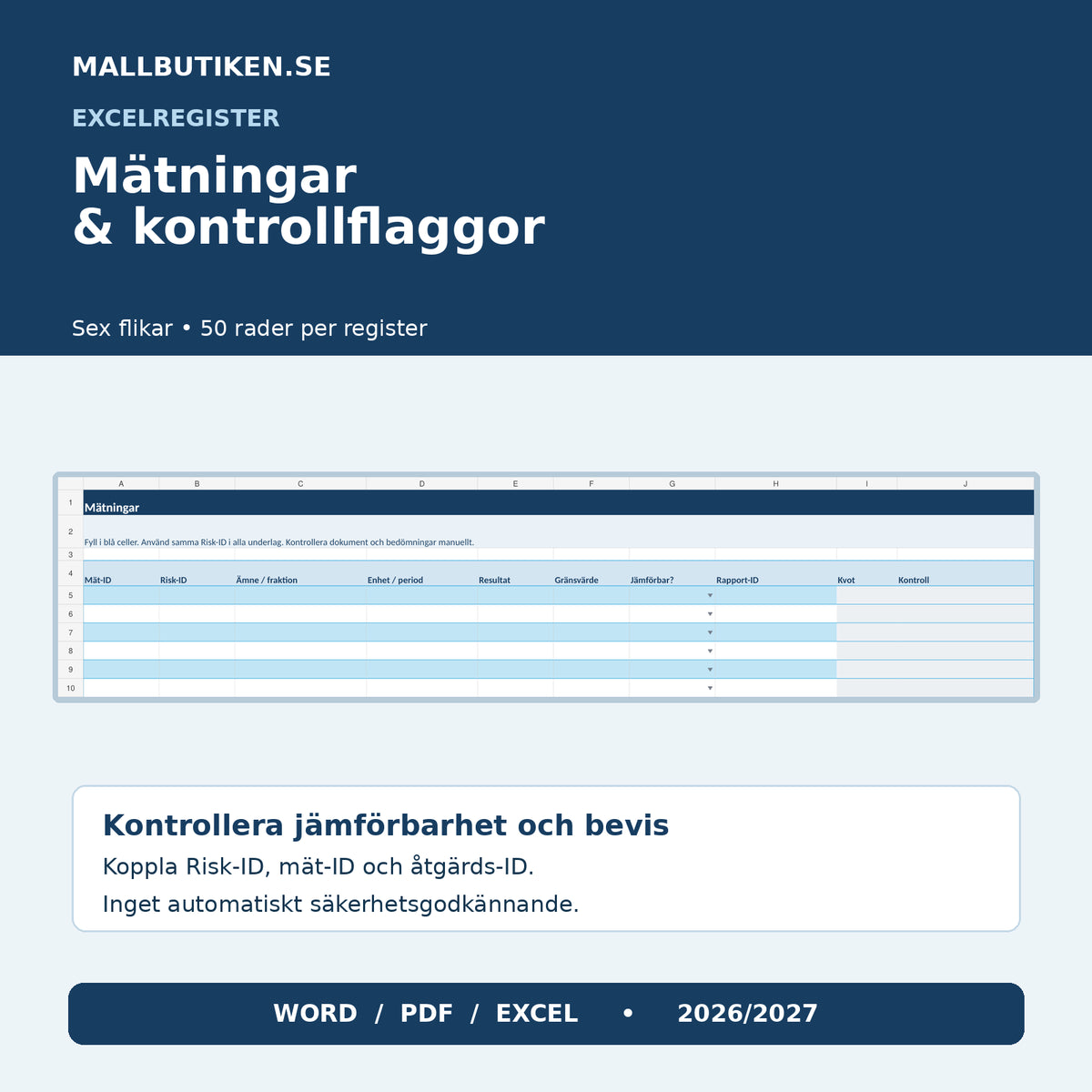
Inventory of chemical hazards, risk assessment per operation, exposure and measurement data, hierarchy of control measures, effectiveness monitoring, and inspection records. The Excel file links risk ID, measurement ID, and control measure ID with administrative control flags.
Why Is the Package Needed in 2026/2027?
The Swedish Work Environment Authority is conducting targeted inspections of chemical hazards in the recycling industry from October 2026 to December 2027. The focus includes inventories of hazards, exposure, risk assessments, and the prioritization of control measures. The inspections do not introduce new regulations. The package is specifically adapted for recycling centers, landfills, and businesses that recycle electronics, batteries, metals, tires, and vehicle parts.
Document List
| Document | Format | Use |
|---|---|---|
| 01 Inventory | Word/PDF | Hazards, properties, location, special regulations, and supporting data. |
| 02 Risk Assessment | Word/PDF | Assess risks per operation and document decisions. |
| 03 Measurement Data | Word/PDF | Prepare for expert measurement and check comparability. |
| 04 Control Measure Plan | Word/PDF | Test control measures in order of priority and monitor their effectiveness. |
| 05 Inspection Records | Word/PDF | Collect evidence references and document non-conformities. |
| 06 Swedish User Guide | Word/PDF | Workflow, examples, and sources. |
| 07 English User Guide | Word/PDF | English guidance for Swedish work templates. |
| 08 Process Register | Excel | Inventory, measurements, control measures, and inspection records. |
Which Chemical Hazards Should Be Inventoried?
AFS 2023:10, Chapter 7, Sections 5–7, covers hazards handled or generated during work. Therefore, also inventory process-generated dust and other chemical hazards, not just purchased products. Document the name, hazardous properties, location, whether a workplace exposure limit exists, and any special work environment regulations that apply. Check unknown incoming materials, safety data sheets, and other relevant data. Work should not begin until a risk assessment has been completed and necessary measures have been implemented.
Measurements and Monitoring
According to Chapter 7, Sections 10–11, the employer must assess air levels and arrange occupational hygiene measurements when acceptable levels cannot be assessed in another way. If a limit is exceeded, the employer must take immediate action. According to Section 16, follow-up measurement to monitor effectiveness should normally be carried out no later than three months after measures against airborne contaminants have been implemented, unless measurement is clearly unnecessary. Special mandatory measurement requirements must be assessed separately. The measurement template is a basis for ordering and reviewing, not a complete measurement report or technical measurement strategy.
Hierarchy of Control Measures
First, attempt to eliminate the hazard, followed by safer alternatives, enclosed systems, exposure-reducing processes, near-source technical controls, organizational solutions, and finally personal protective equipment. Document choices, reasons, responsibilities, expected effectiveness, and re-verification. The order of control measures follows AFS 2023:10, Chapter 7, Section 13.
Excel – Six Tabs
Overview, Hazards, Measurements, Control Measures, Inspection Records, and Sources. Four register tabs with 50 pre-formatted rows each, 206 formula cells, status lists, key performance indicators, and control flags. The spreadsheet only compares values that the user has confirmed as comparable and registered with the necessary supporting data. Duplicates, invalid limit values, and missing data are flagged. The date for follow-up measurement is entered after manual verification. Excel does not automatically determine whether exposure is acceptable or whether regulations are being met.
Practical Example
If an expert has confirmed that two hypothetical values are comparable—for example, result 2 and limit value 1 in the same unit and reference period—the ratio will be 2.0, and the row will be flagged as exceeding the limit. The figures are for calculation purposes only and do not represent limit values for any substance. The employer must take necessary measures and verify the result.
How to Use the Package
- Inventory hazards and assign each hazard an ID.
- Assess all relevant exposure routes and work operations.
- Order expert measurements when necessary and document the results.
- Test the control measures, appoint someone responsible, and monitor their effectiveness.
- Collect evidence for self-monitoring and potential inspections.
Format, Language, and Scope
Work templates and Excel files in Swedish, with Swedish and English guides. Word files should be edited in a compatible word processor. PDFs are for reading and printing, not interactive data entry. XLSX files require compatible spreadsheet software. Special requirements for CMR substances, asbestos, lead, quartz, explosive environments, and medical examinations must be assessed separately. No personal medical data should be included in the Excel file. This package does not replace expert risk assessment, occupational hygiene measurement, permits, official inspection decisions, or legal advice.
Frequently Asked Questions
Are the inspections a new law?
No. They are a targeted inspection initiative by the Swedish Work Environment Authority. The underlying regulations apply regardless of inspections.
Are safety data sheets sufficient for risk assessment?
No. Assess the actual work operation, including process-generated hazards and combined risks.
Can Excel determine whether exposure is safe?
No. The ratio is an administrative basis for comparison; expert assessment and other risks must be considered.
When is follow-up measurement required?
According to Chapter 7, Section 16, effectiveness monitoring after measures against airborne contaminants should normally be measured within three months, unless measurement is clearly unnecessary. Document the reasons for any exceptions.
Can we only use respiratory protection?
Control measures must be tested in the prescribed order of priority. Personal protective equipment is last in the hierarchy.
Is there a free government template?
Yes, the Swedish Work Environment Authority offers general resources. This package complements them with a recycling-specific workflow, measurement data, inspection records, and a linked register.
Is the package a complete chemical or waste management procedure?
No. The focus is on work environment hazards in recycling. Other work environment, waste, and environmental requirements must be addressed separately.
Legal Sources
AFS 2023:10, especially Chapter 7, Sections 5–16; AFS 2023:14 on limit values for respiratory exposure; The Swedish Work Environment Authority's targeted inspections in the recycling industry. AI-assisted legal source review on November 26, 2026; no independent legal or occupational hygiene review.
For broader chemical work, see Chemical Hazards – General Work Environment Package.