Svenska Dokumentmallar
Antifouling Paint & TBT – XRF Testing, Hull Remediation and Waste Certificates | Word/PDF/Excel
Antifouling Paint & TBT – XRF Testing, Hull Remediation and Waste Certificates | Word/PDF/Excel
- File format
- DOCX, PDF, XLSX
- Document language
- Five Swedish working documents Swedish user guide and English User Guide; Swedish Excel register
- Number of files
- 7
Digital download. No physical product is shipped.
Couldn't load pickup availability
About this template
Does the boat have old paint layers that may contain TBT or other hazardous substances? This specialized documentation product helps boat owners, boat clubs, marinas, and remediation contractors document history, XRF measurements, any chemical analysis, ordered hull remediation, hazardous waste, and actual post-remediation inspection. The package is designed for Swedish conditions based on the official 2026 guidance from the Swedish Transport Agency and the Swedish Environmental Protection Agency.
Important: XRF measures tin, not the tributyltin (TBT) molecule. Samples with chemical analysis can be used to identify specific organotin compounds (OTCs). A completed document or Excel status is never an official approval, laboratory statement, TBT-free certificate, or right to use a proven contaminated boat. Actual analysis and official documentation are always crucial.
Quick facts: Five Swedish working documents, a Swedish user guide and an English User Guide, all in editable Word (DOCX) and corresponding searchable/printable PDF formats. Also included is a Swedish Excel workbook (XLSX) with nine tabs. 7 DOCX + 7 PDF + 1 XLSX = 15 files in a digital ZIP package. No physical shipping. The PDF files are not interactively fillable.
Package contents
01 Boat and hull inventory with risk questions; 02 XRF and laboratory analysis – results log; 03 Hull remediation – order basis and control plan; 04 Hazardous waste – handover, receipt, and reporting review; 05 Post-remediation inspection and handover to boat club; 06 Swedish user guide; 07 English User Guide. Each of these seven files is available as DOCX and PDF. In addition, 08 Excel register with nine tabs is included.
What the files contain
Fields for boat ID, paint history, sample location, XRF instrument and tin content, actual chemical analysis of OTCs/TBT, laboratory assessment, remediation contractor, environmental protection, paint residues, waste code, waste weight, carrier, and recipient. It also includes fields for verified reporting to the waste register when such an obligation actually exists, original receipts, and the boat club's possible local conditions. Excel calculates administrative items and waste weights in kg, not TBT levels or automatic legal approval.
Three examples of practical use
1. Private pleasure boat with unknown old paint layers. The owner wants to show the boat club that the hull has been inspected. Record actual measurement and sample reports, risk, planned next step, and possible remediation proof without claiming that the boat's manufacturing year alone determines TBT freedom.
2. Boat club that needs documentation before launching. The club wants to be able to follow which boats have submitted an XRF/lab report and which ones, according to the club's own actual rules, need a supplement. A signed working template is not the same as an accredited analysis or a binding official decision.
3. Contractor remediating hulls. During documented remediation work, paint particles, filters, and protective materials are generated. The package helps the company organize information on actual waste classification, weight, transport, and receipt proof, as well as separately assess the reporting obligation in the Swedish Environmental Protection Agency's waste register.
What does each file contain?
| File | Use | Language and format |
|---|---|---|
| 01 Boat and hull inventory | Boat ID, history, risk data, existing protocol, and local harbor conditions | Swedish · DOCX + searchable PDF |
| 02 XRF and laboratory analysis | Measurement method, tin content, specific OTC/TBT analysis, performer's statement, and source reference | Swedish · DOCX + PDF |
| 03 Order for hull remediation | Agreed scope, professional contractor, dust and soil protection, waste plan, and final report | Swedish · DOCX + PDF |
| 04 Hazardous waste and receipts | Waste code according to actual assessment, weight, carrier, recipient, and possible official report | Swedish · DOCX + PDF |
| 05 Final inspection and boat club | Contractor proof, post-measurement, waste reporting, and actual conditions before use | Swedish · DOCX + PDF |
| 06 Swedish user guide | 14 clear sub-sections on OTCs, measurement, environmental protection, waste rules, and examples | Swedish · DOCX + PDF |
| 07 English User Guide | Instructions for the Swedish hull inspection and waste documentation templates | English · DOCX + PDF |
| 08 Excel register | Nine tabs for case ID, proof, measurements, remediation, waste, receipts, and post-inspections | Swedish · XLSX |
Excel: nine tabs and control signals
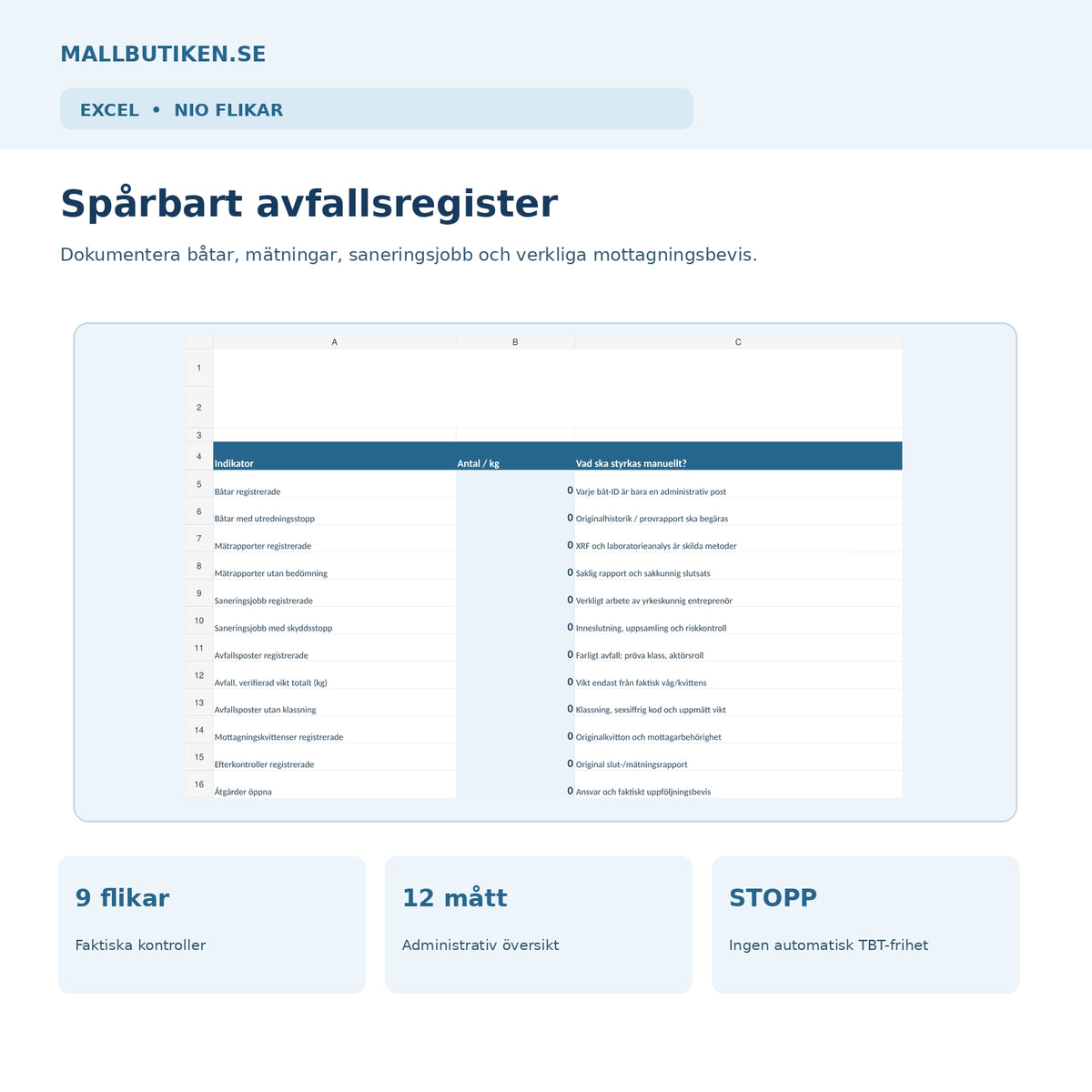
The workbook contains Boats, Measurements, Remediation, Waste, Handover, Post-inspection, Actions, Overview, and Read Me. Seven registers have filterable tables and 100 prepared rows per register. The overview summarizes twelve administrative key figures and reported waste weight without calculating any chemical content or giving the green light for launching.
Example A: A boat without a verified paint assessment gives “STOP – INVESTIGATE BOTTOM PAINT”. Example B: An XRF or lab protocol without an expert statement gives “STOP – MEASUREMENT BASIS MISSING”. Example C: A hazardous waste entry without a waste code or measured weight gives “STOP – WASTE CLASSIFICATION”. Documented steps lead at most to manual expert review, never to an automatic approval.
Workflow – from risk to actual final inspection
- Identify the boat and its history. Document the hull, previous bottom paints, manufacturing year, and the actual boat club's requirements. Draw no conclusions about TBT based on age or the absence of older documents.
- Choose the relevant measurement. Obtain a report from the measurement company or laboratory. XRF provides an indicator of tin content; specific OTC substances may require chemical analysis of a scrape sample.
- Follow the actual legal assessment. If organotin compounds are proven, the Swedish Transport Agency's instructions apply. Do not confuse transport to a remediation site with a general right to use the boat.
- Plan the work with an expert. Check the contractor's professional method, protection against dust, precipitation, and spread, as well as actual waste management. For blasting and other high-risk work, a competent contractor and your own workplace assessment are required.
- Classify and hand over the waste. Collect the actual waste code and weighed amount in kilograms, carrier, recipient, and receipt of acceptance.
- Distinguish between private and professional. A private individual's hazardous household waste is not automatically the same as a contractor's reportable business waste.
- Conclude with proof. Archive the contractor's actual final report, any post-measurements, actual waste receipts, and what the boat club or responsible authority has stated.
Legal control: TBT and boat bottom paint 2026/2027
TBT/OTCs: TBT is an organotin compound that has been found in older boat bottom paint. The Swedish Transport Agency states that organotin compounds have been banned for pleasure boats since 1989 and that they may still be present in underlying old paint layers. EU Regulation (EC) No 782/2003 on organotin compounds on ships is part of the regulatory framework. The Swedish Transport Agency's overview of rules.
XRF is not a TBT analysis: The Swedish Transport Agency's guidance, updated February 9, 2026, describes XRF measurement as a method for measuring tin in paint layers and scrape samples with chemical analysis as a method for identifying specific OTCs. The authority describes a 100 µg/cm² level for assessing organotin compounds according to its guidance. The template does not calculate this assessment itself, and a single value is not an official certificate. Original guidance on measurement.
Remediation and environmental protection: The Swedish Environmental Protection Agency and the Swedish Transport Agency emphasize the need to collect paint residues and avoid spread to soil and water, including through containment and dust collection. The same principles are relevant for smaller hull maintenance that may produce paint flakes or dust. The package contains order questions, not hazardous practical work instructions. Swedish Environmental Protection Agency – inspection of paint remediation and Swedish Transport Agency – remediation.
Hazardous waste: Unless analyses show otherwise, there may be reason to treat generated paint residues and associated materials as hazardous waste. For professional activities, according to Chapter 6 of the Swedish Waste Ordinance (2020:614), there are recording and reporting requirements for applicable roles. Reporting to the Swedish Environmental Protection Agency's waste register generally occurs within two working days from when the recording should be made. Hazardous waste from private households is covered by a special exemption in Chapter 6, Section 21. Swedish Environmental Protection Agency – waste register.
No new universal TBT deadline in 2027: The years 2026/2027 describe the product's edition and usage period. No new general Swedish remediation deadline is claimed. Actual environmental and boat harbor conditions may, however, need to be followed in each individual case.
Frequently Asked Questions (FAQ)
How do I know if my pleasure boat has TBT in the bottom paint?
Older paint layers and the boat's history may indicate risk, but they do not constitute a sample result. The Swedish Transport Agency describes XRF measurement of tin as well as scrape samples and chemical analysis of specific organotin compounds. Follow expert interpretation.
Can I write that the boat is TBT-free when XRF shows a low value?
No, not solely based on this product or an arbitrary limit value. Check current guidance, measurement method limitations, expert assessment, and local requirements.
Is XRF a laboratory test for tributyltin?
No. XRF shows the element tin. Specific OTC/TBT compounds are analyzed with a suitable chemical method, for example, analysis of scrape samples.
Can I use the template myself as a remediation certificate?
No. It organizes actual contractor reports, waste receipts, and possible post-remediation inspection. It does not issue any technical certification or right to launch a boat.
Is the boat club always obliged to report members' paint waste to the waste register?
No. The Swedish Environmental Protection Agency states that the obligation is determined by who is actually the waste producer or has another relevant professional role. The boat club is not automatically the producer of the waste a private member generates themselves.
Must a private boat owner report their own hazardous household waste?
Generally not under the same provisions as professional activities; the special exemption for private individuals in the Waste Ordinance should be examined. The waste must still be handled and handed over correctly.
What waste code does boat bottom paint have?
It depends on the actual waste type, substances, and classification. The package has a field for the correct six-digit code but does not fill in a guessed code.
Does Excel report automatically to the Swedish Environmental Protection Agency's waste register?
No. Excel records administrative data and actual receipts. The legally responsible business must submit official reports separately when requirements apply.
Can I use the templates for a commercial marina or remediation company?
Yes, as administrative basis, but professional remediation requires your own competence, workplace, environmental, and waste assessment. The documents do not replace any such assessment.
Are the templates in English and the PDF files fillable?
The five working documents and the Excel register are in Swedish. An English guide is included. The PDF files are searchable but not interactively fillable; use Word for editing.
For the difference between XRF, chemical TBT testing, hull paint removal and hazardous paint waste, read our guide to TBT in boat hull paint.
Nearby templates without the same content
Boat haul-out and winter storage deals with agreements and handover of the boat. Pleasure boat harbor – waste management plan deals with the harbor's overall waste system. This new TBT product documents instead the individual hull's risk, measurement, remediation, and hazardous paint waste.
Review and transparency
Version 1.0, November 20, 2026. The sources above have undergone AI-assisted factual and legal review. All DOCX, PDF, XLSX, calculations, warning statuses, and ZIP files have been technically tested. No external independent lawyer, accredited laboratory, remediation expert, or authority has reviewed or approved the product. Therefore, it should be used as an administrative working basis together with actual expert reports and current rules. Microsoft Office has not been tested separately in an installed Office environment.