Svenska Dokumentmallar
CLP ATP23 2027 – reclassification, label, safety data sheet and inventory decision | Word/PDF/Excel
CLP ATP23 2027 – reclassification, label, safety data sheet and inventory decision | Word/PDF/Excel
- File format
- DOCX, PDF, XLSX
- Document language
- Five Swedish work templates and a Swedish guide in DOCX/PDF; an English User Guide in DOCX/PDF not English main templates; Swedish XLSX with 9 tabs.
- Number of files
- 7
Digital download. No physical product is shipped.
Couldn't load pickup availability
About this template
Are your company's chemical products affected by the new EU classifications on 1 February 2027? The 23rd ATP amendment to the EU CLP Regulation, (EU) 2025/1222, adds 22 new and amends 10 existing harmonised substance entries. This practical template package helps suppliers, importers and quality/regulatory managers identify affected products and document what needs to be investigated, updated and verified before continued sale.
Quick facts: 5 Swedish work templates + 1 Swedish user guide + 1 English User Guide, each in editable Word/DOCX and a corresponding searchable PDF. In addition, an Excel register with nine tabs. 7 DOCX + 7 PDF + 1 XLSX = 15 files in a digital ZIP. No automatic classification, SDS generation or regulatory submission is included.
Package contents
Five Swedish work templates, a Swedish guide and a separate English user guide in both DOCX and PDF. A Swedish Excel workbook with nine tabs links products, substances, supplier responses, status and decisions. A total of 15 digital customer files; the English instructions are not English versions of the main forms.
What the files contain
A traceable process from CAS/EC/Index numbers to checking the ATP23 entry, expert classification review, request for supplier evidence, label/SDS check and manual decision on stock and sales channel. Register statuses are administrative data, not automatic approvals for marketing.
Who is the template intended for?
For Swedish manufacturers, importers, chemical suppliers, distributors, formulators and companies with their own chemical product brands. It can be used by quality managers and REACH/CLP managers working together with chemically knowledgeable staff. Examples include a supplier who needs to review an old label, a retailer with stock before February 2027 or an importer waiting for revised classification from a raw material supplier.
All documents
| Document / file | Practical use | Language | Format |
|---|---|---|---|
| 1. Product and substance inventory | Inventory trade names, SKUs, relevant substances, CAS/EC/Index numbers and identified ATP23 entries. | SV | DOCX + PDF |
| 2. Supplier letter – ATP23 and SDS | Request factual information about changed classification, new label and safety data sheet. | SV | DOCX + PDF |
| 3. Classification and consequential requirements assessment | Document expert review of mixtures, SCL, M-factors, ATE and any consequential requirements. | SV | DOCX + PDF |
| 4. Label and safety data sheet check | Follow up on label, packaging, SDS revision, customer distribution and UFI/PCN as needed. | SV | DOCX + PDF |
| 5. Stock, channel block and manual release decision | Record batches, sales channels, actual blocks, decisions and evidence. | SV | DOCX + PDF |
| 6. Swedish user guide | Twelve steps, legal timeline, three case types and Excel instructions. | SV | DOCX + PDF |
| 7. English User Guide | English guide for the Swedish forms; no English operating forms are included. | EN | DOCX + PDF |
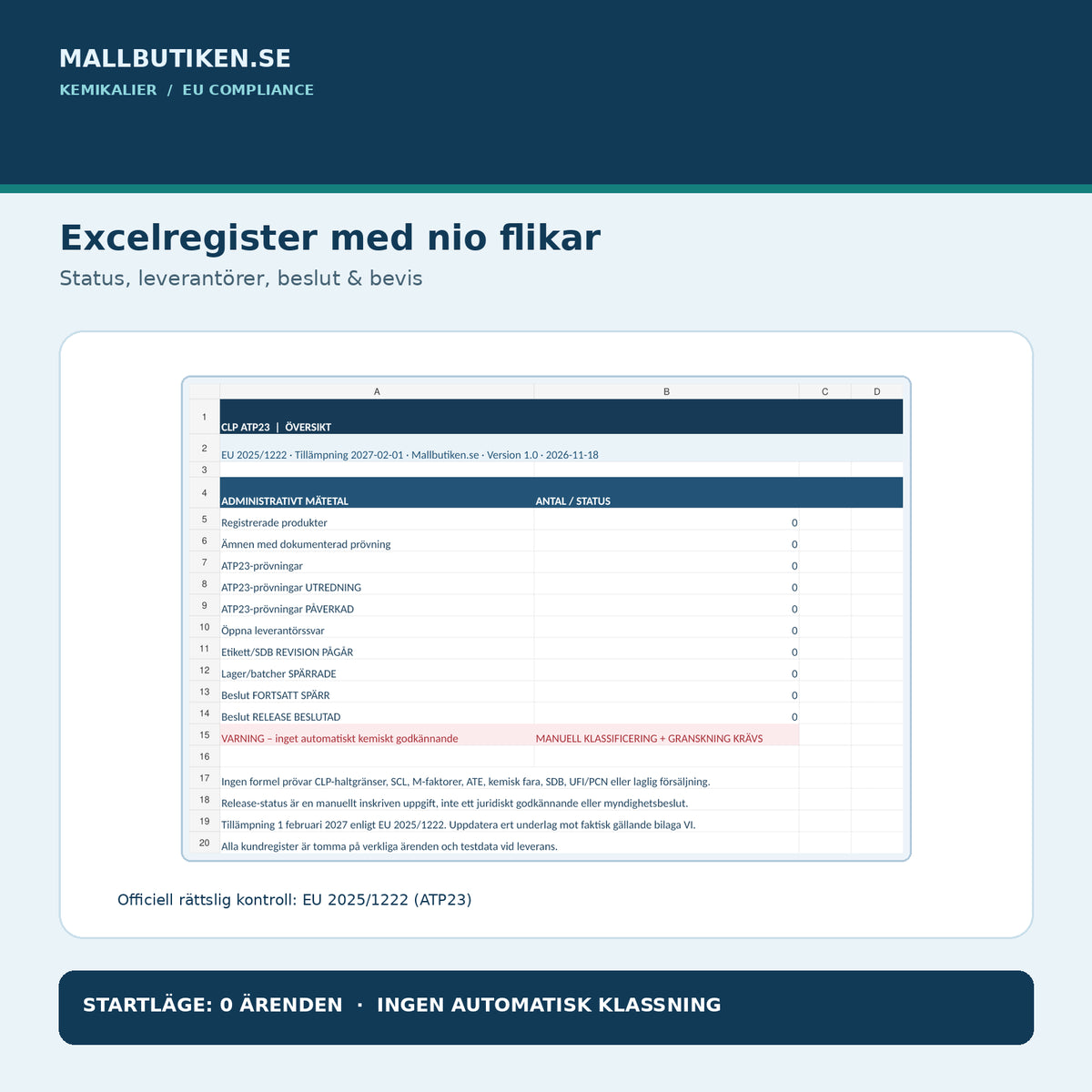
| 8. Excel register with nine tabs | Overview, Products, Substances, ATP23_review, Suppliers, Label_SDS, Stock_channel, Decisions and Read_me. | SV | XLSX |
Why must substance identity be checked?
ATP23 amends Annex VI to the CLP Regulation for specific substances and substance groups. Identify the correct entry with CAS, EC and Index numbers; searching by trade name is not sufficient. Some entries include, among other things, specific concentration limits, M-factors, ATE or special notes. The correct assessment of a mixture is not equivalent to simply copying the substance's labelling. The Swedish Chemicals Agency's ATP23 guidance and EU 2025/1222.
SDS, label, stock – what needs to be checked?
Label and packaging: check actual hazard classification, labelling information, language, any child-resistant features and tactile warning labelling. Safety data sheet: assess whether the SDS needs to be revised according to REACH Article 31 and which previous customers are affected by any onward supply. Stock: document batch and actual handling before/after 1 February 2027; do not assume that earlier stock can be sold indefinitely with old labelling. Information for UFI/PCN, e-commerce hazard text and any REACH restrictions is checked on separate regulatory tracks where applicable.
Excel – nine tabs without automatic hazard classification
Overview, Products, Substances, ATP23_review, Suppliers, Label_SDS, Stock_channel, Decisions and Read_me. The register is for administrative traceability. The ten overview values start at 0 in the customer version. Formulas count the number of cases and manually registered statuses; no formula calculates classification, toxicity, SCL/M-factor/ATE or the legal right to market a chemical. A separate scenario test with an open ATP23 investigation, blocked stock and continued block has been performed. Test data has been removed.
How you work – six control points
- Inventory actual products and identify affected substances against the official ATP23 list.
- Request written supplier documentation and check relevant SDS and label versions.
- Have competent staff review substances and mixtures using the correct concentration and classification rules.
- Review consequential requirements for labelling, packaging, REACH restrictions and relevant regulatory submissions.
- Track affected stock, retailers, online store product information and affected customers.
- Make a separate manual decision on continued investigation, actual block or eventual release after required expert review.
Frequently asked questions
When does CLP ATP23 apply?
EU 2025/1222 shall apply from 1 February 2027. Suppliers were given the opportunity to use the amendments earlier. Check the current legislative act's annex and your own product assumptions.
Which substances are covered?
The Swedish Chemicals Agency describes 22 new and 10 amended entries in CLP Annex VI. Checks must be made using the correct CAS, EC and Index numbers. The templates are delivered without fabricated or incomplete substance classification.
Must all mixtures with an affected substance be reclassified?
Not automatically. The mixture's actual composition and CLP's mixing rules, including relevant specific concentration limits, M-factors and ATE, must be assessed individually.
Can the old label be used after 1 February 2027?
Not with the support of any general unlimited ATP23 transition. It requires review of the actual product, affected entry, applicable classification and labelling, and any special product rules.
Does Excel update safety data sheets automatically?
No. Excel has administrative registers and formulas that count statuses. It does not generate a 16-part SDS, hazard pictograms, H-phrases or a notification to poison information.
When should the SDS be updated?
REACH Article 31 requires update without delay when new information about hazards or risk management becomes available, when the SDS requirement is applicable. In some cases, revised sheets should be sent to previous recipients. Assess each product separately.
Is UFI and PCN notification included?
No. The package only contains control points for whether separate obligations are applicable. The template store has a separate CLP package for the distributor's UFI, PCN and poison information.
Are the PDF files fillable and are there English templates?
The PDF files are searchable and printable but not interactively fillable. The five operational templates and Excel are in Swedish; English User Guide is included for instructions.
Difference from existing Mallbutiken templates
For special handling of the distributor's UFI, PCN and poison information, there is a separate package. For hazard information and product cards in e-commerce, there is a separate template. Chemical risks refers to the workplace's general chemical risks. This product applies especially to the ATP23 reclassification and verifiable transition to 1 February 2027.
Legal sources, version control and scope of responsibility
Commission Delegated Regulation (EU) 2025/1222 · Swedish Chemicals Agency – ATP23 · ECHA – CLP Annex VI · Swedish Chemicals Agency – safety data sheet. Document version 1.0, dated 18 November 2026. AI-assisted legal source check and technical QA have been performed. No documented external lawyer or chemical specialist review, laboratory testing or regulatory certification has been performed. PDF files are searchable/printable, but not interactive PDF forms. Microsoft Word or compatible software is required for editing.