Svenska Dokumentmallar
CNC cutting fluid – bacterial control, biocidal testing and waste log | Word/PDF/Excel
CNC cutting fluid – bacterial control, biocidal testing and waste log | Word/PDF/Excel
- File format
- DOCX, PDF, XLSX
- Document language
- Five Swedish working documents Swedish User Guide and English User Guide; Swedish Excel workbook
- Number of files
- 7
Digital download. No physical product is shipped.
Couldn't load pickup availability
About this template
CNC cutting fluid – bacterial control, biocidal product testing and waste log
Do you work with CNC lathes, milling machines or other metalworking processes where cutting fluid, emulsion or machining oil is used? Cutting fluids change during operation and can pose risks to skin, airways and the working environment. This specialized package helps workshops document chemical risk assessments, actual pH and concentration measurements, mist formation, biocidal product type 13 and the removal of used fluid.
Package contents
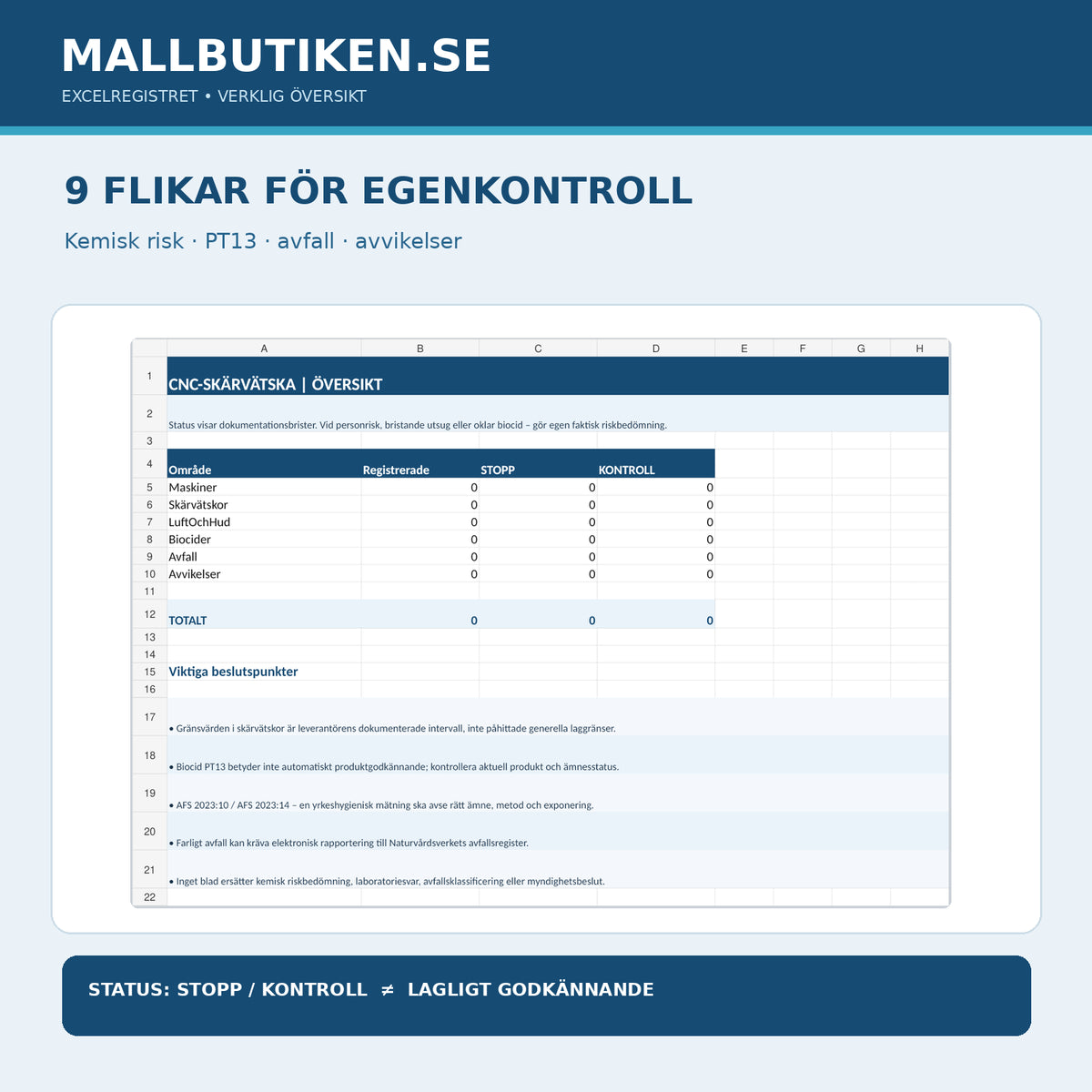
15 ready-made customer files: 7 editable Word (DOCX) files, 7 matching searchable PDFs and 1 Excel workbook with 9 tabs. Five Swedish work templates, a Swedish user guide and an English User Guide. The Excel workbook contains 600 status formulas and an overview. Digital ZIP download once the file link has been completed in Shopify.
What the files contain
Machine register, safety data sheets and occupational health risks; monitoring of concentration, pH and microbiology; ventilation, skin contact and air measurement; testing of permitted PT13 biocides with actual supplier terms; separate waste classification of cutting fluid and oily swarf, transport and receipt evidence, and an action log.
Five document templates for metalworking
- Facility and chemical risk assessment: machine ID, cutting fluid brand, SDS, skin/airway exposure, endotoxins, extraction and protective measures.
- Cutting fluid control, concentration and pH: actual sample ID, date, refractometer method, supplier limits, microbiological lab result and retesting.
- Air mist and skin exposure: encapsulation, extraction function, reported complaints, measurement requirements and assessment according to the correct occupational exposure limit rule.
- Biocide PT13 – product testing and addition: monitoring of the actual permitted product, any transitional rules, label, dose, protective measure and re-inspection.
- Used cutting fluid, swarf and waste handover: actual waste code, quantity, hazardous waste assessment, authorized carrier, receipt, and optional waste register evidence.
Two separate guides are included: a Swedish step-by-step guide and an English-language user guide for Swedish operating conditions.
Excel with nine tabs and controls
Machines, Cutting Fluids, AirAndSkin, Biocides, Waste, Deviations, Overview, Sources and Read Me. The workbook contains 600 row-based status formulas, as well as summary formulas and 18 documented list validations. The formulas provide STOP for, for example, pH outside the entered supplier range, an unmonitored biocidal product, poor extraction, hazardous waste without a receipt, and deviations that have been closed without re-inspection. A missing supplier range results in CHECK – never automatically approved.
Legal basis – from the 2025 AFS structure
The Swedish Work Environment Authority's regulations AFS 2023:10 and AFS 2023:14 came into force under the new regulatory structure on January 1, 2025. They contain relevant rules on chemical risks, risk assessment, and occupational exposure limits for identified airborne contaminants. No universal limit value for all types and mixtures of cutting fluid is specified in this product; the correct substance, exposure, and any supplier ranges must be identified.
Preservatives that protect fluids for machining or cutting belong to biocidal product type 13. Which product may be used depends on factors including the active substance, product status, and applicable transitional provisions. Used emulsions, oils, sludge, and oily swarf require actual waste classification. Hazardous waste may entail a duty to record and report to the Swedish Environmental Protection Agency's waste register.
Frequently asked questions about CNC cutting fluid
How often do I need to measure concentration and pH?
Monitoring frequency and accepted ranges should be determined based on the risk assessment, the supplier's instructions, and actual operating conditions. The package does not claim that a universal range applies to all emulsion fluids.
Does a bad smell mean the bacterial content exceeds a legal limit?
No. Odor may indicate a need for investigation but is not a laboratory result. Document the sample, analysis method, and relevant supplier or expert assessment basis.
Is there a single binding limit value for cutting fluid mist?
An assessment of the actual airborne contaminant is required according to AFS 2023:14. Older industry guidelines should not be confused with a universal legal limit value for all cutting fluids.
Can I add a biocidal product just because it is product type PT13?
No. Check the actual product status, active substance, permitted conditions of use, and transitional rules with the Swedish Chemicals Agency, as well as the label and safety data sheet.
Is all used cutting fluid hazardous waste?
Waste classification must be based on actual content, waste stream, and the current waste ordinance. Many used machining fluids are covered by hazardous waste codes, but each type of waste should be checked.
Must oily metal swarf be logged separately?
It may need to be assessed as a separate waste stream with a different waste code and handling route than the fluid. Document the actual classification and recipient.
Can Excel approve the machine or the working environment?
No. The status terms STOP, CHECK, and DOCUMENTED are administrative aids, not medical results, legal statuses, or regulatory decisions.
Are laboratory testing or external legal review included?
No. The package contains editable documents and Excel but does not perform physical sampling, industrial hygiene measurement, actual waste reporting, or external legal review.
Related templates
For more general handling of hazardous waste and transport documents, there is a separate document package. For oil separators and emptying checks, there is another template. They do not replace this CNC-specific control.
Verifiable legal sources
- Swedish Work Environment Authority – chemical risk sources
- Swedish Work Environment Authority – Risks in the working environment (AFS 2023:10)
- Swedish Work Environment Authority – Occupational exposure limits (AFS 2023:14)
- Prevent – Cutting fluids, reduce the risk of skin and respiratory complaints
- Swedish Chemicals Agency – Product types for biocidal products
- Swedish Chemicals Agency – Permitted biocidal products and transitional rules
- Waste Ordinance (2020:614)
- Swedish Environmental Protection Agency – Waste classification and coding
- Swedish Environmental Protection Agency – Waste register
Internal AI-assisted legal source check November 21, 2026. No independent legal review. No physical sampling or laboratory measurement has been performed. No guarantee is provided regarding regulatory approval, SEO visibility, or sales results.